
Category: Parkinson’s Disease: Clinical Trials
Objective: To compare the effects of 25Hz (facilitatory) and 1Hz (inhibitory) repetitive transcranial magnetic stimulation (rTMS) over the supplementary motor area (SMA) on gait initiation in Parkinson’s disease (PD).
Background: Gait initiation deficits in PD are often characterized by impaired anticipatory postural adjustments (APA). The SMA plays a key role in movement preparation [1], and SMA-rTMS has shown potential to improve motor function in PD [2]. However, the effects and optimal protocol for enhancing gait initiation remain unclear.
Method: In this ongoing double-blind, sham-controlled trial, participants with PD (H&Y stages II-III, with self-reported gait initiation difficulty) are randomized to 10 sessions of 25Hz rTMS, 1Hz rTMS, or sham stimulation over the SMA [Fig. 1]. All sessions are conducted in the ON-medication state. This interim analysis includes the first 21 randomized participants (25Hz: n=8; 1Hz: n=6; Sham: n=7); complete gait data were available for 18 participants. The primary outcome is APA duration during gait initiation, measured using force plates and VICON motion capture system [Fig. 2][3]. Secondary outcomes include gait initiation time and clinical measures.
Results: Mixed-design ANOVAs revealed a significant Group×Time interaction in APA duration (F(2,15)=5.907, p=0.013, partial η²=0.441; Fig. 3) and gait initiation (F(2,15)=5.922, p=0.013, partial η²=0.441; Fig. 4). APA duration decreased in both active rTMS groups (25 Hz: pre 0.940±0.194 s, post 0.792±0.026 s; 1 Hz: pre 1.200±0.548 s, post 0.823±0.272 s), while the sham group showed a slight increase (pre 0.872±0.108 s, post 0.927±0.195 s). Within-group analysis revealed a significant reduction in the 1Hz group (p=0.033) and a trend in the 25Hz group (p=0.067). Similarly, both active rTMS groups exhibited reductions in gait initiation time, while the sham group remained unchanged. Clinical outcomes improved over time across all groups (Time effect, all p<0.05) [Table 1], without significant Group×Time interactions. No serious adverse events occurred.
Conclusion: Interim findings suggest that both 25Hz and 1Hz rTMS over the SMA may improve gait initiation by reducing APA duration, with statistically significant within-group improvement observed for the 1Hz protocol. These results support SMA-rTMS as a promising approach for gait initiation deficits. Ongoing recruitment will clarify frequency-specific efficacy and mechanisms in a larger sample.
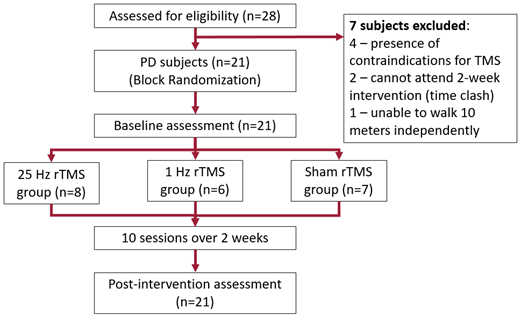
Study Design
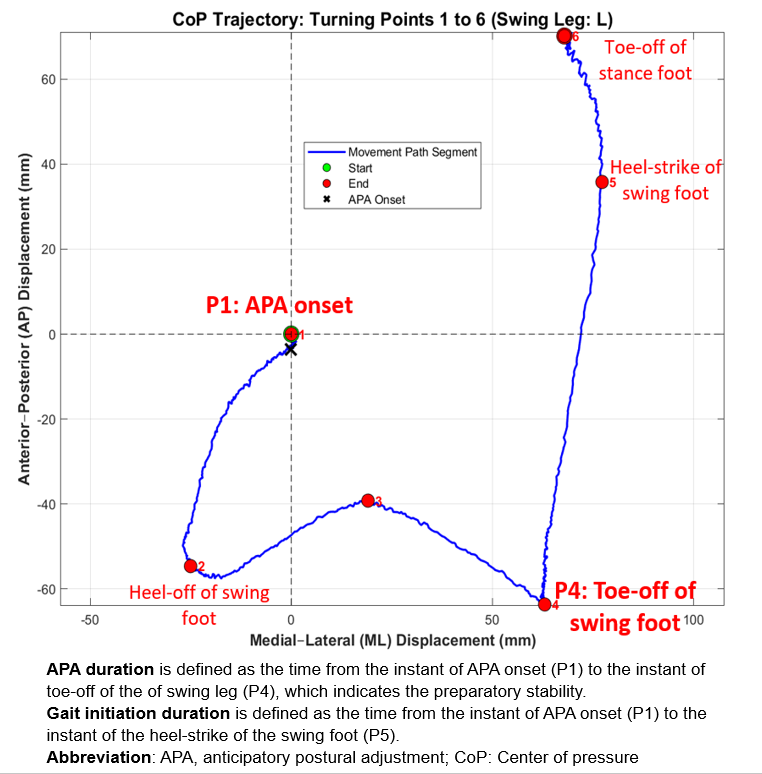
Analysis of Center of Pressure Trajectory
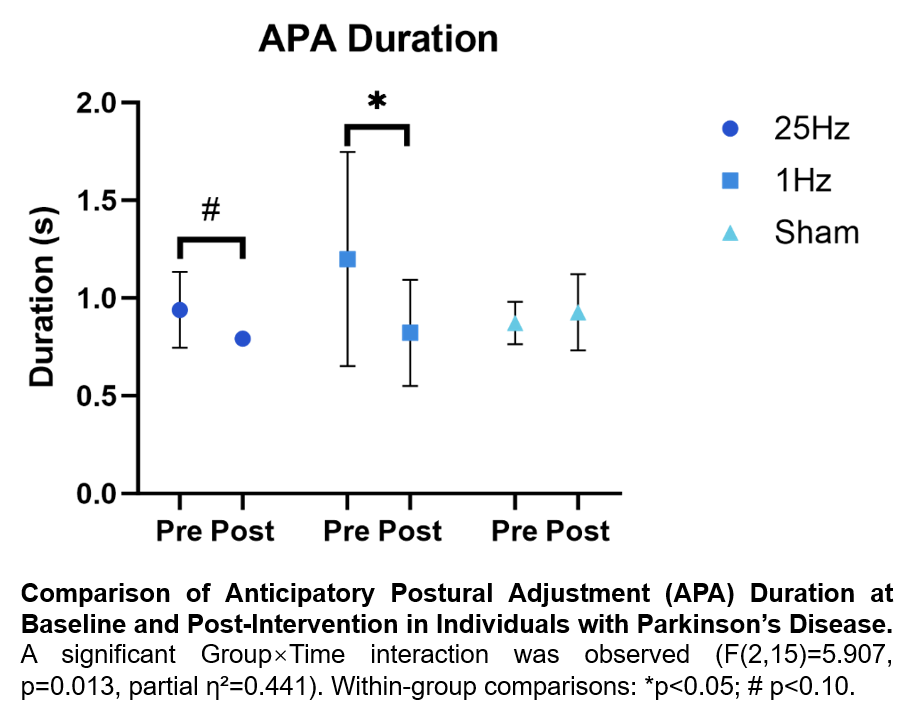
Comparison of APA Duration
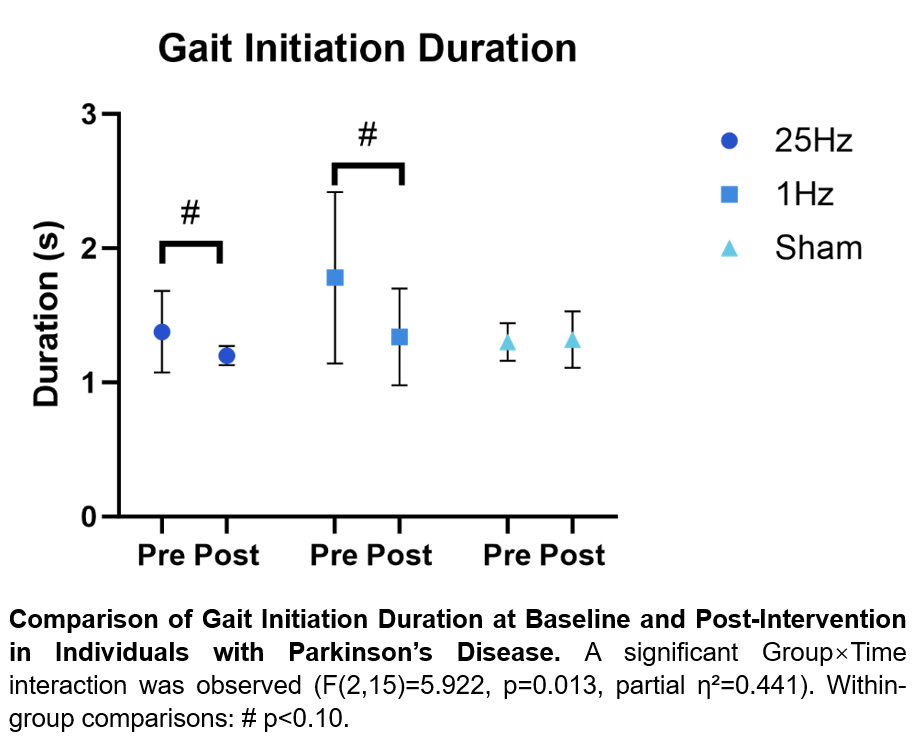
Comparison of Gait Initiation Duration
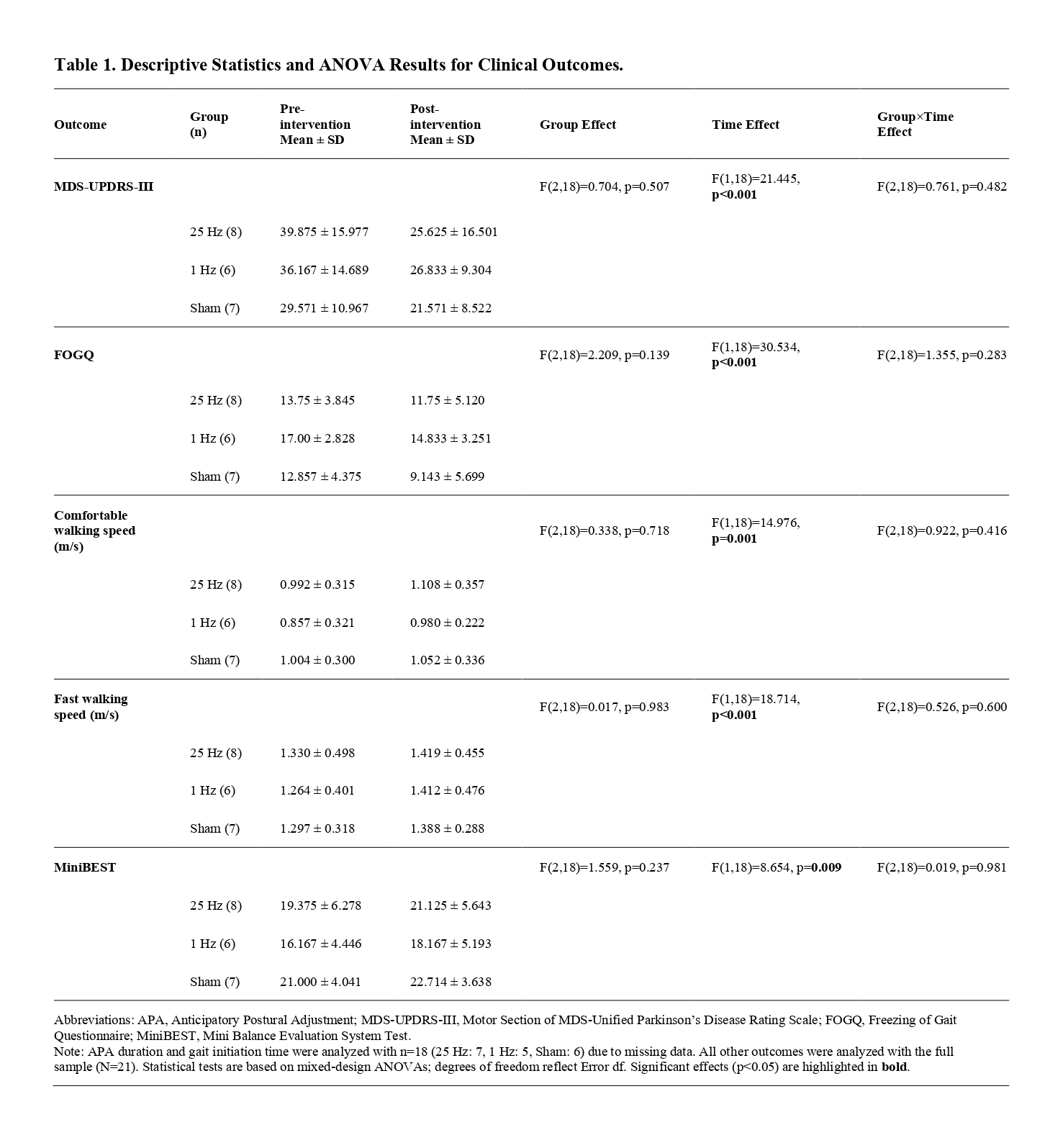
Results for Clinical Outcomes
References: [1] Jacobs JV, Lou JS, Kraakevik JA, Horak FB. The supplementary motor area contributes to the timing of the anticipatory postural adjustment during step initiation in participants with and without Parkinson’s disease. Neuroscience 2009;164(2):877-85.
[2] Chen Y, Jiang H, Wei Y, Ye S, Jiang J, Mak MKY, et al. Effects of non-invasive brain stimulation over the supplementary motor area on motor function in Parkinson’s disease: A systematic review and meta-analysis. Brain Stimul 2025;18(1):1-14.
[3] Papa EV, Addison O, Foreman KB, Dibble LE. Reproducibility and responsiveness of gait initiation in Parkinson’s disease. J Biomech 2019;87:197-201.
To cite this abstract in AMA style:
Y. Chen, Y. Wang, Y. Wang, J. Jiang, C. Xu, F. Chung, M. Pang, M. Mak, M. Huang. Frequency-Specific Effects of SMA-rTMS on Gait Initiation in Parkinson’s Disease [abstract]. Mov Disord. 2026; 41 (suppl 1). https://www.mdsabstracts.org/abstract/frequency-specific-effects-of-sma-rtms-on-gait-initiation-in-parkinsons-disease/. Accessed October 1, 2026.« Back to 2026 International Congress
MDS Abstracts - https://www.mdsabstracts.org/abstract/frequency-specific-effects-of-sma-rtms-on-gait-initiation-in-parkinsons-disease/