
Objective: To identify IMU insole-derived gait biomarkers differentiating healthy controls (HC), idiopathic rapid eye movement sleep behavior disorder (iRBD), and Parkinson disease (PD) during a 10-meter walk test.
Background: Gait in PD is characterized by slowing, shorter strides, reduced ankle motion, and increased irregularity. IMU-embedded insoles can capture spatiotemporal and nonlinear gait features without laboratory infrastructure and may provide digital biomarkers in iRBD, a prodromal stage of PD.
Method: We analyzed 301 participants: HC (n=102), iRBD (n=46), mild PD (Hoehn and Yahr 1–2, n=102), and moderate PD (Hoehn and Yahr 2.5–3, n=51). Participants performed a 10-meter walk at slow, preferred, and fast speeds while wearing 6-axis IMU insoles. Features included gait speed, normalized stride length, walking dynamic index, double support time, swing asymmetry, ankle dorsiflexion–plantarflexion range of motion (ROM), estimated anterior-posterior center-of-gravity velocity, and early-stance sample entropy. Mixed-design analysis of variance was applied to 1,587 features with false discovery rate correction.
Results: Ankle ROM showed the largest group effect (left partial eta-squared=0.278; right partial eta-squared=0.260; both false discovery rate-corrected p<0.001), with a monotonic decline across stages. Early-stance sample entropy also differed (partial eta-squared=0.164, p<0.001), increasing from 0.79±0.22 in HC to 1.10±0.30 in moderate PD. Normalized stride length (partial eta-squared=0.152), walking dynamic index (partial eta-squared=0.140), gait speed (partial eta-squared=0.128), and anterior-posterior center-of-gravity velocity (partial eta-squared=0.119) decreased progressively, whereas double support time (partial eta-squared=0.067) and swing asymmetry (partial eta-squared=0.062) increased. Faster walking amplified inter-group differences.
Conclusion: Reduced ankle ROM and increased gait entropy capture complementary aspects of gait dysfunction—kinematic rigidity and movement irregularity—in iRBD and PD. IMU insole-derived metrics may serve as wearable digital biomarkers for prodromal detection and disease severity monitoring.
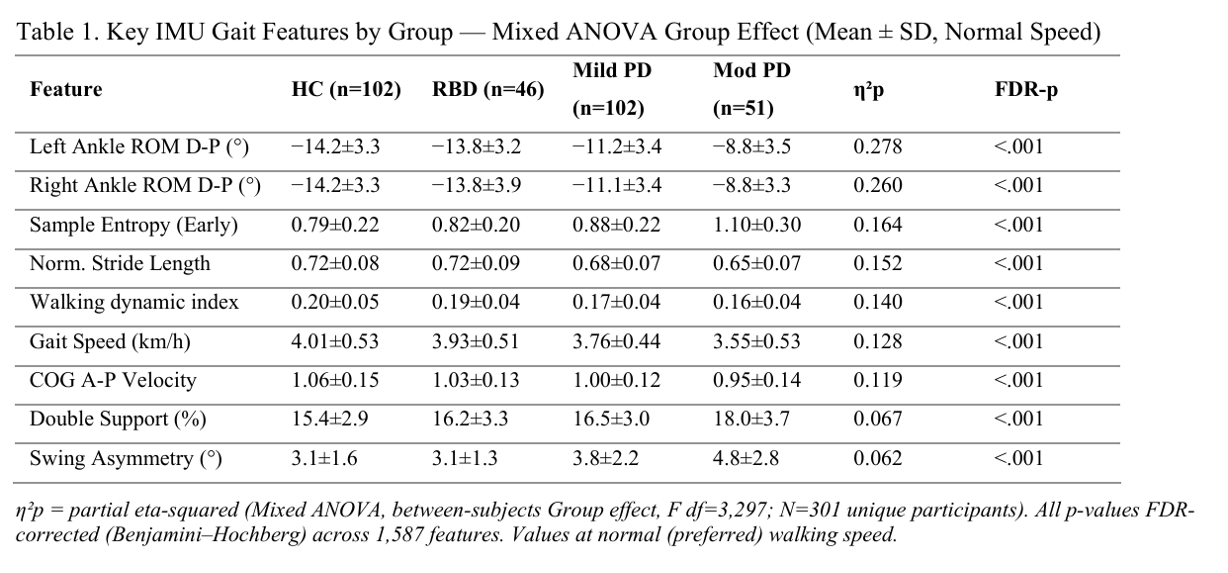
Table 1. Key IMU Gait Features by Group
References: 1. Maetzler W, et al. Quantitative wearable sensors for objective assessment of Parkinson’s disease. Mov Disord. 2013;28(12):1628–37.
2. Del Din S, et al. Free-living monitoring of Parkinson’s disease: lessons from the field. Mov Disord. 2016;31(9):1293–313.
3. Kluge F, et al. Sensor-based gait analysis as a digital biomarker for Parkinson’s disease severity. npj Digit Med. 2021;4(1):126.
To cite this abstract in AMA style:
JH. Jung, M. Son, J. Jeon, SY. Kang, PH. Lee, SJ. Kim. IMU Insole-Derived Gait Digital Biomarkers in idiopathic RBD and Parkinson Disease [abstract]. Mov Disord. 2026; 41 (suppl 1). https://www.mdsabstracts.org/abstract/imu-insole-derived-gait-digital-biomarkers-in-idiopathic-rbd-and-parkinson-disease/. Accessed October 1, 2026.« Back to 2026 International Congress
MDS Abstracts - https://www.mdsabstracts.org/abstract/imu-insole-derived-gait-digital-biomarkers-in-idiopathic-rbd-and-parkinson-disease/