
Objective: To develop a risk prediction model for anxiety or depression in Parkinson’s disease (PD) patients, identify key factors, and examine acupuncture’s effect on anxiety or depression risk.
Background: Anxiety or depression affect approximately 30% of PD patients in China, threatening their quality of life. Pharmacological treatments have limitations, including serotonin syndrome from drug interactions, while cognitive behavioral therapy faces high costs and limited accessibility. Acupuncture shows efficacy for anxiety and PD motor symptoms, but large-scale studies on its impact on PD-related anxiety or depression remain lacking.
Method: Clinical data of 839 PD patients (2014–2025) were collected from electronic medical records. A prediction model was constructed using anxiety or depression as the binary outcome. Patients were divided into acupuncture and non-acupuncture groups, and Risk Ratio (RR) was calculated to assess the association between acupuncture and anxiety or depression risk.
Results: The decision tree model showed good performance (AUC=0.862) with no overfitting. “Insomnia” was the strongest predictor (risk: 0.95 in insomniacs vs. 0.02 in non-insomniacs), followed by BMI and age. SHAP analysis confirmed insomnia’s contribution. The acupuncture group had significantly lower anxiety or depression incidence (24.5% vs. 32.1%; RR=0.76, 95%CI: 0.61–0.95, P=0.017), representing a 24% risk reduction.
Conclusion: The decision tree model effectively predicts anxiety or depression risk in PD patients, with insomnia, BMI, and age as key factors. Acupuncture significantly reduces this risk, aiding clinical screening and personalized intervention.
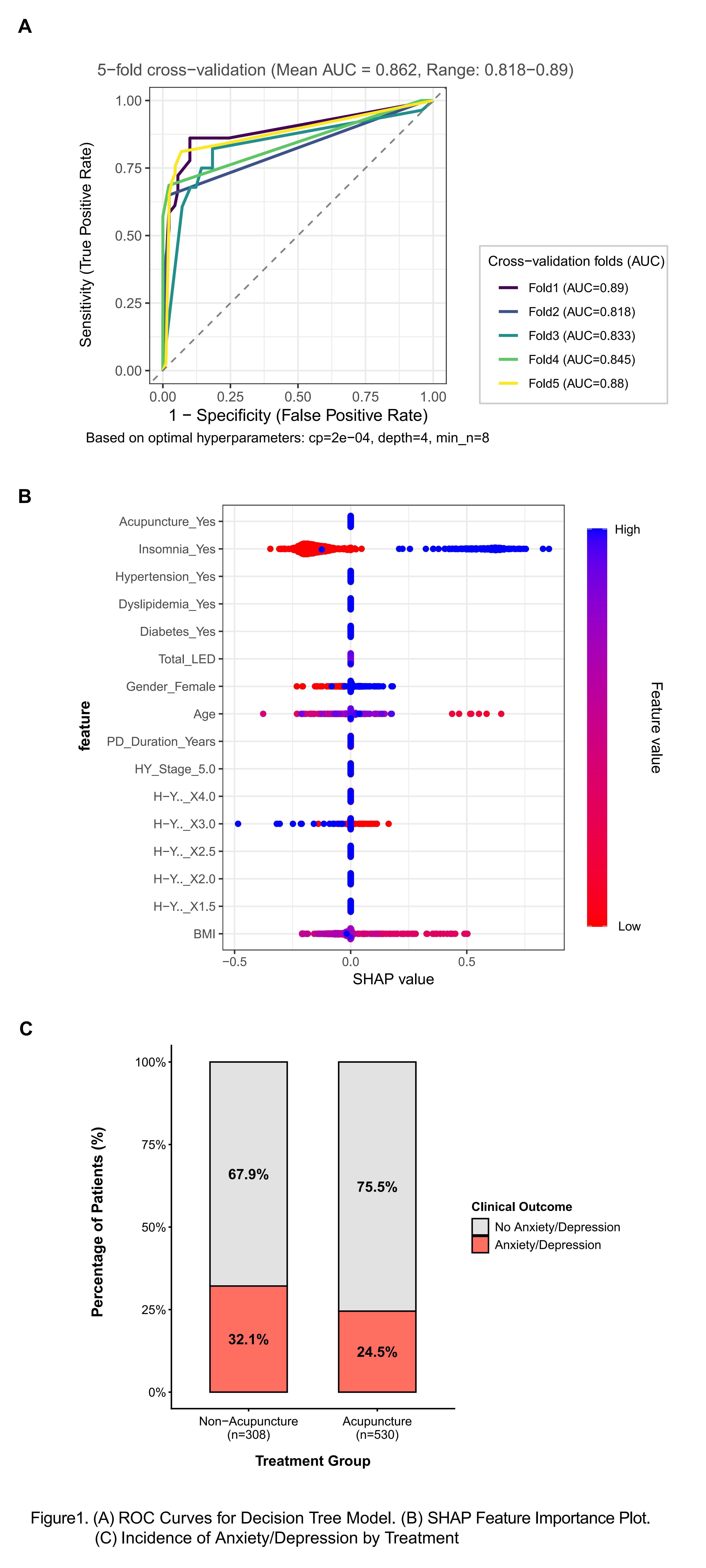
Figure 1
To cite this abstract in AMA style:
W. Yixuan, L. Xin, X. Liangman, L. Shumin, Z. Fan, Z. Lixing. A Retrospective Cohort-Based Construction of a Risk Prediction Model for Anxiety or Depression in Parkinson’s Disease and Analysis of Acupuncture Exposure Effects [abstract]. Mov Disord. 2026; 41 (suppl 1). https://www.mdsabstracts.org/abstract/a-retrospective-cohort-based-construction-of-a-risk-prediction-model-for-anxiety-or-depression-in-parkinsons-disease-and-analysis-of-acupuncture-exposure-effects/. Accessed October 1, 2026.« Back to 2026 International Congress
MDS Abstracts - https://www.mdsabstracts.org/abstract/a-retrospective-cohort-based-construction-of-a-risk-prediction-model-for-anxiety-or-depression-in-parkinsons-disease-and-analysis-of-acupuncture-exposure-effects/