
Objective: To assess sleep quality in patients with XDP using the Pittsburgh Sleep Quality Index (PSQI), determine the prevalence of poor sleep quality, and examine its association with clinicodemographic and clinical characteristics.
Background: X-linked dystonia-parkinsonism (XDP), or Lubag disease, is a rare adult-onset neurodegenerative disorder endemic to the Philippines that primarily affects males. Although both motor and non-motor manifestations are recognized, sleep disturbance in XDP remains insufficiently characterized.
Method: This cross-sectional study included patients with XDP recruited from the XDP registry and Movement Disorders Clinic at Makati Medical Center. Data were collected through Zoom or Viber interviews. Sleep quality was assessed using the PSQI, while anxiety and depressive symptoms were measured using the Hospital Anxiety and Depression Scale–Pilipino (HADS-P). Disease severity was evaluated using the XDP-MDSP Rating Scale; rigidity and postural instability were excluded during remote assessments. Logistic regression was performed to identify factors associated with poor sleep quality.
Results: A total of 34 male participants were included [Table 1]. Mean age was 44.0 ± 6.1 years, mean disease duration was 5.9 ± 3.5 years, and 82.4% had cervical dystonia [Table 1]. Mean global PSQI score was 8.09 ± 4.43 [Table 1, Table 2]. Using a PSQI cutoff of >5, 23 patients (67.6%) had poor sleep quality and 11 (32.4%) had good sleep quality [Table 2]. Compared with those with good sleep quality, patients with poor sleep quality more often had cervical dystonia and had higher HADS-P anxiety and depression scores [Table 3]. In multivariable logistic regression, cervical dystonia (adjusted OR 5.62, 95% CI 1.25-10.33), higher HADS-P anxiety scores (adjusted OR 1.15, 95% CI 1.03-1.23), and higher HADS-P depression scores (adjusted OR 1.20, 95% CI 1.03-1.37) were independently associated with poor sleep quality [Figure 1].
Conclusion: Poor sleep quality is highly prevalent in XDP and represents an important non-motor burden. Cervical dystonia and higher anxiety and depressive symptom scores were independently associated with worse sleep. Routine sleep assessment should be incorporated into the clinical evaluation of patients with XDP.
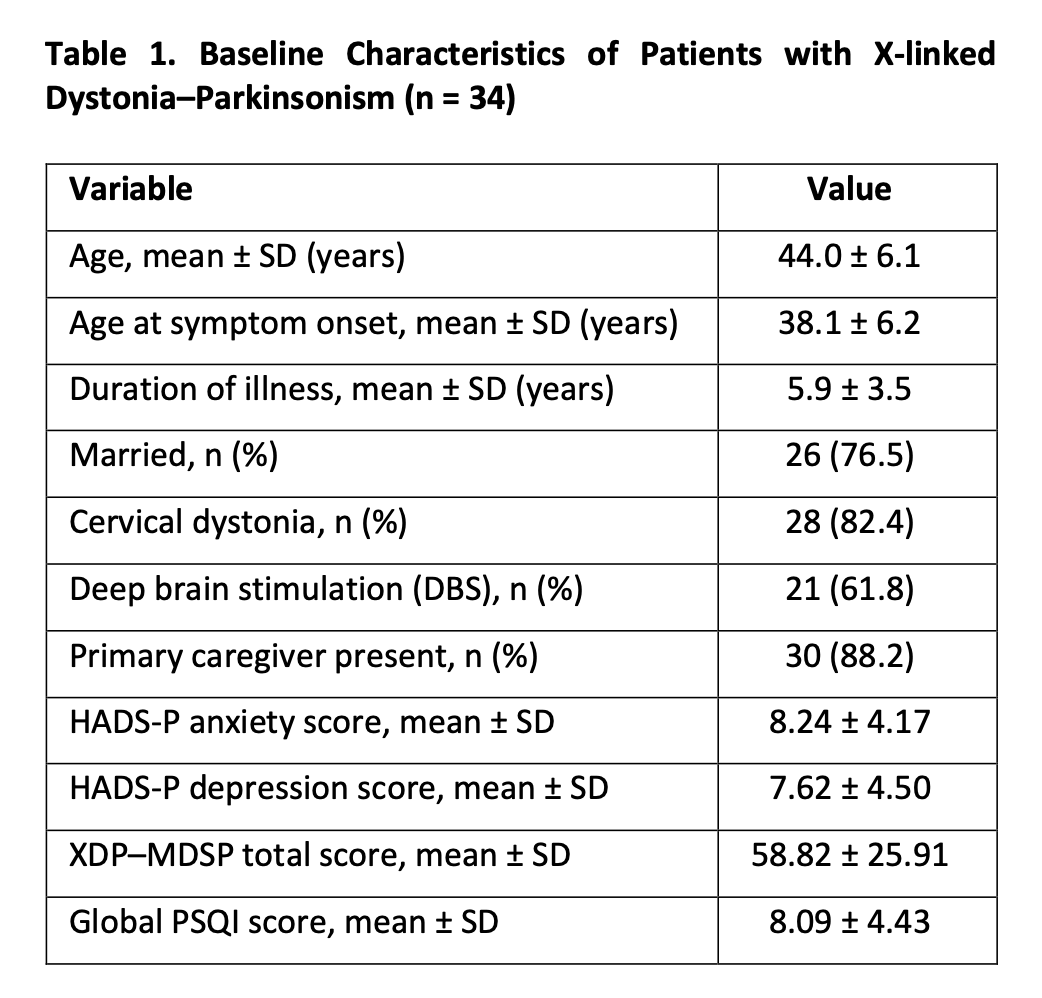
Clinical Characteristics of XDP Patients
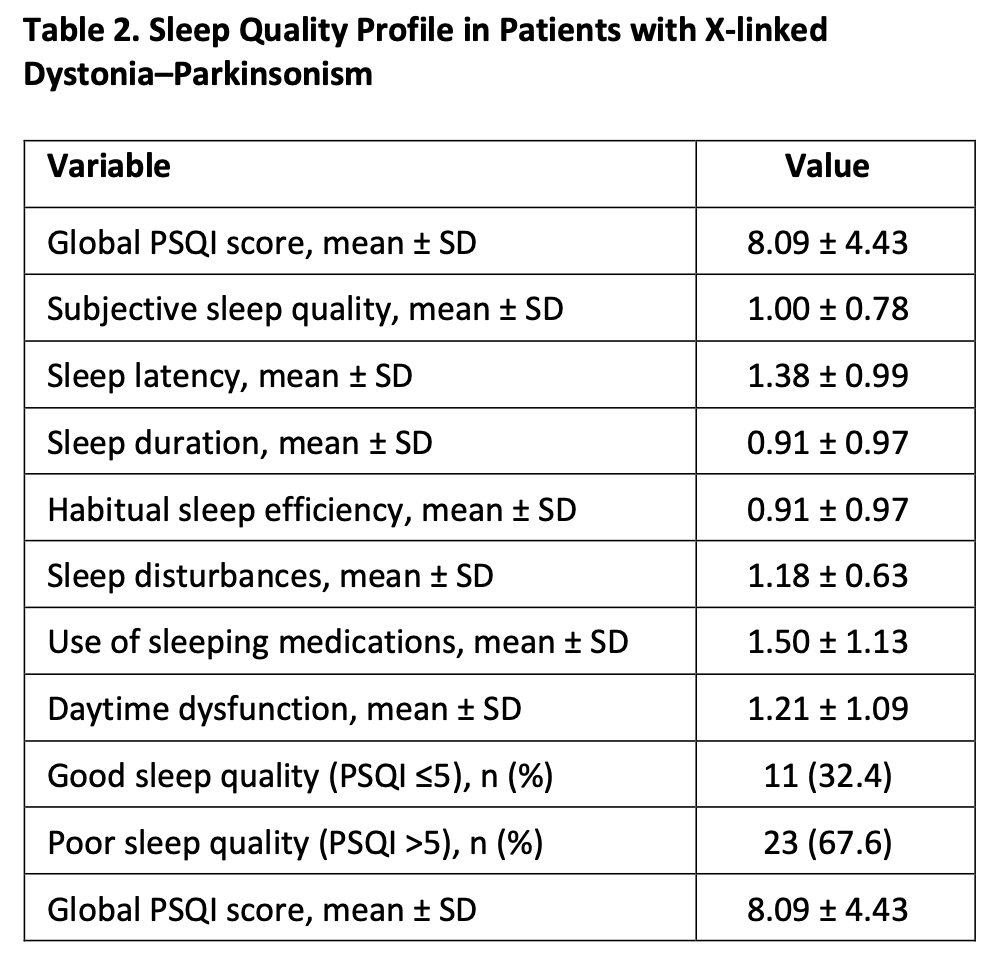
Sleep Quality Scores in XDP Patients
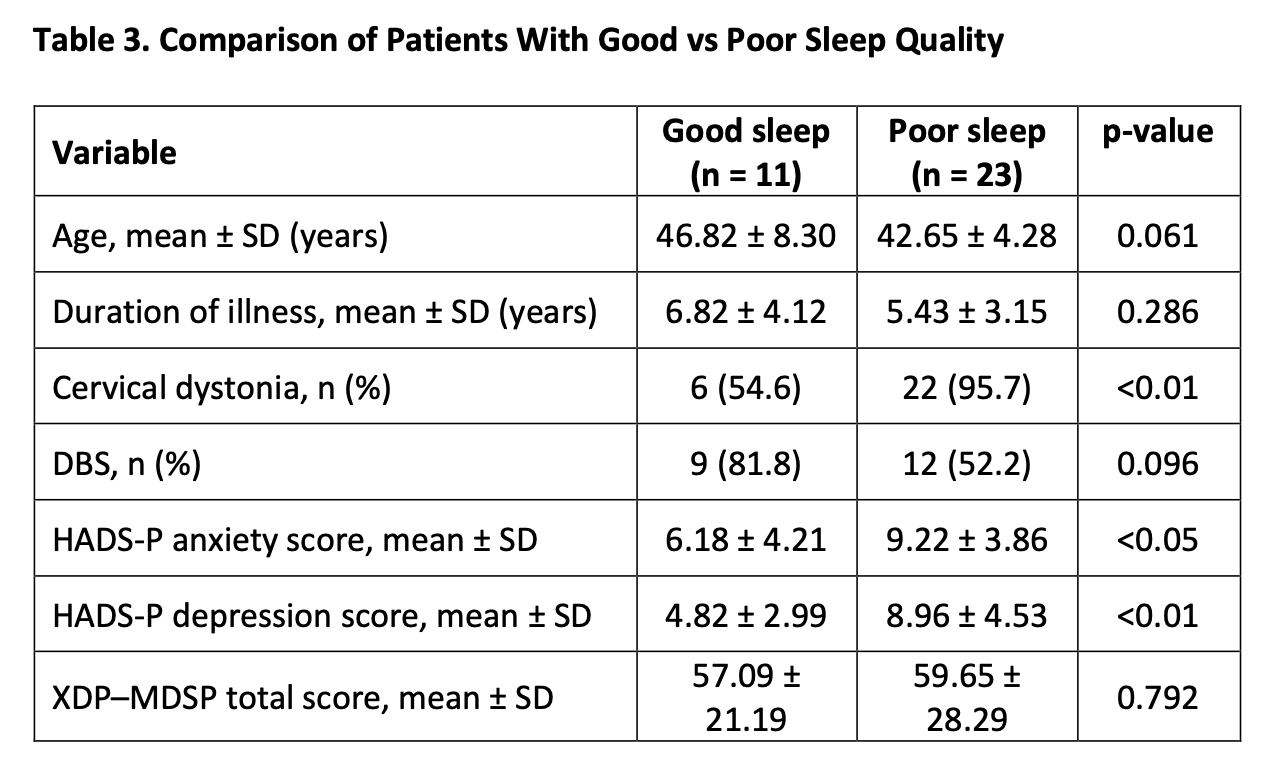
Clinical Factors by Sleep Quality
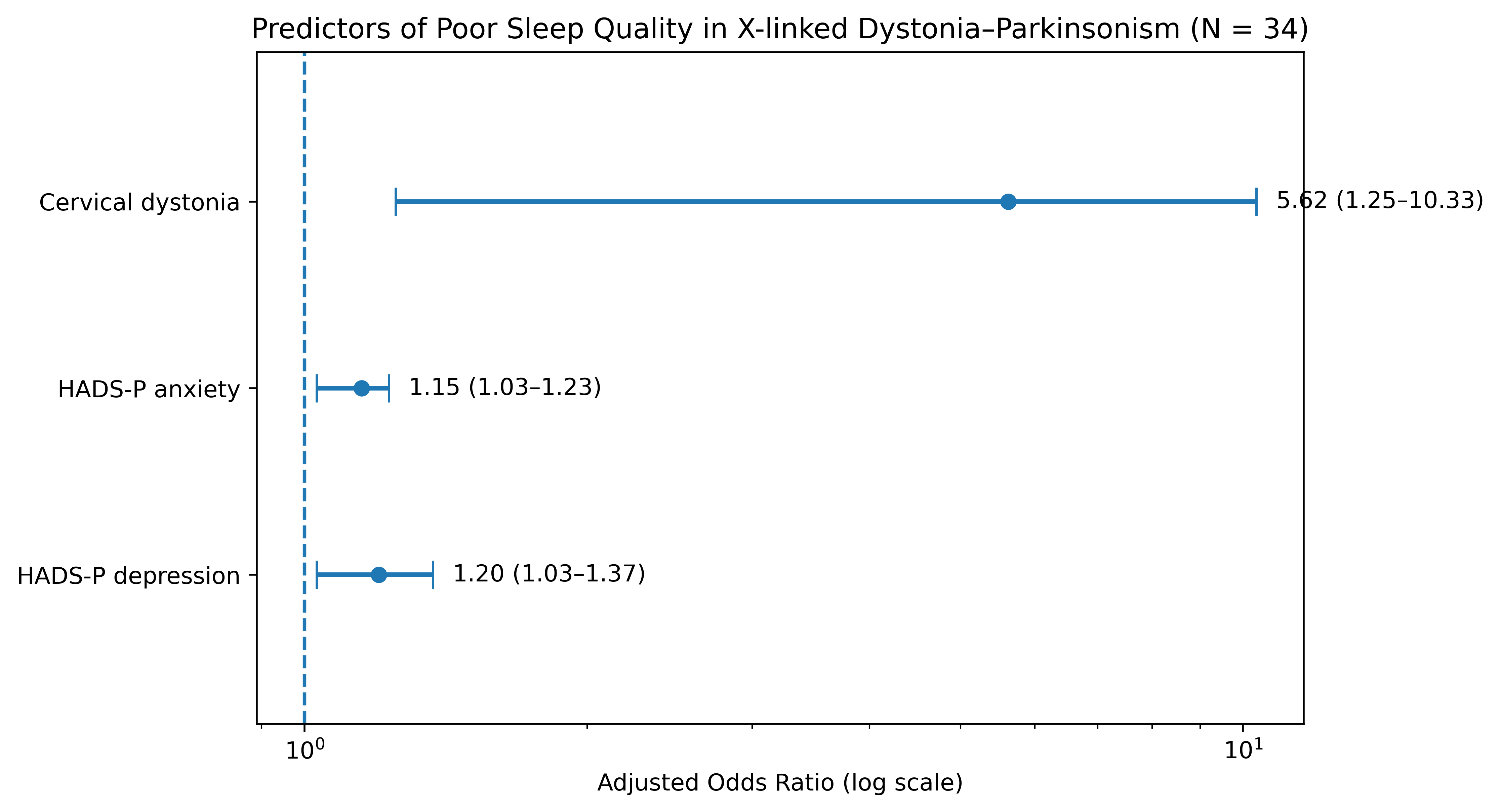
Predictors of Poor Sleep Quality in XDP
References: Bailey, G. A., Hubbard, E. K., Fasano, A., Tijssen, M. A. J., Lynch, T., Anderson, K. N., & Peall, K. J. (2021). Sleep disturbance in movement disorders: Insights, treatments and challenges. Journal of Neurology, Neurosurgery & Psychiatry, 92(7), 723–736. https://doi.org/10.1136/jnnp-2020-325546
Evidente, V. G. H. (2018). X-linked dystonia-parkinsonism. In M. P. Adam, J. Feldman, G. M. Mirzaa, et al. (Eds.), GeneReviews® [Internet]. University of Washington, Seattle. https://www.ncbi.nlm.nih.gov/books/NBK1489/
Kurtis, M. M., Balestrino, R., Rodriguez-Blazquez, C., Forjaz, M. J., & Martinez-Martin, P. (2018). A review of scales to evaluate sleep disturbances in movement disorders. Frontiers in Neurology, 9, 369. https://doi.org/10.3389/fneur.2018.00369
Pasco, P. M. D., Jamora, R. D. G., Rosales, R. L., & Ng, A. R. (2010). Cross-cultural validation of the XDP–Movement Disorder Society of the Philippines Rating Scale. Journal of Movement Disorders, 3(2), 32–38. https://doi.org/10.14802/jmd.10009
Rosales, R. L. (2010). X-linked dystonia parkinsonism: Clinical phenotype, genetics and therapeutics. Journal of Movement Disorders, 3(2), 32–38. https://doi.org/10.14802/jmd.10009
Santiano, R. A. S., & Rosales, R. L. (2021). A cross-cultural validation of the Filipino and Hiligaynon versions of the parts IIIB (non-motor features) and IV (activities of daily living) of the X-linked dystonia-parkinsonism–MDSP rating scale. Clinical Parkinsonism & Related Disorders, 5, 100100. https://doi.org/10.1016/j.prdoa.2021.100100
Carpi M. (2025). The Pittsburgh Sleep Quality Index: a brief review. Occupational medicine (Oxford, England), 75(1), 14–15. https://doi.org/10.1093/occmed/kqae121
Lee, L. V., Maranon, E., Demaisip, C., Peralta, O., Borres-Icasiano, R., Arancillo, J., Rivera, C., Munoz, E., Tan, K., & Reyes, M. T. (2002). The natural history of sex-linked recessive dystonia parkinsonism of Panay, Philippines (XDP). Parkinsonism & Related Disorders, 9(1), 29–38. https://doi.org/10.1016/s1353-8020(02)00042-1
De Guzman MLRE. A validation of the Hospital Anxiety and Depression Scale (HADS) in the medically-ill. Acta Med Philipp. 2013;47(3):53-62.
Bailey GA, et al. J Neurol Neurosurg Psychiatry 2021;92:723–736. doi:10.1136/jnnp-2020-325546
Menza, M., Dobkin, R. D., Marin, H., & Bienfait, K. (2010). Sleep disturbances in Parkinson’s disease. Movement disorders : official journal of the Movement Disorder Society, 25 Suppl 1(Suppl 1), S117–S122. https://doi.org/10.1002/mds.22788
Zuzuárregui, J. R. P., & During, E. H. (2020). Sleep Issues in Parkinson’s Disease and Their Management. Neurotherapeutics : the journal of the American Society for Experimental NeuroTherapeutics, 17(4), 1480–1494. https://doi.org/10.1007/s13311-020-00938-y
Salazar Leon, L. E., & Sillitoe, R. V. (2022). Potential interactions between cerebellar dysfunction and sleep disturbances in dystonia. Dystonia (Lausanne, Switzerland), 1, 10691. https://doi.org/10.3389/dyst.2022.10691
Antelmi, E., Ferri, R., Provini, F., Scaglione, C. M. L., Mignani, F., Rundo, F., Vandi, S., Fabbri, M., Pizza, F., Plazzi, G., Martinelli, P., & Liguori, R. (2017). Modulation of the Muscle Activity During Sleep in Cervical Dystonia. Sleep, 40(7). https://doi.org/10.1093/sleep/zsx088
Benadof, C. N., Cisneros, E., Appelbaum, M. I., Stebbins, G. T., Comella, C. L., & Peterson, D. A. (2019). Sensory Tricks Are Associated with Higher Sleep-Related Quality of Life in Cervical Dystonia. Tremor and other hyperkinetic movements (New York, N.Y.), 9, 10.7916/4q53-vt23. https://doi.org/10.7916/4q53-vt23
Jamora, R. D., Ledesma, L. K., Domingo, A., Cenina, A. R., & Lee, L. V. (2014). Nonmotor features in sex-linked dystonia parkinsonism. Neurodegenerative disease management, 4(3), 283–289. https://doi.org/10.2217/nmt.14.16
Lee, L. V., Rivera, C., Teleg, R. A., Dantes, M. B., Pasco, P. M., Jamora, R. D., Arancillo, J., Villareal-Jordan, R. F., Rosales, R. L., Demaisip, C., Maranon, E., Peralta, O., Borres, R., Tolentino, C., Monding, M. J., & Sarcia, S. (2011). The unique phenomenology of sex-linked dystonia parkinsonism (XDP, DYT3, “Lubag”). The International journal of neuroscience, 121 Suppl 1, 3–11. https://doi.org/10.3109/00207454.2010.526728
Bollu, P. C., & Sahota, P. (2017). Sleep and Parkinson Disease. Missouri medicine, 114(5), 381–386.
Del Pino, R., Murueta-Goyena, A., Ayala, U., Acera, M., Fernández, M., Tijero, B., Carmona, M., Fernández, T., Gabilondo, I., & Gómez-Esteban, J. C. (2021). Clinical long-term nocturnal sleeping disturbances and excessive daytime sleepiness in parkinson’s disease. PLOS ONE, 16(12). https://doi.org/10.1371/journal.pone.0259935
Kanclerska, J., Szymańska-Chabowska, A., Poręba, R., Michałek-Zrąbkowska, M., Lachowicz, G., Mazur, G., & Martynowicz, H. (2023). A Systematic Review of Publications on the Associations Between Sleep Architecture and Arterial Hypertension. Medical science monitor : international medical journal of experimental and clinical research, 29, e941066. https://doi.org/10.12659/MSM.941066
Tenison, E., McGrogan, A., Ben-Shlomo, Y., & Henderson, E. J. (2025). Identifying and Predicting Risk for Hospital Admission among Patients with Parkinsonism. Movement disorders clinical practice, 12(1), 43–56. https://doi.org/10.1002/mdc3.14257
Cataniag, P., Ong, J. N., & Diesta, C. C. (2025). Impact of X-Linked Dystonia-Parkinsonism on Caregiver Strain, Anxiety, and Depression .
Yi, Q., Yu-Peng, C., Jiang-Ting, L., Jing-Yi, L., Qi-Xiong, Q., Dan-Lei, W., Jing-Wei, Z., Zhi-Juan, M., Yong-Jie, X., Zhe, M., & Zheng, X. (2022). Worse sleep quality aggravates the motor and non-motor symptoms in parkinson’s disease. Frontiers in Aging Neuroscience, 14. https://doi.org/10.3389/fnagi.2022.887094)
Badillo, S. P. J., & Jamora, R. D. G. (2019). Zolpidem for the Treatment of Dystonia. Frontiers in neurology, 10, 779. https://doi.org/10.3389/fneur.2019.00779
Stone, G., Morgan, C., & Kaplish, N. (2025). Diagnosis and management of sleep disorders in individuals with Parkinson disease. Practical Neurology, 24(7), 16–21.
Jamora, R. D., Diesta, C. C., Pasco, P. M., & Lee, L. V. (2011). Oral pharmacological treatment of X-linked dystonia parkinsonism: successes and failures. The International journal of neuroscience, 121 Suppl 1, 18–21. https://doi.org/10.3109/00207454.2010.544433
Guilleminault, C., & Flagg, W. (1984). Effect of baclofen on sleep-related periodic leg movements. Annals of neurology, 15(3), 234–239. https://doi.org/10.1002/ana.410150304
Amara, A. W., Watts, R. L., & Walker, H. C. (2011). The effects of deep brain stimulation on sleep in Parkinson’s disease. Therapeutic advances in neurological disorders, 4(1), 15–24. https://doi.org/10.1177/1756285610392446
Bucur, M., & Papagno, C. (2023). Deep Brain Stimulation in Parkinson Disease: A Meta-analysis of the Long-term Neuropsychological Outcomes. Neuropsychology review, 33(2), 307–346. https://doi.org/10.1007/s11065-022-09540-9
Combs, H. L., Folley, B. S., Berry, D. T., Segerstrom, S. C., Han, D. Y., Anderson-Mooney, A. J., Walls, B. D., & van Horne, C. (2015). Cognition and Depression Following Deep Brain Stimulation of the Subthalamic Nucleus and Globus Pallidus Pars Internus in Parkinson’s Disease: A Meta-Analysis. Neuropsychology review, 25(4), 439–454. https://doi.org/10.1007/s11065-015-9302-0
Kurtis, M. M., Rajah, T., Delgado, L. F., & Dafsari, H. S. (2017). The effect of deep brain stimulation on the non-motor symptoms of Parkinson’s disease: a critical review of the current evidence. NPJ Parkinson’s disease, 3, 16024. https://doi.org/10.1038/npjparkd.2016.24
Campbell, M. C., Black, K. J., Weaver, P. M., Lugar, H. M., Videen, T. O., Tabbal, S. D., Karimi, M., Perlmutter, J. S., & Hershey, T. (2012). Mood response to deep brain stimulation of the subthalamic nucleus in Parkinson’s disease. The Journal of neuropsychiatry and clinical neurosciences, 24(1), 28–36. https://doi.org/10.1176/appi.neuropsych.11030060
Accolla, E. A., & Pollo, C. (2019). Mood Effects After Deep Brain Stimulation for Parkinson’s Disease: An Update. Frontiers in neurology, 10, 617. https://doi.org/10.3389/fneur.2019.00617
Dafsari, H. S. et al. Beneficial nonmotor effects of subthalamic and pallidal neurostimulation in Parkinson’s disease. Brain Stimul. 13, 1697–1705 (2020).
Dafsari, H. S. et al. Beneficial effect of 24-month bilateral subthalamic stimulation on quality of sleep in Parkinson’s disease. J. Neurol. 267, 1830–1841 (2020).
Weaver, F. M. et al. Randomized trial of deep brain stimulation for Parkinson disease: thirty-six-month outcomes. Neurology 79, 55–65 (2012).
Weaver, F. M. et al. Bilateral deep brain stimulation vs best medical therapy for patients with advanced Parkinson disease: a randomized controlled trial. Jama 301, 63–73, (2009).
Brüggemann, N., Heldmann, M., Klein, C., Domingo, A., Rasche, D., Tronnier, V., Rosales, R. L., Jamora, R. D., Lee, L. V., & Münte, T. F. (2016). Neuroanatomical changes extend beyond striatal atrophy in X-linked dystonia parkinsonism. Parkinsonism & related disorders, 31, 91–97. https://doi.org/10.1016/j.parkreldis.2016.07.012
Steinhardt, J., Lokowandt, L., Schmidt, C. X., Rasche, D., Oster, H., Wilms, B., & Brüggemann, N. (2025). The Impact of Deep Brain Stimulation of the Subthalamic Nucleus on Sleep-Wake Function and Circadian Rhythms in Patients with Parkinson’s Disease. Movement disorders clinical practice, 12(11), 1801–1810. https://doi.org/10.1002/mdc3.70160
Luo, Y., Liu, J., Chen, D., Liu, M., Yuan, Y., Hu, J., Wu, J., Wang, F., Liu, C., Chen, J., & Mao, C. (2023). How sleep quality affects activities of daily living in Parkinson’s disease: the mediating role of disease severity and the moderating role of cognition. Frontiers in aging neuroscience, 15, 1238588. https://doi.org/10.3389/fnagi.2023.1238588
Holth J. K., Fritschi S. K., Wang C., Pedersen N. P., Cirrito J. R., Mahan T. E., et al. (2019). The sleep-wake cycle regulates brain interstitial fluid tau in mice and CSF tau in humans. Science 363, 880–884. doi: 10.1126/science.aav2546
Rolinski M., Szewczyk-Krolikowski K., Tomlinson P. R., Nithi K., Talbot K., Ben-Shlomo Y., et al. (2014). REM sleep behaviour disorder is associated with worse quality of life and other non-motor features in early Parkinson’s disease. J. Neurol. Neurosurg. Psychiatry 85, 560–566. doi: 10.1136/jnnp-2013-306104
Rana A. Q., Qureshi A. R. M., Shamli Oghli Y., Saqib Y., Mohammed B., Sarfraz Z., et al. (2018). Decreased sleep quality in Parkinson’s patients is associated with higher anxiety and depression prevalence and severity, and correlates with pain intensity and quality. Neurol. Res. 40, 696–701. doi: 10.1080/01616412.2018.1462880
Santos García D., De Deus F. T., Paz González J. M., Cores Bartolomé C., Valdés Aymerich L., Muñoz Enríquez J. G., et al. (2021). Staging Parkinson’s disease combining motor and nonmotor symptoms correlates with disability and quality of life. Parkinson’s Disease 2021:8871549. doi: 10.1155/2021/8871549
Santos-García, D., Castro, E. S., de Deus Fonticoba, T., Panceiras, M. J. F., Enriquez, J. G. M., González, J. M. P., Bartolomé, C. C., Planellas, L. L., Caldentey, J. G., Caballol, N., Legarda, I., López, I. C., Manzanares, L. L., Rivera, M. A. Á., Catalán, M. J., Nogueira, V., Borrué, C., Sauco, M. Á., Vela, L., Cubo, E., … Martinez-Martin, P. (2021). Sleep Problems Are Related to a Worse Quality of Life and a Greater Non-Motor Symptoms Burden in Parkinson’s Disease. Journal of geriatric psychiatry and neurology, 34(6), 642–658. https://doi.org/10.1177/0891988720964250
To cite this abstract in AMA style:
ME. Magsombol, KP. Amamanglon, P. Cataniag, R. Picar, CC. Diesta, JN. Ong. Sleep Quality Among Patients with X-linked Dystonia Parkinsonism [abstract]. Mov Disord. 2026; 41 (suppl 1). https://www.mdsabstracts.org/abstract/sleep-quality-among-patients-with-x-linked-dystonia-parkinsonism/. Accessed October 1, 2026.« Back to 2026 International Congress
MDS Abstracts - https://www.mdsabstracts.org/abstract/sleep-quality-among-patients-with-x-linked-dystonia-parkinsonism/