
Objective: To report the clinical course and long-term outcome of repeated 1 Hz rTMS (right M1 + left cerebellum) in a botulinum toxin-naïve idiopathic cervical dystonia patient after discontinuing oral medications.
Background: Cervical dystonia (CD) is typically managed with medications or botulinum toxin. Low-frequency rTMS targeting motor cortex and cerebellum may modulate dystonic networks, but data on repeated courses and sustained complete remission are limited.
Method: A 33-year-old male with left rotational CD underwent two identical 10-session courses of 1 Hz rTMS (8-figure coil; right M1 + left cerebellum [2 cm below inion, 3 cm left]; 900 pulses/target; 80% RMT; 2 weeks/course). Botulinum toxin-naïve; self-discontinued trihexyphenidyl (1 mg tid) and baclofen (5 mg tid) before first course. Weekly assessments: TWSTRS Severity (0-35), GDS(neck) (0-10), CDIP-58 total (0-100) and subscales, self-rating (0-10). Follow-up: 24 months via telephone.
Results: Baseline TWSTRS Severity: 19 (Course 1), 12 (Course 2); CDIP-58 ≈43 both. Course 1: TWSTRS decreased to 5 post-treatment, reached 0 at 3 weeks (improvement 19 points), mild rebound to 1-2 at 5-7 weeks. Course 2: TWSTRS to 2 post-treatment, 0 at 2 weeks (improvement 12 points); GDS(neck)=0, CDIP-58=0 (all subscales normalized: head/neck, pain/discomfort, upper limb activities, walking, sleep, annoyance, mood, psychosocial). Transient right ear tinnitus post-Course 1 resolved 3 weeks post-Course 2; no other adverse events. No recurrence over 24 months (as of March 2026); patient reported complete normalcy without antidystonic drugs.
Conclusion: Repeated dual-target low-frequency rTMS induced rapid, complete, and sustained remission lasting ≥2 years in this botulinum toxin-naïve CD case post-medication discontinuation. Transient mild tinnitus was self-limiting. Findings suggest potential disease-modifying effects and support further N-of-1 series or controlled trials.
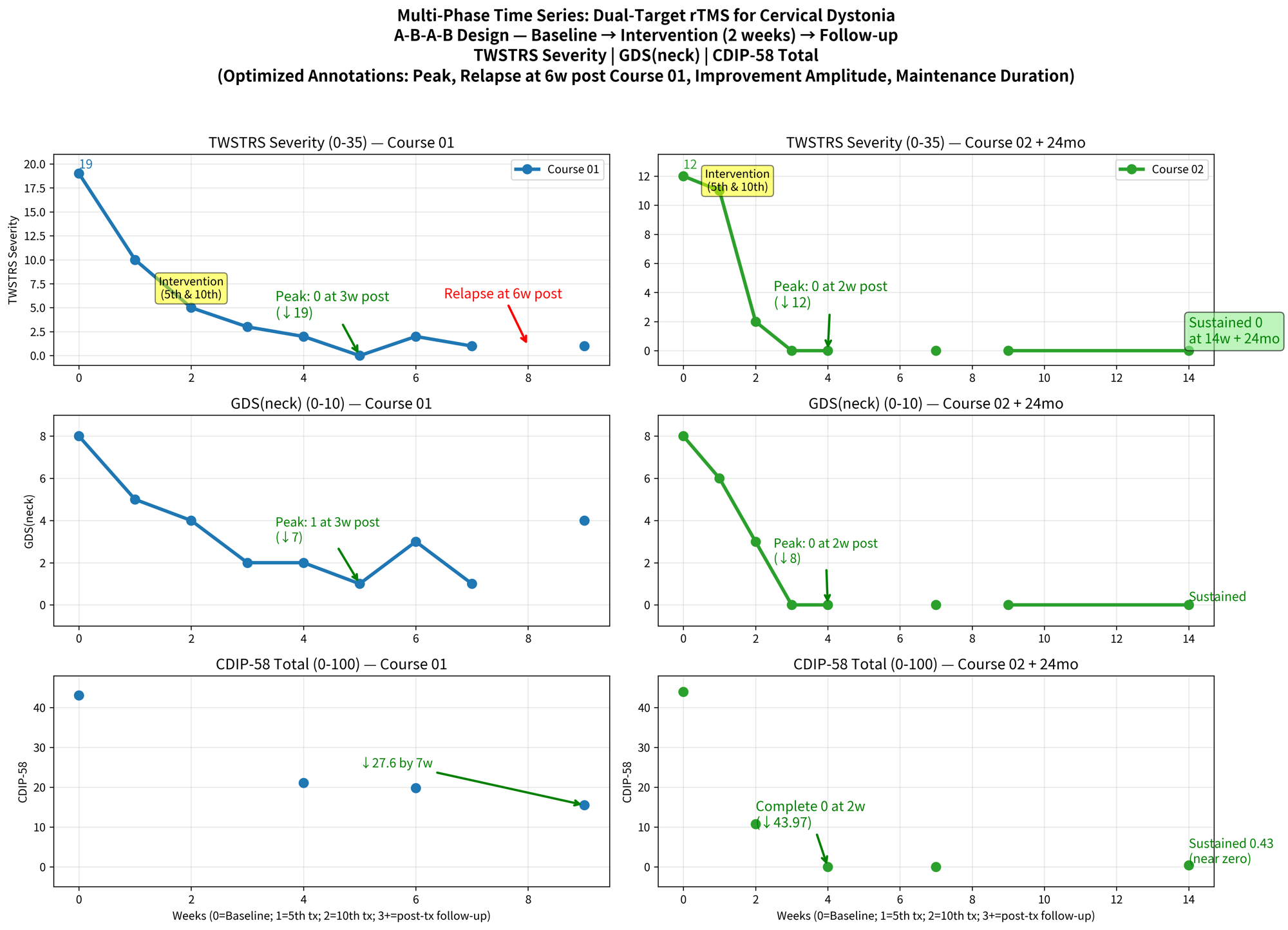
figure1.
To cite this abstract in AMA style:
Y. Wu, M. Zhang, H. Sun, Z. Zheng, H. Shang. Complete and sustained remission of cervical dystonia after repeated dual-target low-frequency rTMS (right M1 + left cerebellum): a 2-year follow-up case report [abstract]. Mov Disord. 2026; 41 (suppl 1). https://www.mdsabstracts.org/abstract/complete-and-sustained-remission-of-cervical-dystonia-after-repeated-dual-target-low-frequency-rtms-right-m1-left-cerebellum-a-2-year-follow-up-case-report/. Accessed October 1, 2026.« Back to 2026 International Congress
MDS Abstracts - https://www.mdsabstracts.org/abstract/complete-and-sustained-remission-of-cervical-dystonia-after-repeated-dual-target-low-frequency-rtms-right-m1-left-cerebellum-a-2-year-follow-up-case-report/