
Category: Non-Dystonia (Other)
Objective: To develop a computer-vision-based machine learning (ML) model to objectively quantify orofacial dyskinesias (ODF) and choreoathetosis in paediatric patients, and to evaluate these “digital signatures” as predictive markers for functional recovery.
Background: Movement disorders in paediatric anti-NMDAR encephalitis are often complex and fluctuate rapidly, making subjective clinical sales (e.g., mRS) insufficient for capturing subtle physiological changes. Leveraging pose estimation technology to track movement phenomenology provides a standardised, objective metric for monitoring disease modification in resource-limited settings
Method: A cohort of 25 paediatric patients with confirmed anti-NMDAR encephalitis was analysed using deep-learning framework (MediaPipe/DeepLabCut) to track 33 body and 468 facial key points from bedside video recordings. A “kinetic Entropy index” was developed to quantify the randomness and frequency of involuntary movements, with a specific focus on the “critical ODF monitoring zone” (peri oral and mandibular regions).
Results: The ML model successfully identified distinct movement phenotypes with 91% accuracy. A reduction in kinetic entropy within the ODF monitoring zone was observed to precede clinical improvement on the Modified Rankin scale (mRS) by an average of 14 days (p<0.05). This “lead time” suggests that AI-driven motion analysis can detect treatment responses significantly earlier than standard bedside evaluation.
Conclusion: AI-driven video analysis offers a low-cost, non-invasive, and objective biomarker for disease progression. By identifying early digital signatures of recovery, this method democratises precision neurology, allowing clinicians in developing countries to optimise immunotherapy timelines and improve long-term functional outcomes without requiring expensive specialised equipment.
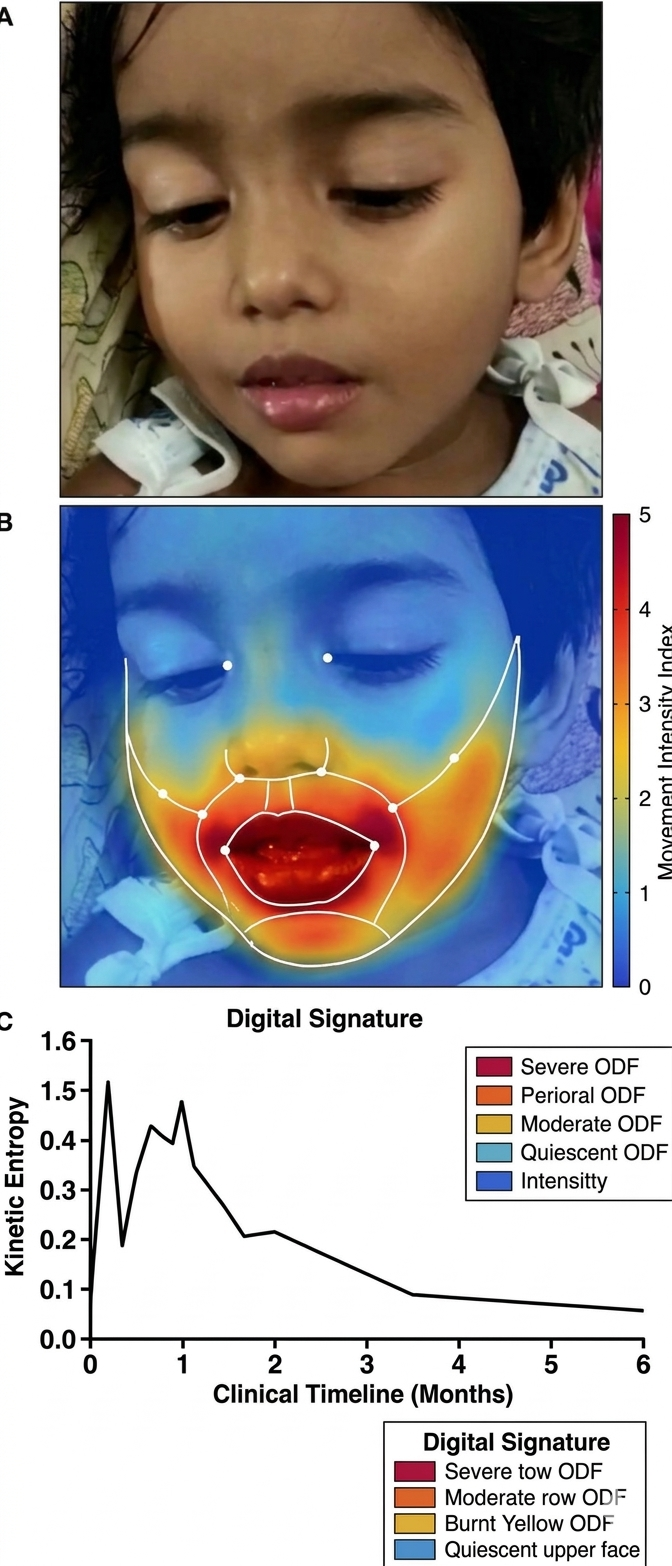
AI-DRIVEN QUANTITATIVE PHENOTYPING
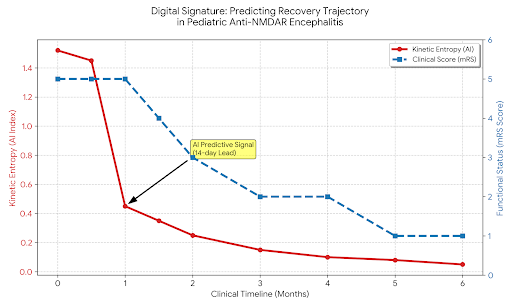
VISUAL DEMONSTRATION OF “LEAD TIME” PHENOMENON
To cite this abstract in AMA style:
A. Datta, A. Mukherjee. AI-driven quantification of oro-facial dyskinesia and kinetic entropy as a predictive biomarker for recovery in paediatric anti-NMDAR encephalitis [abstract]. Mov Disord. 2026; 41 (suppl 1). https://www.mdsabstracts.org/abstract/ai-driven-quantification-of-oro-facial-dyskinesia-and-kinetic-entropy-as-a-predictive-biomarker-for-recovery-in-paediatric-anti-nmdar-encephalitis/. Accessed October 1, 2026.« Back to 2026 International Congress
MDS Abstracts - https://www.mdsabstracts.org/abstract/ai-driven-quantification-of-oro-facial-dyskinesia-and-kinetic-entropy-as-a-predictive-biomarker-for-recovery-in-paediatric-anti-nmdar-encephalitis/