
Objective: Evaluate the effect of acoustic neuromodulation (AN) on people with functional movement disorder (FMD).
Background: FMD, characterized by involuntary, unwanted movements that can be disabling, is associated with dysregulated autonomic, motor, and emotional systems. Comorbid symptoms of insomnia, depression, anxiety, and post-traumatic stress contribute to symptom persistence and impaired quality of life. Effective non-pharmacologic, noninvasive, and durable treatments remain limited. AN is a closed-loop, brainwave echoing, acoustic neurostimulation technology, providing real-time auditory feedback derived from brain electrical activity. AN has demonstrated benefit in improving symptoms related to stress, mood, and insomnia, and autonomic regulation in other populations.
Method: In this uncontrolled, exploratory study, 8 people with FMD (median age 46 years, 5 female) were enrolled. Participants received 4-8, hour-long sessions of tones linked to brainwaves plus continued current care. Data was collected at baseline (V1), post-intervention (V2), 4-6 weeks post-intervention (V3), and 8-12 weeks post-intervention (V4). The primary outcome was Patient Global Impression of Change (PGI-C) at V4. Secondary outcomes included changes in insomnia (ISI), depression (CES-D), anxiety (GAD-7), perceived stress (PSS), PTSD symptoms (PCL-C), and autonomic function (heart rate variability (HRV) and baroreflex). Friedman test was used.
Results: Seven participants completed all visits. 57% (n=4) were “very much improved” on PGI-C at V4. [figure1]. From V1 to V4, median scores for symptoms of insomnia improved by 5 (ISI, p=.027), depression by 10 (CES-D, p=.02), anxiety by 5 (GAD-7, p=.002), stress by 17 (PSS, p=.036) and post-traumatic stress by 14 (PCLC, p=.002) [table1][figure2]. Of 6 participants with complete HRV data, five (83%) trended towards improvement in parasympathetic function (SDNN, mean 13.9%, CI[-6.4 – 34.2]). Of five participants with complete baroreflex data, four (80%) showed improvement (Sequence ALL, mean 44.6%, CI[-19.5 – 13.9]).
Conclusion: Preliminary findings suggest improvements in patient-reported symptom measures, most clinically meaningful, including PGI-C, depression, anxiety, stress, and insomnia. While there were favorable trends in autonomic regulation, this initial data lacks sufficient power for meaningful interpretation. Recruitment efforts are ongoing to better understand the effects of AN on people with FMD.
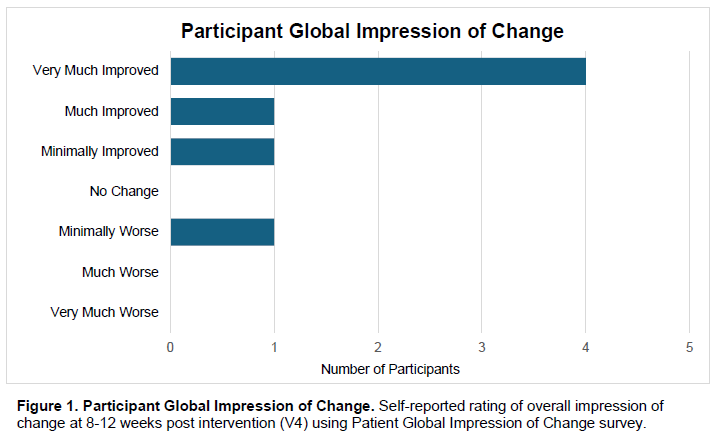
Figure 1. Participant Global Impression of Change
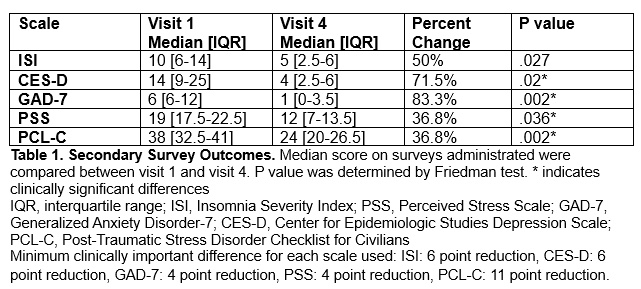
Table 1. Secondary Survey Outcomes
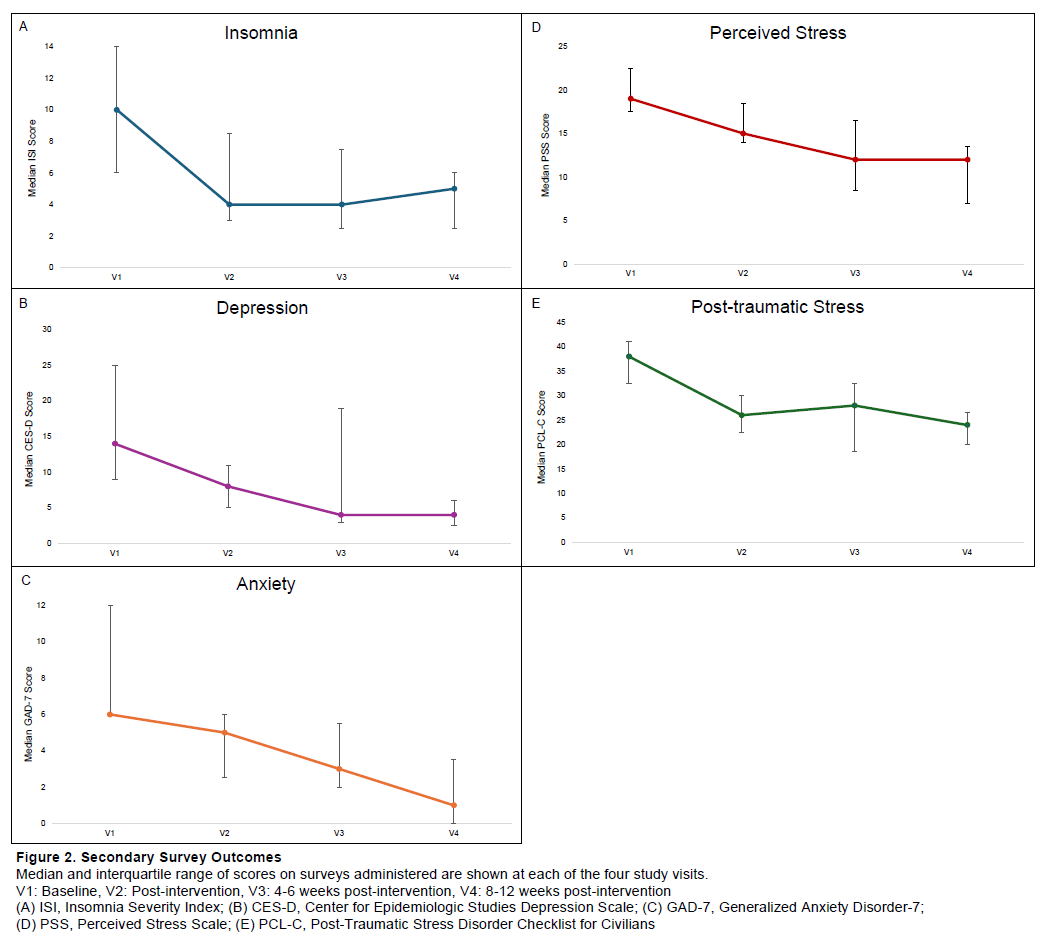
Figure 2. Secondary Survey Outcomes
References: [1] Park JE. Functional movement disorders: updates and clinical overview. J Mov Disord. 2024;17(3):251-261. doi:10.14802/jmd.24126.
[2] Macchi ZA, Kletenik I, Olvera C, Holden SK. Psychiatric comorbidities in functional movement disorders: a retrospective cohort study. Mov Disord Clin Pract. 2021;8(5):725-732. doi:10.1002/mdc3.13226.
[3] Graham CD, Kyle SD. A preliminary investigation of sleep quality in functional neurological disorders: poor sleep appears common, and is associated with functional impairment. J Neurol Sci. 2017;378:163-166. doi:10.1016/j.jns.2017.05.021.
[4] Tegeler CL, Munger Clary H, Shaltout HA, Russell GB, Danhauer SC, Tegeler CH. Randomized controlled trial of acoustic neuromodulation to enhance well-being in healthcare workers. Global Advances in Integrative Medicine and Health. 2025;14. doi:10.1177/27536130251388984.
[5] Romozzi M, Vollono C, Calabresi P, De Cesaris F, Iannone LF. Patients’ Global Impression of Change (PGIC) score compared to monthly migraine days to evaluate treatment persistence with anti-CGRP monoclonal antibodies. Ann Clin Transl Neurol. 2025;12(6):1292-1295. doi:10.1002/acn3.70053.
To cite this abstract in AMA style:
B. Dukes, C. Tegeler, C. Tegeler, H. Munger Clary, K. Brown, M. Thenganatt, H. Shaltout, D. Shah-Zamora. Closed-Loop Acoustic Neuromodulation for Functional Movement Disorder [abstract]. Mov Disord. 2026; 41 (suppl 1). https://www.mdsabstracts.org/abstract/closed-loop-acoustic-neuromodulation-for-functional-movement-disorder/. Accessed October 1, 2026.« Back to 2026 International Congress
MDS Abstracts - https://www.mdsabstracts.org/abstract/closed-loop-acoustic-neuromodulation-for-functional-movement-disorder/