
Objective: To determine whether simple standing balance tasks, assessed using a single wearable inertial measurement unit (IMU), can effectively differentiate individuals with Parkinson’s disease (PD) from age-matched healthy controls (HC).
Background: Different subtypes of PD have been identified, such as tremor-dominant PD, postural instability and gait dysfunction (PIGD). The PIGD is often characterised by postural imbalance, shuffling, stooped posture at disease onset with relatively rapid progression compared to tremor-dominant subtype. Postural instability is a major contributor to falls risk in PD, yet early balance impairments are often not detected by standard clinical assessments. Wearable sensor–based measures of postural sway may provide a more sensitive and practical method for detecting early balance difficulties.
Method: Fifty participants (n=50), including 25 participants with PD (74.7 ± 6.4 yrs) and 25 age-matched HC (72.76 ± 6.7 yrs) were recruited. Trunk acceleration was recorded using a single IMU during four standing conditions: quiet standing on firm ground, standing on foam, and both conditions performed with a cognitive dual task. A broad set of time-domain, frequency-domain, and non-linear sway features was extracted. Statistical comparisons were conducted between groups, and machine-learning classifiers (k-nearest neighbours, support vector machines, and decision trees) were trained using the full feature set and after Joint Mutual Information (JMI) feature selection.
Results: Significant group differences were found primarily during standing quiet on firm ground. Participants with PD exhibited increased sway path length, higher sway velocity, and greater jerk, indicating reduced smoothness of postural control. Baseline classification performance ranged from 56% (k-nearest neighbours) to 74% (decision tree). After JMI feature selection, performance improved, with the decision tree achieving an accuracy of 82%.
Conclusion: A brief, low-burden, easy-to-administer standing test using a single IMU, combined with targeted feature selection and machine-learning analysis, can sensitively detect PD-related postural instability. This approach shows promise as a practical tool for screening or monitoring balance impairment in PD.
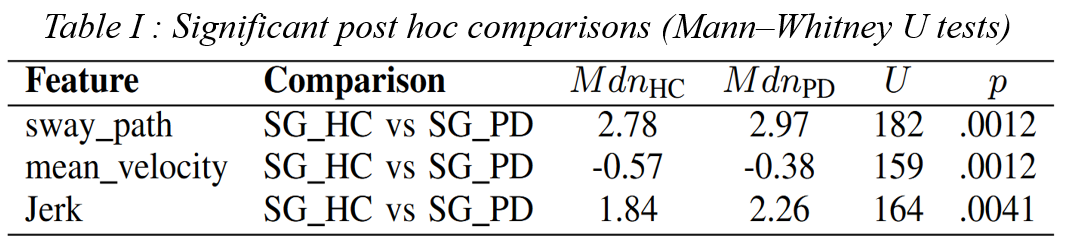
Table 1 Significant post hoc comparisons
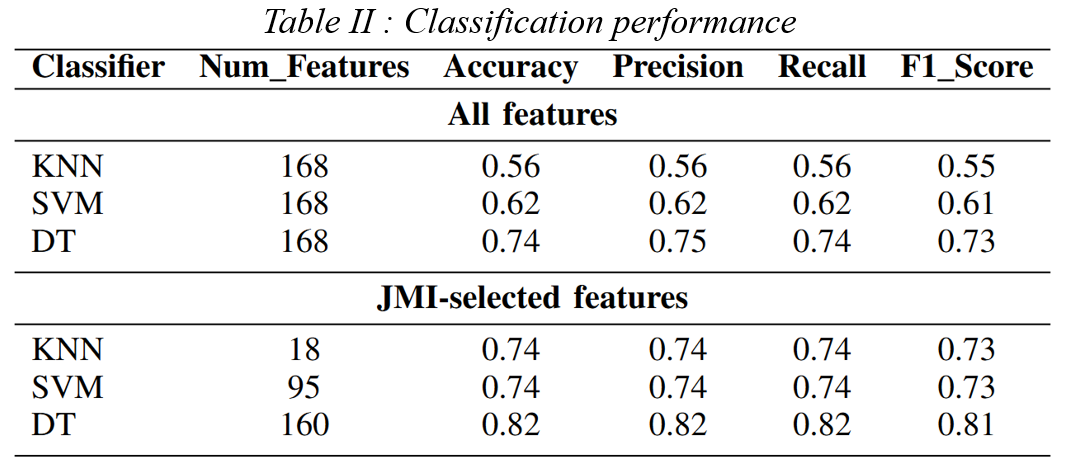
Table 2 Classification performance
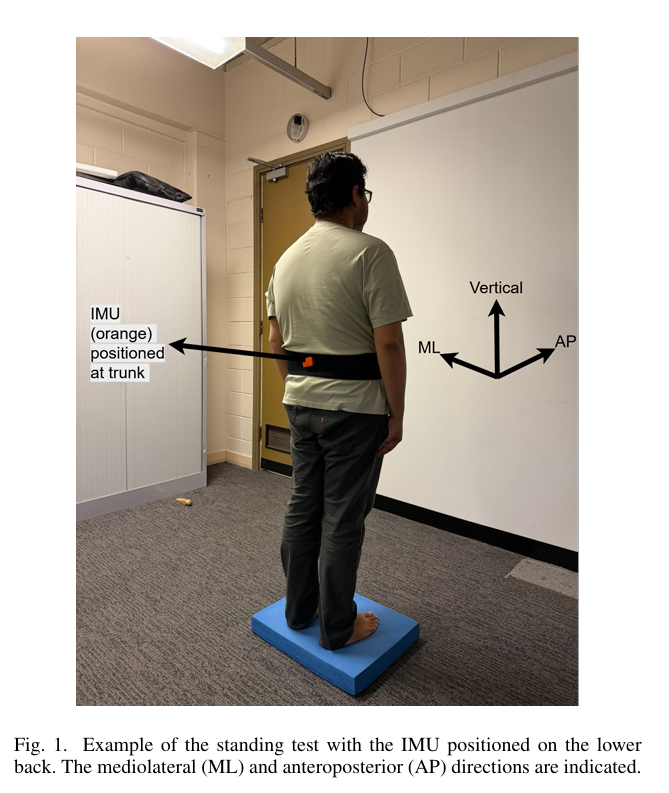
Fig 1 Example of the standing test with the IMU
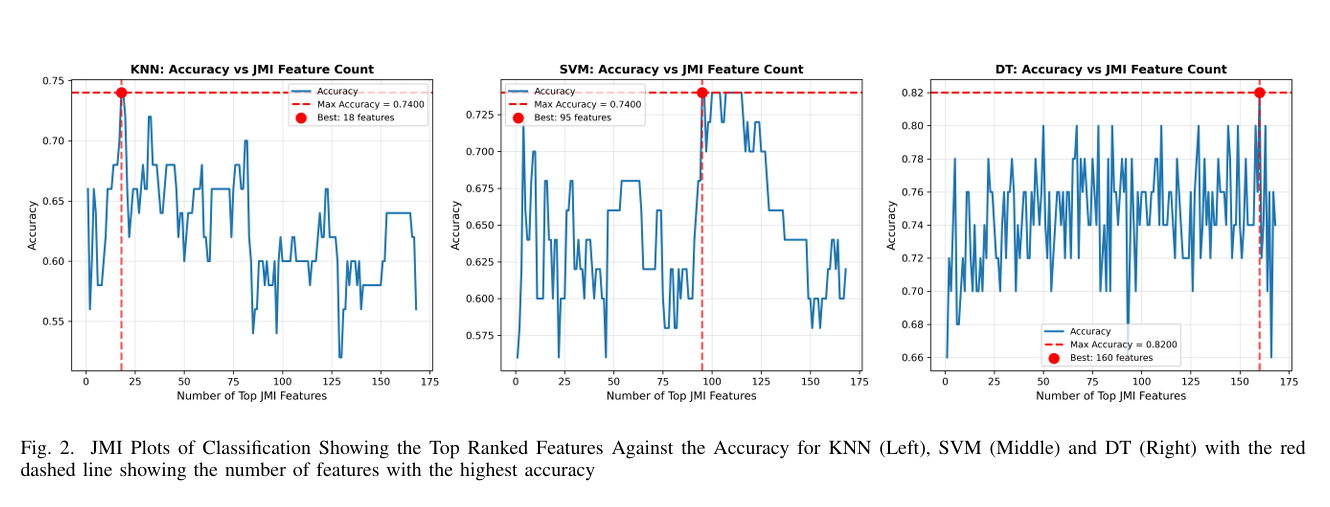
Fig 2 JMI Plots of classification
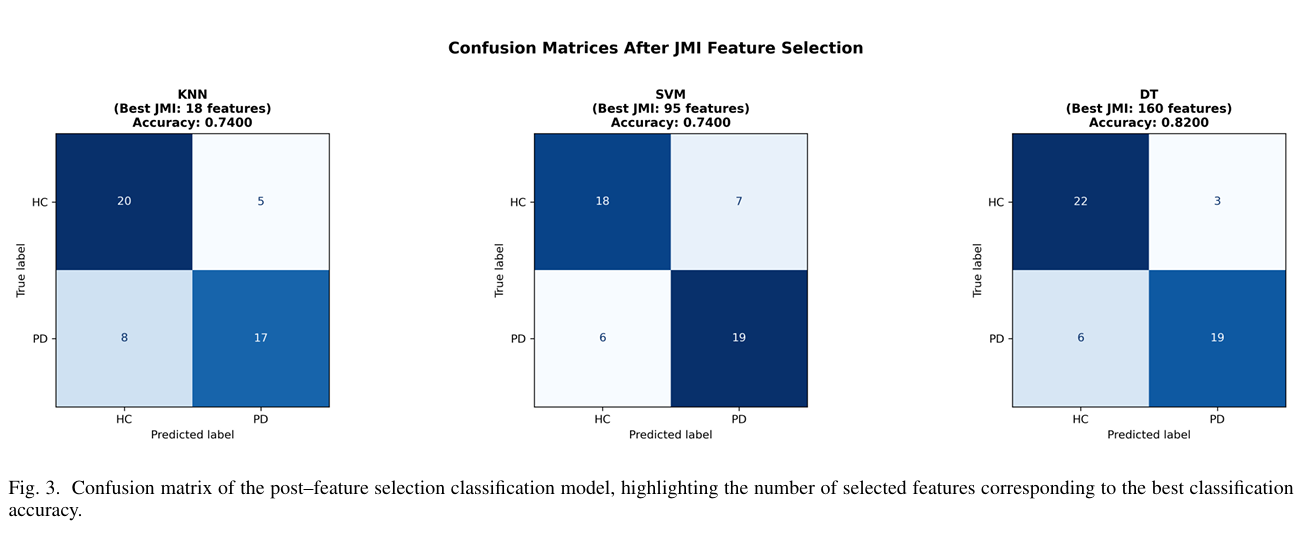
Fig 3 Confusion matrix of the classification model
References: [1] World Health Organization, “Parkinson disease,” 2023, accessed: 2026-02-06. [Online]. Available: https://www.who.int/news-room/factsheets/detail/parkinson-disease
[2] Australian Institute of Health and Welfare, “Neurological conditions in Australia: Parkinson’s disease in australia,” 2025, accessed: 2026-0220. [Online]. Available: https://www.aihw.gov.au/reports/neurologicalconditions/parkinsons-disease-in-australia
[3] M. Sousani, R. F. Rojas, E. Preston, and M. Ghahramani, “Toward a multi-modal brain-body assessment in parkinson’s disease: A systematic review in fnirs,” IEEE journal of biomedical and health informatics, vol. 27, no. 10, pp. 4840–4853, 2023.
[4] E. Warmerdam, M. Schumacher, T. Beyer, P. T. Nerdal, L. Schebesta, K. H. St¨urner, K. E. Zeuner, C. Hansen, and W. Maetzler, “Postural sway in parkinson’s disease and multiple sclerosis patients during tasks with different complexity,” Frontiers in neurology, vol. 13, p. 857406, 2022.
[5] M. Ghahramani, D. Stirling, F. Naghdy, G. Naghdy, and J. Potter, “Body postural sway analysis in older people with different fall histories,” Medical & biological engineering & computing, vol. 57, no. 2, pp. 533 542, 2019.
[6] Y. Baradaran, R. F. Rojas, R. Goecke, and M. Ghahramani, “Multimodal brain-body analysis of prefrontal cortex activity and postural sway with sensory manipulation,” Computers in Biology and Medicine, vol. 193, p. 110338, 2025.
[7] N. Baker, C. Gough, and S. J. Gordon, “Inertial sensor reliability and validity for static and dynamic balance in healthy adults: a systematic review,” Sensors, vol. 21, no. 15, p. 5167, 2021.
[8] P. Wodarski, J. Jurkoj´c, M. Chmura, E. Warmerdam, R. Romijnders, M. A. Hobert, W. Maetzler, K. Cygo´n, and C. Hansen, “Trend change analysis of postural balance in parkinson’s disease discriminates be tween medication state,” Journal of neuroengineering and rehabilitation, vol. 21, no. 1, p. 112, 2024.
[9] A. C. de Souza Fortaleza, M. Mancini, P. Carlson-Kuhta, L. A. King, J. G. Nutt, E. F. Chagas, I. F. Freitas Junior, and F. B. Horak, “Dual task interference on postural sway, postural transitions and gait in people with parkinson’s disease and freezing of gait,” Gait & Posture, vol. 56, pp. 76–81, 2017. [Online]. Available: https://pubmed.ncbi.nlm.nih.gov/28521148/
[10] M. Sousani, R. F. Rojas, E. Preston, and M. Ghahramani, “Integrating imu sensors and dual-task timed up and go to identify biomarkers for early-stage Parkinson’s disease detection,” IEEE Sensors Journal, 2025. “Postural sway in patients with early parkinson’s disease performing cognitive tasks while standing,” Neurological Research, Jun. 2018.
[12] M. Erdem, M. Balal, and M. Demirkıran, “Postural stability in early Parkinson’s disease: effect of cognitive dual-tasking,” Cukurova Medical Journal, vol. 47, no. 4, pp. 1539–1546, 2022.
[13] F. Castelli Gattinara Di Zubiena, G. Menna, I. Mileti, A. Zampogna, F. Asci, M. Paoloni, A. Suppa, Z. Del Prete, and E. Palermo, “Machine learning and wearable sensors for the early detection of balance disorders in parkinson’s disease,” Sensors (Basel), vol. 22, no. 24, p. 9903, 2022.
[14] C. Caramia, D. Torricelli, M. Schmid, A. Mu˜noz-Gonzalez, J. Gonzalez Vargas, F. Grandas, and J. L. Pons, “Imu-based classification of Parkinson’s disease from gait: A sensitivity analysis on sensor location and feature selection,” IEEE journal of biomedical and health informatics, vol. 22, no. 6, pp. 1765–1774, 2018.
[15] N. Hasegawa, V. V. Shah, P. Carlson-Kuhta, J. G. Nutt, F. B. Horak, and M. Mancini, “How to select balance measures sensitive to Parkinson’s disease from body-worn inertial sensors—separating the trees from the forest,” Sensors, vol. 19, no. 15, p. 3320, 2019.
[16] J. F. Hafer, R. Vitali, R. Gurchiek, C. Curtze, P. Shull, and S. M. Cain, “Challenges and advances in the use of wearable sensors for lower extremity biomechanics,” Journal of biomechanics, vol. 157, p. 111714, 2023.
[17] M. L. Pollind and R. Soangra, “Mini-logger-a wearable inertial measurement unit (imu) for postural sway analysis,” in 2020 42nd Annual International Conference of the IEEE Engineering in Medicine & Biology Society (EMBC). IEEE, 2020, pp. 4600–4603.
[18] P. G. Monaghan, A. S. Monaghan, A. Hooyman, B. W. Fling, J. M. Huisinga, and D. S. Peterson, “Using the instrumented sway system (isway) to identify and compare balance domain deficits in people with multiple sclerosis,” Archives of physical medicine and rehabilitation, vol. 104, no. 9, pp. 1456–1464, 2023.
[19] M. Mancini, A. Salarian, P. Carlson-Kuhta, C. Zampieri, L. King, L. Chiari, and F. B. Horak, “Isway: a sensitive, valid and reliable measure of postural control,” Journal of neuroengineering and rehabilitation, vol. 9, no. 1, p. 59, 2012.
[20] R. Fernandez Rojas, X. Huang, and K.-L. Ou, “A machine learning approach for the identification of a biomarker of human pain using fnirs,” Scientific reports, vol. 9, no. 1, p. 5645, 2019.
[21] A. Pantall, P. Suresparan, L. Kapa, R. Morris, A. Yarnall, S. Del Din, and L. Rochester, “Postural dynamics are associated with cognitive decline in parkinson’s disease,” Frontiers in neurology, vol. 9, p. 1044, 2018.
[22] C. Curtze, J. G. Nutt, P. Carlson-Kuhta, M. Mancini, and F. B. Horak, “Objective gait and balance impairments relate to balance confidence and perceived mobility in people with parkinson disease,” Physical therapy, vol. 96, no. 11, pp. 1734–1743, 2016.
[23] E. M. Bekkers, K. Dockx, S. Devan, S. Van Rossom, S. M. Verschueren B. R. Bloem, and A. Nieuwboer, “The impact of dual-tasking on postural stability in people with parkinson’s disease with and without freezing of gait,” Neurorehabilitation and neural repair, vol. 32, no. 2, pp. 166–174, 2018.
[24] B. Palakurthi and S. P. Burugupally, “Postural instability in Parkinson’s disease: a review,” Brain sciences, vol. 9, no. 9, p. 239, 2019.
[25] L. Morenilla, G. M´arquez, J. A. S´anchez, O. Bello, V. L´opez-Alonso, H. Fern´andez-Lago, and M. ´ A. Fern´andez-del Olmo, “Postural stability and cognitive performance of subjects with Parkinson’s disease during a dual-task in an upright stance,” Frontiers in Psychology, vol. 11, p. 1256, 2020.
[26] Jankovic J, McDermott M, Carter J, Gauthier S, Goetz C, Golbe L, Huber S, Koller W, Olanow C, Shoulson I, et al. Variable expression of Parkinson’s disease: a base-line analysis of the DATATOP cohort. The Parkinson Study Group. Neurology. 1990 Oct;40(10):1529-34.
To cite this abstract in AMA style:
F. Rashid, R. Fernandez-Rojas, S. Dal, M. Ghahramani. Detecting Parkinson’s Disease with Postural Sway via Single IMU and Machine Learning [abstract]. Mov Disord. 2026; 41 (suppl 1). https://www.mdsabstracts.org/abstract/detecting-parkinsons-disease-with-postural-sway-via-single-imu-and-machine-learning/. Accessed October 1, 2026.« Back to 2026 International Congress
MDS Abstracts - https://www.mdsabstracts.org/abstract/detecting-parkinsons-disease-with-postural-sway-via-single-imu-and-machine-learning/