
Category: Technology
Objective: To assess the validity of a remote wearable sensor protocol performed at home with a simplified sensor configuration in people with Parkinson’s Disease (PwP).
Background: Remote protocols must enable the collection of clinically accurate data, while remaining simple for unsupervised use[1]. It is currently unclear whether a reduced sensor configuration can produce clinically comparable results in unstandardised home environments.
Method: 30 PwP are currently enrolled in a 16-month longitudinal study, with visits at four-month intervals. Visits 1, 3 and 5 include in-clinic active assessments followed by the same tests performed remotely the following day. Participants also complete three full days of passive monitoring following active testing. Visits 2 and 4 are conducted entirely remote. In-clinic assessments use six IMUs (lumbar, torso, wrists, feet). Remote assessments use a reduced sensor configuration (active: lumbar and feet; passive: active + 1 wrist) [Figure 1]. Active tasks include a five-metre walk, 30-second balance tasks, and timed-up-and-go. Extracted measures between clinic and home environments were evaluated using Pearson correlation at baseline.
Results: The five-metre walk shows stronger agreement between clinic and home than balance tasks. Mean-derived measures demonstrated moderate-strong correlation between environments (r≈0.65 [0.25–0.85]), exceeding correlations for variability-based measures (r≈0.3 [0.01–0.8]). Lower limb derived measures showed the greatest degree of correlation. Agreement was similar between affected and non-affected limbs.
Following the first two visits, all participants completed passive monitoring, with average mean daily wear time >12 hours. Compared to Visit 1, remote-only Visit 2 showed more technical issues and two instances of missing data due to uncharged devices. Participants reported overall ease of use and comfort, though foot sensors were more frequently removed than lumbar and wrist sensors for convenience, comfort, and safety.
Conclusion: Preliminary findings suggest a simplified three-sensor configuration shows moderate to strong agreement between active remote and in-clinic assessment, particularly for lower limb gait measures, and is feasible for passive home monitoring. Ongoing longitudinal analysis will determine whether the simplified array may detect disease status and progression compared to previously used six-sensor configuration[2].
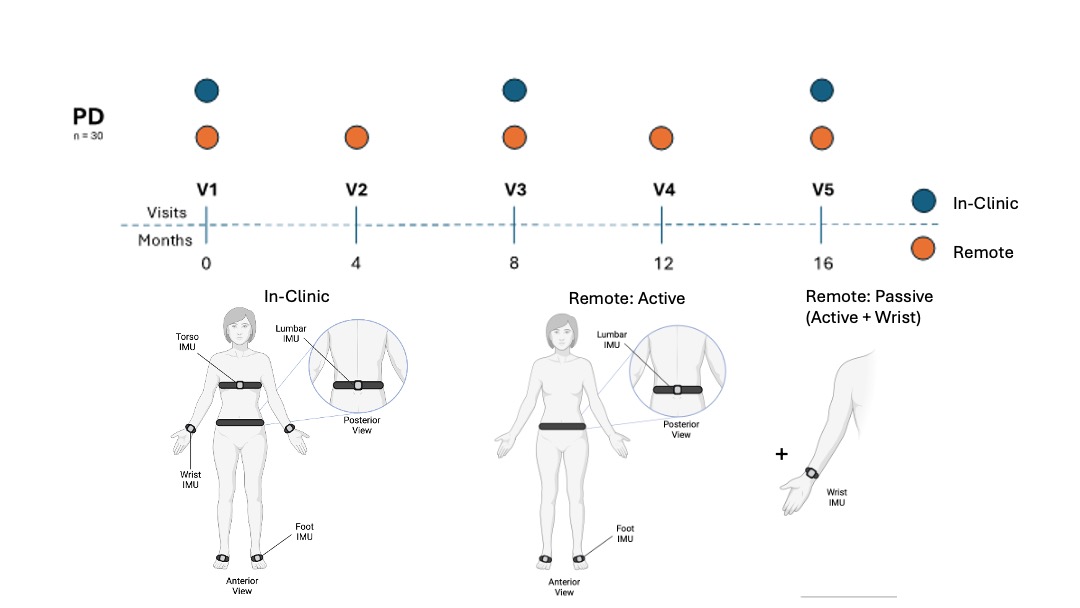
Figure 1
References: [1] De Vos M, Prince J, Buchanan T, FitzGerald JJ, Antoniades CA. Discriminating progressive supranuclear palsy from Parkinson’s disease using wearable technology and machine learning. Gait Posture. 2020 Mar;77:257-263. doi: 10.1016/j.gaitpost.2020.02.007. Epub 2020 Feb 10. PMID: 32078894.
[2] Sotirakis C, Su Z, Brzezicki MA, Conway N, Tarassenko L, FitzGerald JJ, Antoniades CA. Identification of motor progression in Parkinson’s disease using wearable sensors and machine learning. NPJ Parkinsons Dis. 2023 Oct 7;9(1):142. doi: 10.1038/s41531-023-00581-2. PMID: 37805655; PMCID: PMC10560243.
To cite this abstract in AMA style:
N. Conway, C. Sotirakis, A. D'Souza, P. Ginis, V. Shah, C. Antoniades. From Clinic to Home: Transitioning a Reduced Wearable Sensor Monitoring Array in Parkinson’s Disease [abstract]. Mov Disord. 2026; 41 (suppl 1). https://www.mdsabstracts.org/abstract/from-clinic-to-home-transitioning-a-reduced-wearable-sensor-monitoring-array-in-parkinsons-disease/. Accessed October 1, 2026.« Back to 2026 International Congress
MDS Abstracts - https://www.mdsabstracts.org/abstract/from-clinic-to-home-transitioning-a-reduced-wearable-sensor-monitoring-array-in-parkinsons-disease/