
Category: Tremor
Objective: To investigate the association between 24-hour ambulatory blood pressure monitoring (ABPM) patterns, particularly nocturnal non-dipping, and psychosis severity, movement disorder burden, and non-motor symptoms in children with early-stage epilepsy
Background: Beyond recurrent seizures, pediatric epilepsy frequently involves neuropsychiatric symptoms, movement abnormalities, and autonomic dysfunction. Disruption of circadian blood pressure (BP) regulation specifically nocturnal non-dipping may reflect impaired central autonomic control and contribute to neurobehavioral vulnerability. However, objective autonomic markers linked to psychosis and movement disorder burden in childhood epilepsy remain underexplored
Method: In this cross-sectional study, 60 children with epilepsy (mean age 11.4 ± 3.2 years; 50% female) underwent 24-hour ambulatory BP monitoring. Non-dipping was defined as <10% nocturnal reduction in mean arterial pressure (MAP). Psychotic symptoms were quantified using the Brief Psychiatric Rating Scale (BPRS). Movement disorders (dystonia, tremor, myoclonus) were graded clinically using standardized neurological examination scores. Non-motor symptoms and quality of life were assessed using validated pediatric instruments. Correlation and multivariate regression analyses were performed
Results: Twenty-six patients (43%) demonstrated a non-dipping BP profile. Non-dippers had significantly higher mean BPRS scores compared with dippers (41.3 ± 8.6 vs 32.7 ± 7.9; p < 0.001). The percentage nocturnal MAP decline inversely correlated with psychosis severity (r = –0.48, p = 0.002) and movement disorder severity scores (r = –0.42, p = 0.005). Non-dippers exhibited higher prevalence of sleep disturbances (85% vs 68%), urinary dysfunction (73% vs 61%), and constipation (65% vs 58%). In multivariate models adjusted for age, seizure frequency, and antiseizure medication load, non-dipping independently predicted higher psychosis scores (β = 0.36, p = 0.01) and poorer quality-of-life indices (β = –0.39, p = 0.008)
Conclusion: Nocturnal BP non-dipping is common in pediatric epilepsy and independently associates with psychosis severity and movement disorder burden. Circadian autonomic assessment may serve as an objective biomarker for neuropsychiatric risk stratification, supporting integrated autonomic–neurobehavioral evaluation in pediatric epileptology
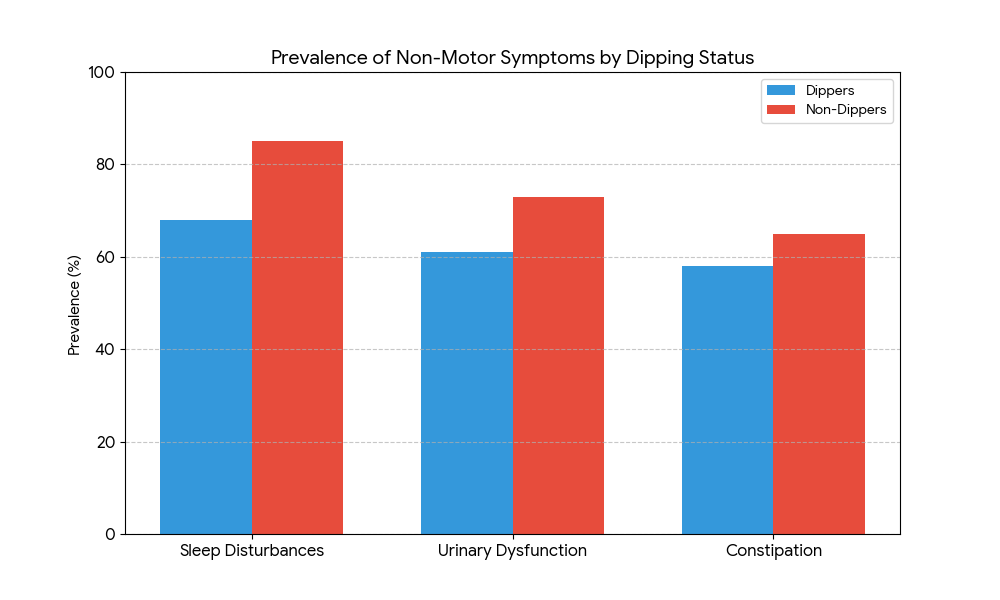
Chart 2
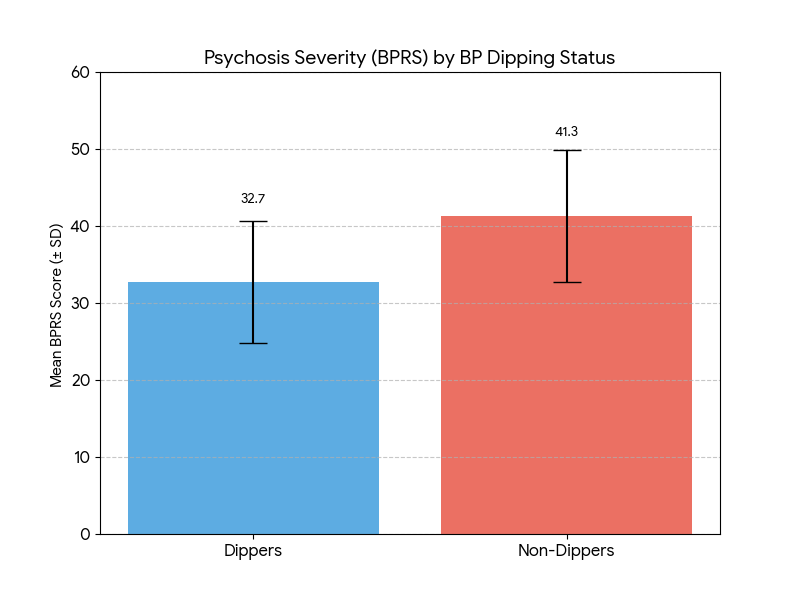
Chart 1
To cite this abstract in AMA style:
S. Sharma, V. Sharma, P. Maheshwari. Nocturnal Blood Pressure Non-Dipping as an Autonomic Biomarker of Psychosis and Movement Disorder Severity in Pediatric Epilepsy [abstract]. Mov Disord. 2026; 41 (suppl 1). https://www.mdsabstracts.org/abstract/nocturnal-blood-pressure-non-dipping-as-an-autonomic-biomarker-of-psychosis-and-movement-disorder-severity-in-pediatric-epilepsy/. Accessed October 1, 2026.« Back to 2026 International Congress
MDS Abstracts - https://www.mdsabstracts.org/abstract/nocturnal-blood-pressure-non-dipping-as-an-autonomic-biomarker-of-psychosis-and-movement-disorder-severity-in-pediatric-epilepsy/