
Objective: The objective of this work is to develop and evaluate a deep learning framework for segmenting and classifying Parkinson’s disease (PD) resting tremor severity using wearable accelerometer data.
Background: PD affects more than 10 million people worldwide, and one way it is characterized is through motor symptoms including resting tremors. Clinical tremor assessments largely rely on intermittent observations and subjective rating scales, which lack temporal resolution and objectivity. The data provided by wearable technologies that are used as input to machine learning pipelines can offer a promising approach for continuous and quantitative monitoring of PD motor symptoms.
Method: Accelerometer recordings from individuals with PD were obtained from the Michael J. Fox Foundation Levodopa Response Study [1]. Signals from the dominant hand were segmented into 3-second windows and filtered using a 0.5–10 Hz band-pass filter to isolate tremor frequencies. Time- and frequency-domain features were extracted, generating 144 candidate features that were reduced to 64 using principal component analysis. Several neural network architectures were evaluated, including convolutional neural networks (CNNs), long short-term memory (LSTM) networks, and a multiscale CNN encoder with a classifier. Models were trained using supervised learning with random oversampling to address class imbalance. A reinforcement learning approach was also explored to fine-tune pretrained models using subject-specific data.
Results: The multiscale CNN achieved the best performance with a test accuracy of 66.3% for tremor severity classification across five classes [figure1]. Random oversampling improved recall for minority classes and increased F1 scores as well [figure2]. Fine-tuning based on reinforcement learning techniques improved the validation accuracy by an average of 3%, with improvements of up to 17% for some subjects [figure3].
Conclusion: Deep learning models can classify PD tremor severity using wearable accelerometer data and may support objective, personalized symptom monitoring. The multiscale CNN showed the strongest baseline performance, while reinforcement learning–based fine-tuning demonstrated potential for personalized tremor assessments. These results support the development of wearable systems for continuous PD motor symptom monitoring.
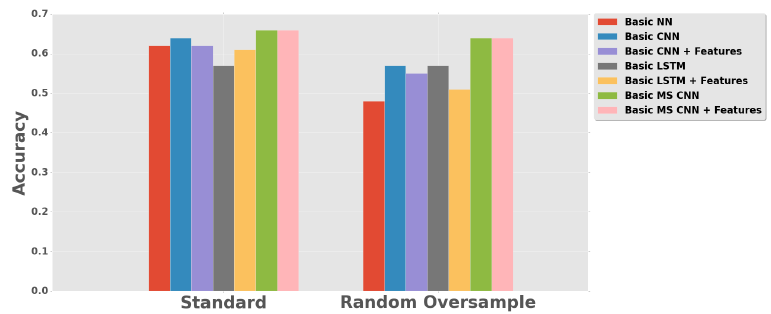
figure1
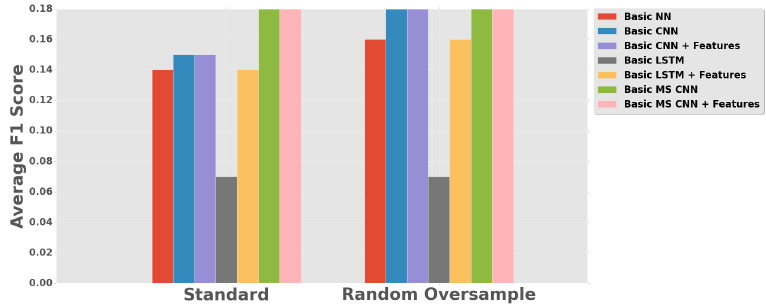
figure2
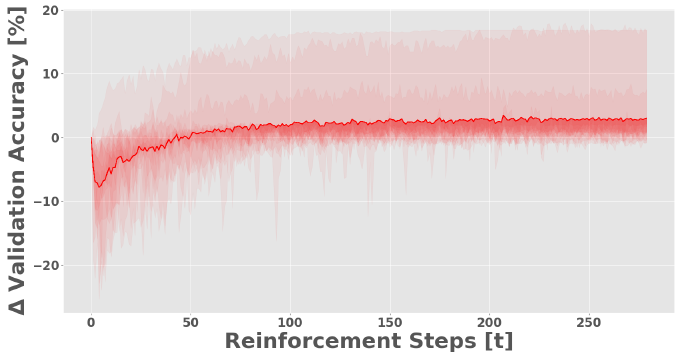
figure3
References: [1] Daneault, JF., Vergara-Diaz, G., Parisi, F. et al. Accelerometer data collected with a minimum set of wearable sensors from subjects with Parkinson’s disease. Sci Data 8, 48 (2021). https://doi.org/10.1038/s41597-021-00830-0
To cite this abstract in AMA style:
J. Jaegerman, C. Lucasius, J. Ambrad, C. Gorodetsky. Towards Deep Learning for Personalized Parkinson’s Disease Tremor Segmentation and Severity Classification Using Wearable Sensors [abstract]. Mov Disord. 2026; 41 (suppl 1). https://www.mdsabstracts.org/abstract/towards-deep-learning-for-personalized-parkinsons-disease-tremor-segmentation-and-severity-classification-using-wearable-sensors/. Accessed October 1, 2026.« Back to 2026 International Congress
MDS Abstracts - https://www.mdsabstracts.org/abstract/towards-deep-learning-for-personalized-parkinsons-disease-tremor-segmentation-and-severity-classification-using-wearable-sensors/