
Objective: To describe mobility impairment, balance disturbances, and walking aid use in Parkinson’s disease (PD), and to examine discrepancies between subjective balance complaints and objective postural instability.
Background: Mobility impairment is a major manifestation of PD and contributes to increased fall risk, loss of independence, and reduced quality of life [1,2]. As the disease progresses, patients may develop gait slowing, postural instability, and reliance on walking aids [3-5]
Method: This descriptive observational study analyzed registry data from PD patients treated at the Neurology Outpatient Clinic of Dr. Cipto Mangunkusumo Hospital, Jakarta, Indonesia, between 2020 and 2025. Variables included demographics, age at onset, Hoehn and Yahr (HY) stage, subjective balance complaints, pull test results, mobility impairment, and walking aid use based on the Unified Parkinson’s Disease Rating Scale. Young-onset PD and levodopa therapy were recorded. Descriptive analysis and logistic regression evaluated discrepancies between subjective and objective balance.
Results: A total of 120 patients were included (57.5% men) with a mean age at onset of 59.7 ± 12.9 years. Young-onset PD occurred in 24.2%, and 87.5% of patients received levodopa therapy [table1]. Based on HY staging, most patients were in stages 2–3. Mobility impairment was observed in 75.8% of patients, including mild gait slowing (41.7%), occasional walking aid use (21.7%), consistent walking aid use (12.5%), and need for assistance (7.5%) [table2]. Subjective balance complaints were reported by 73.3% of patients, while postural instability on pull test was observed in 71.7% [table3]. Among patients with subjective complaints, 80.7% demonstrated positive pull test findings, whereas 46.9% of patients without complaints already showed postural instability [table4]. Overall, discrepancies between subjective perception and objective balance assessment were identified in 26.7% of patients. HY stage was a significant predictor of discrepancy (p = 0.008).
Conclusion: Mobility impairment is common in PD and frequently accompanied by balance disturbances. Discrepancies between subjective balance complaints and objective postural instability were observed in some patients. These findings emphasize the importance of assessing both subjective and objective balance in PD evaluation to guide management and improve quality of life.
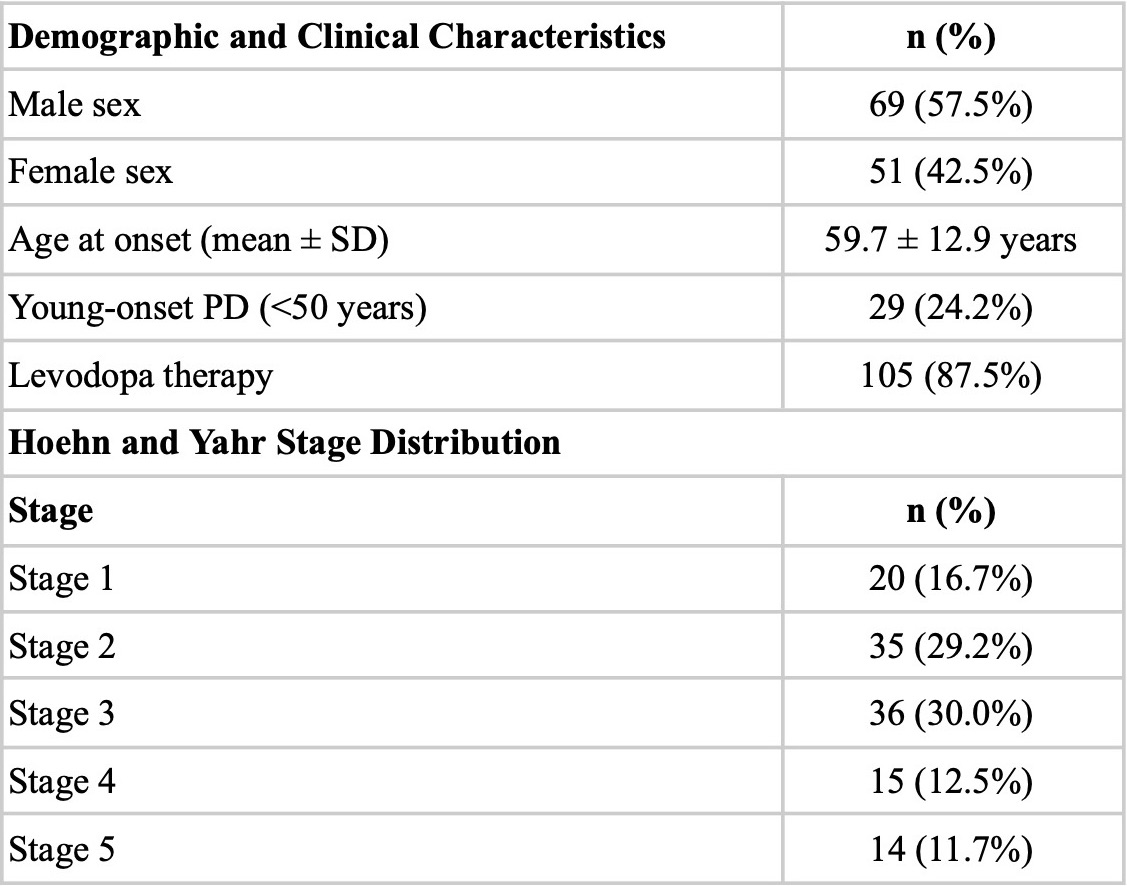
Patient Characteristics (n = 120)
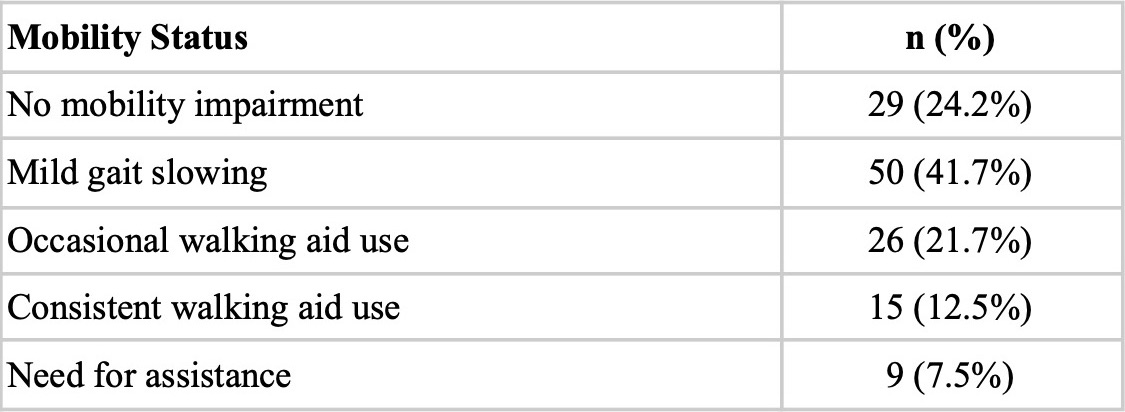
Mobility and Walking Aid Use in PD
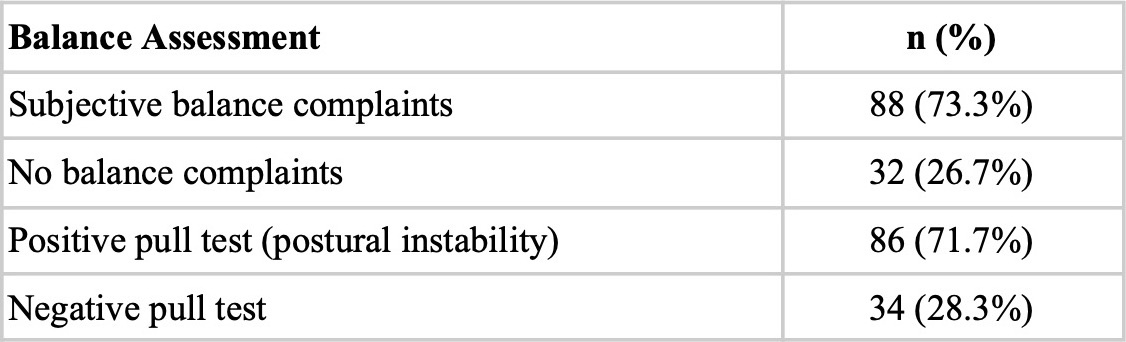
Balance Complaints and Postural Instability

Subjective Balance vs Pull Test Results
References: 1. Camargo, C. H. F., Ferreira-Peruzzo, S. A., Ribas, D. I. R., Franklin, G. L., & Teive, H. A. (2024). Imbalance and gait impairment in Parkinson’s disease: discussing postural instability and ataxia. Neurological Sciences, 45(4), 1377-1388.
2. Murueta-Goyena, A., Muino, O., & Gomez-Esteban, J. C. (2024). Prognostic factors for falls in Parkinson’s disease: a systematic review. Acta Neurologica Belgica, 124(2), 395-406.
3. Mylius, V., Zenev, E., Brook, C. S., Brugger, F., Maetzler, W., Gonzenbach, R., & Paraschiv-Ionescu, A. (2024). Imbalance and falls in patients with Parkinson’s disease: Causes and recent developments in training and sensor-based assessment. Brain sciences, 14(7), 625.
4. do Amaral, C. M. S., de Almeida, S. B., de Almeida, R. P., do Nascimento, S. L., Ribeiro, R. M., & Braga-Neto, P. (2024). Effectiveness of vestibular rehabilitation on postural balance in Parkinson’s disease: a systematic review and meta-analysis of randomized controlled trials. BMC neurology, 24(1), 161.
5. Pongmala, C., Stonsaovapak, C., van Emde Boas, M., Bhanderi, H., Luker, A., Michalakis, F., … & Bohnen, N. I. (2024). Body composition, falls, and freezing of gait in Parkinson’s disease: gender-specific effects. The Journal of frailty & aging, 13(3), 293-299.
To cite this abstract in AMA style:
E. Isadora, D. Tunjungsari, A. Tiksnadi. Mobility Impairment And Balance Perception Discrepancy In Parkinson’s Disease [abstract]. Mov Disord. 2026; 41 (suppl 1). https://www.mdsabstracts.org/abstract/mobility-impairment-and-balance-perception-discrepancy-in-parkinsons-disease/. Accessed October 1, 2026.« Back to 2026 International Congress
MDS Abstracts - https://www.mdsabstracts.org/abstract/mobility-impairment-and-balance-perception-discrepancy-in-parkinsons-disease/