
Objective: To determine whether musician’s dystonia (MD) is associated with abnormal cerebellar–cortical functional connectivity and whether cerebellar continuous theta burst stimulation (cTBS) can modulate these network alterations.
Background: Dystonia has traditionally been attributed to basal ganglia dysfunction; however, increasing evidence implicates cerebellar network involvement. MD is a focal task-specific dystonia characterized by involuntary muscle contractions occurring during instrument performance, impairing voluntary motor control. Affecting ~1% of professional musicians, MD can significantly disrupt performance and careers. Resting-state fMRI (rsfMRI) studies have demonstrated abnormal cerebellar connectivity in focal hand dystonia, and cerebellar cTBS has shown therapeutic effects in cervical dystonia, suggesting cerebellar network modulation may represent a potential treatment strategy.
Method: Fifteen patients with MD and ten healthy musicians were recruited. Participants completed two randomized, blinded cross-over sessions separated by at least 1 week. In each session, rsfMRI was acquired before and after cerebellar stimulation. Participants received either real or sham cTBS targeting the right cerebellum. Real cTBS consisted of bursts of three pulses at 50 Hz delivered at 5 Hz for 40 seconds (600 pulses). Four T1-weighted MRI images per participant were bias-corrected, registered to the first session, and averaged using ANTs. Images were segmented and smoothed (8 mm kernel) using CAT12, followed by ROI-based analysis with the Neuromorphometrics atlas. Group comparisons between healthy musicians and MD patients controlled for age, sex, and intracranial volume.
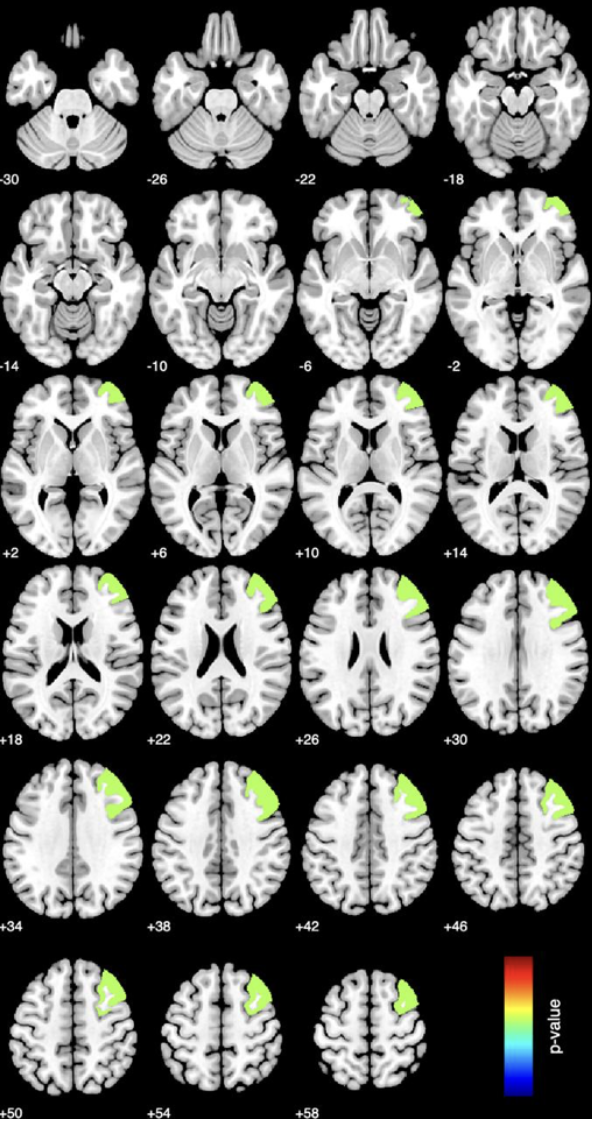
Results: Voxel-based morphometry revealed reduced gray matter volume in musician’s dystonia patients compared with healthy controls in the middle frontal gyrus (HC > MD; p = 0.02, Holm–Bonferroni corrected).
Conclusion: Patients with musician’s dystonia show reduced gray matter volume in the middle frontal gyrus compared with healthy musicians. This finding points to structural changes in frontal brain regions involved in planning and controlling highly skilled movements, supporting the idea that alterations in higher-order motor networks contribute to musician’s dystonia.
To cite this abstract in AMA style:
N. Nasrkhani, A. Bhattacharya, R. Chen. Investigating Cerebellar Network Alterations in Musician’s Dystonia [abstract]. Mov Disord. 2026; 41 (suppl 1). https://www.mdsabstracts.org/abstract/investigating-cerebellar-network-alterations-in-musicians-dystonia/. Accessed October 1, 2026.« Back to 2026 International Congress
MDS Abstracts - https://www.mdsabstracts.org/abstract/investigating-cerebellar-network-alterations-in-musicians-dystonia/