
Objective: To develop and evaluate a Motor Frailty Index (MFI) based on routine clinical variables as an early predictor of motor progression in persons with Parkinson’s disease.
Background: Parkinson’s disease progression is heterogeneous, patients with similar motor severity can present different progression pathways. Currently, there is no simple clinical index that integrates early motor vulnerability to identify patients at higher risk of accelerated decline. The concept of “motor frailty” could capture this subclinical vulnerability by combining routine clinical variables. Developing and validating an MFI could improve prognostic stratification in a real-world setting.
Method: We conducted a longitudinal observational study. The MFI was developed to capture baseline motor vulnerability across five domains: motor severity by MDS-UPDRS-III, axial motor symptoms, walking/balance, nutrition (inverted body mass index), and sleep/fatigue. Components were standardized using z-scores, and participants were categorized into MFI terciles (T1-T3). The primary outcome was the ON-state MDS-UPDRS-III score. We utilized a piecewise linear mixed model with a cutoff at one year to estimate early and late progression, adjusting for age, sex, disease duration, motor phenotype, and baseline levodopa equivalent daily dose.
Results: We analyzed 2,757 observations from 1,042 participants. We identified a significant biphasic trajectory in the cohort. During the first year, patients in the highest frailty group (T3) showed substantial motor improvement (-12.13 points, p<0.001), while the lowest frailty group (T1) remained stable (+0.45 points, p=0.67). After the first year, we observed motor decline across all groups; however, the rate of worsening was significantly slower in the high-frailty group compared to the low-frailty (+0.77 vs +1.62 points, p=0.027).
Conclusion: By developing and applying a clinical MFI, we found that higher baseline motor frailty predicts a distinct biphasic trajectory, featuring substantial early improvement followed by a slower decline. We attribute this early stabilization to real-world treatment optimization. Our findings demonstrate that single-slope linear models may inadequately capture early-stage progression dynamics
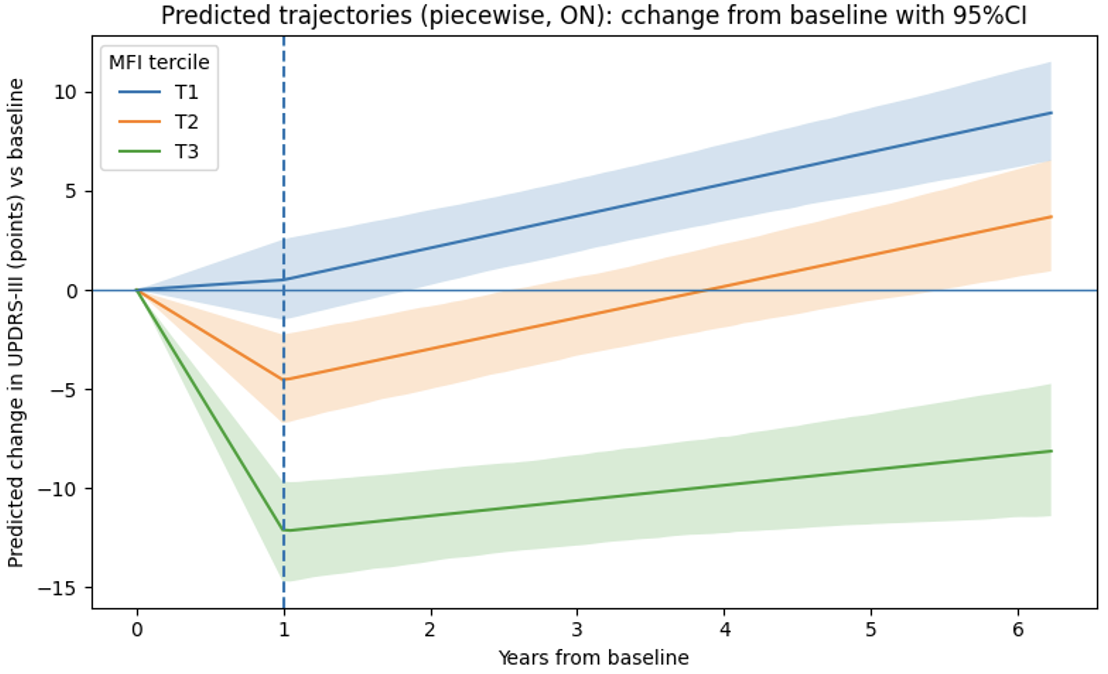
Predicted trajectories
To cite this abstract in AMA style:
O. Esquivel-Zapata, M. Velasco -Delgado, A. Beltrán-Torres, N. Sánchez-Lorenzo, C. Abad-Tinajero, D. Nafate-Wences, A. Cervantes-Arriaga, M. Rodríguez-Violante. Motor Frailty Index (MFI) as an Early Predictor of Functional Progression in Parkinson’s Disease: A Longitudinal Analysis [abstract]. Mov Disord. 2026; 41 (suppl 1). https://www.mdsabstracts.org/abstract/motor-frailty-index-mfi-as-an-early-predictor-of-functional-progression-in-parkinsons-disease-a-longitudinal-analysis/. Accessed October 1, 2026.« Back to 2026 International Congress
MDS Abstracts - https://www.mdsabstracts.org/abstract/motor-frailty-index-mfi-as-an-early-predictor-of-functional-progression-in-parkinsons-disease-a-longitudinal-analysis/