
Category: Parkinson's Disease: Surgical Therapy
Objective: To systematically compare the long-term efficacy, durability, and safety profiles of unilateral magnetic resonance-guided focused ultrasound (MRgFUS) thalamotomy versus deep brain stimulation (DBS) in patients with medication-resistant Parkinson’s disease (TDPD).
Background: MRgFUS of the ventral intermediate nucleus is an incision-free alternative to DBS for refractory TDPD. A comparative analysis of the safety trade-off between hardware risks (DBS) and irreversible lesion deficits (MRgFUS), as well as long-term durability, is required to optimize patient selection [1].
Method: We did a systematic review and network meta-analysis of controlled trials and observational cohorts from 2017 to 2025 to compare VIM-MRgFUS with VIM-, subthalamic nucleus (STN)-, or globus pallidus (GPi)-DBS in TDPD. For inclusion, there had to be clinically confirmed TDPD diagnoses, standardized outcome measures (CRST or MDS-UPDRS-III), and at least 6 months of follow-up. The primary outcomes were the extent of tremor suppression, durability exceeding 12 months, and the characterization of adverse event (AE) phenotypes. When appropriate, the cumulative ranking (SUCRA) was used to rank the interventions statistically. (see Figure 1).
Results: Data from 34 trials involving over 800 patients indicated no significant difference in unilateral tremor suppression. Direct comparisons indicated comparable reductions in treated hemibody tremor (DBS: 62.4% vs MRgFUS: 69.4%) [3]. Bilateral DBS better managed axial symptoms. A 5-year follow-up showed that 73% of MRgFUS patients still felt better [4]. Rescue STN-DBS was successful for late MRgFUS recurrence [6]. [see Table 1]
Conclusion: MRgFUS thalamotomy offers long-lasting tremor suppression on one side, similar to DBS for TDPD, and has a good safety record when it comes to infection and hardware risks. DBS, on the other hand, is still better for managing symptoms on both sides and making adjustments. MRgFUS is a strong choice for some patients, but because it can cause permanent problems with walking or feeling and may come back later, doctors should be very careful when talking to patients about the long-term effects of the disease (see Figure 1).
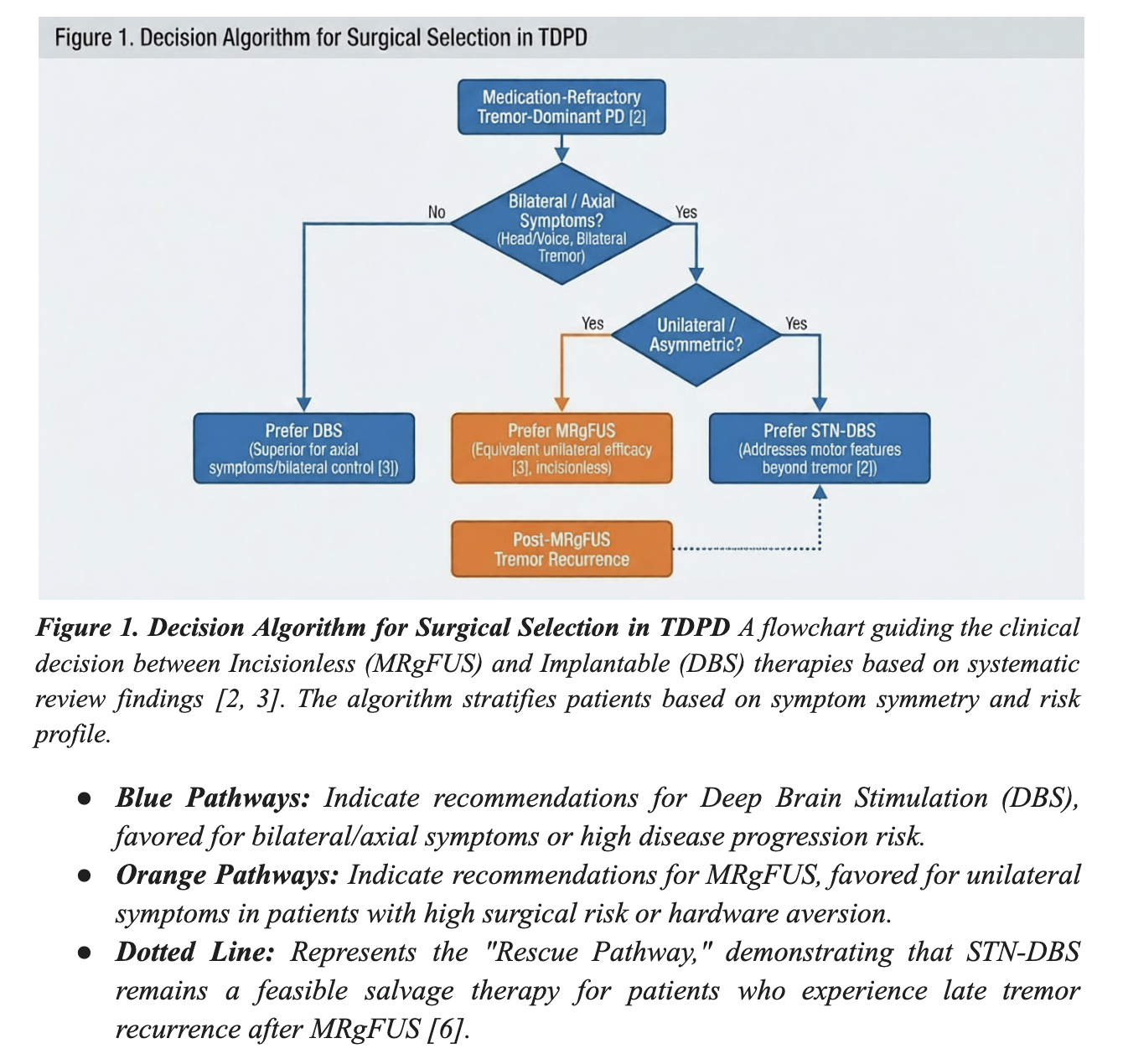
At end of Methods and Conclusion sections
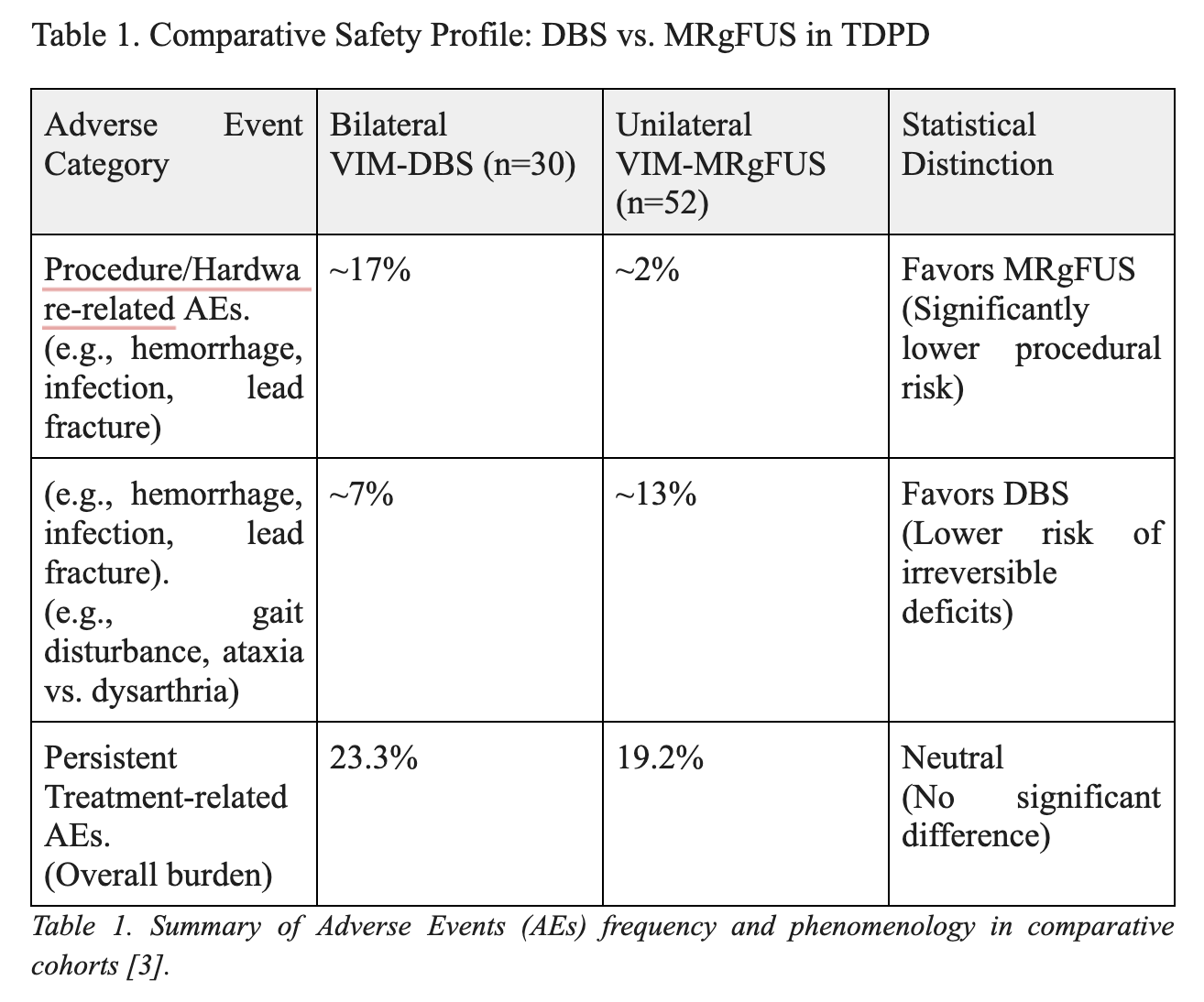
At end of result section
References: [1] Bond AE, Shah BB, Huss DS, et al. Safety and Efficacy of Focused Ultrasound Thalamotomy for Patients With Medication-Refractory, Tremor-Dominant Parkinson Disease: A
Randomized Clinical Trial. JAMA Neurol. 2017;74(12):1412-1418.
[2] Lin F, Wu D, Yu J, et al. Comparison of efficacy of deep brain stimulation and focused ultrasound in parkinsonian tremor: a systematic review and network meta-analysis. J Neurol Neurosurg Psychiatry. 2021;92(4):434-443.
[3] Baumann CR, Fleisch A, Mahendran S, et al. Thalamic Deep Brain Stimulation Versus Magnetic Resonance-Guided Focused Ultrasound in Tremor Patients: A Retrospective Single-Surgeon Comparison. Mov Disord. 2025;40(5).
[4] Sinai A, Nassar M, Sprecher E, et al. Focused Ultrasound Thalamotomy in Tremor Dominant Parkinson’s Disease: Long-Term Results. J Parkinsons Dis. 2022;12(1):199-206.
[5] Peters J, Maamary J, Kyle K, et al. Unilateral focused ultrasound thalamotomy for tremor-dominant Parkinson’s disease: blinded evaluation and imaging correlation. Brain Commun. 2025;7(4):fcaf303.
[6] Maamary J, Peters J, Kyle K, et al. Effective Subthalamic Nucleus Deep Brain Stimulation Following MRgFUS for Tremor Dominant Parkinson’s Disease. Mov Disord Clin Pract. 2023;10(3):486-492.
To cite this abstract in AMA style:
A. Al-Zaidi, F. Al-Zaidi, Z. Hussein. Incisionless versus Implantable: A Comparative Systematic Review of Magnetic Resonance-Guided Focused Ultrasound (MRgFUS) Thalamotomy versus Deep Brain Stimulation in Tremor-Dominant Parkinson’s Disease: Long-Term Durability and Safety Outcomes [abstract]. Mov Disord. 2026; 41 (suppl 1). https://www.mdsabstracts.org/abstract/incisionless-versus-implantable-a-comparative-systematic-review-of-magnetic-resonance-guided-focused-ultrasound-mrgfus-thalamotomy-versus-deep-brain-stimulation-in-tremor-dominant-parkinson/. Accessed October 1, 2026.« Back to 2026 International Congress
MDS Abstracts - https://www.mdsabstracts.org/abstract/incisionless-versus-implantable-a-comparative-systematic-review-of-magnetic-resonance-guided-focused-ultrasound-mrgfus-thalamotomy-versus-deep-brain-stimulation-in-tremor-dominant-parkinson/