
Category: Tremor
Objective: To present a post-stroke pontine bleed patient who developed a rare movement disorder with a treatment approach.
Background: A 43-year-old male presented with involuntary movement of the head, doubling of vision, and incoordination of movements on the left side for 6 months. On physical examination, the patient was noted to have pendular nystagmus synchronous with palatal tremor, left-sided dysmetria and dysdiadokinesia, and truncal ataxia. A cranial MRI was done, revealing enlargement of the inferior olivary nucleus on the left and chronic pontine bleed [figure1]. A definitive diagnosis of hypertrophic olivary degeneration with symptomatic palatal tremor secondary to pontine hemorrhage was made and maintained on clonazepam 0.5 mg and propranolol 30 mg per day. Improvement of cerebellar signs was noted after 2 weeks; however, palatal tremors persisted.
Method: This study described a single patient diagnosed with unilateral pendular nystagmus and palatal tremor managed at our institution. Clinical data were obtained from the patient following informed consent.
Results: Initial neuroimaging with computed tomography demonstrated a pontine intracranial hemorrhage measuring approximately 5 cc. Follow-up magnetic resonance imaging revealed hypertrophy of the left inferior olivary nucleus consistent with hypertrophic olivary degeneration, along with chronic changes from the previous pontine bleed.
On examination, the patient presented with cerebellar signs on the left with pendular nystagmus, head tremors, and ataxia. In primary gaze, the right eye remained at midline while the left eye was deviated laterally. Rhythmic palatal movements were observed and occurred synchronously with the pendular nystagmus, consistent with palatal tremor. Treatment with Clonazepam (0.5 mg) and Propranolol (30 mg/day) resulted in partial improvement of cerebellar signs after two weeks; however, palatal tremor persisted.
Conclusion: Oculo-palatal tremors are a rare movement disorder with stroke as one of the most common etiologies. It usually resolves spontaneously, but interventions are necessary, particularly if it impairs activities of daily living. The primary goal of treatment is addressing the etiology, with symptomatic treatment as a secondary goal.
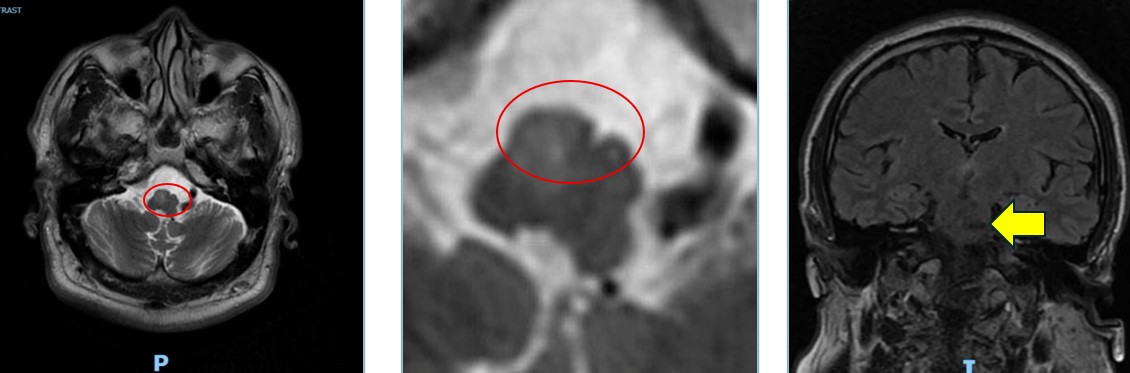
Figure 1. Cranial MRI
To cite this abstract in AMA style:
J. Cruz, J. Ong, C. Diesta, P. Cataniag. Synchronous Unilateral Pendular Nystagmus and Palatal Myoclonus After Pontine Hemorrhage: A Case Report [abstract]. Mov Disord. 2026; 41 (suppl 1). https://www.mdsabstracts.org/abstract/synchronous-unilateral-pendular-nystagmus-and-palatal-myoclonus-after-pontine-hemorrhage-a-case-report/. Accessed October 1, 2026.« Back to 2026 International Congress
MDS Abstracts - https://www.mdsabstracts.org/abstract/synchronous-unilateral-pendular-nystagmus-and-palatal-myoclonus-after-pontine-hemorrhage-a-case-report/