
Objective: We performed a population-based retrospective cohort study to investigate the association between long-term exposure to ambient air pollutants and the development of Parkinson’s disease (PD) in the metropolitan area of Taranto (South Italy).
Background: Environmental exposures are increasingly recognized as potential contributors to neurodegenerative diseases: among them, air pollution has been proposed as a risk factor for PD [1,2].
Method: Individual-level exposure to air pollutants was estimated over a 10-year observation period using environmental monitoring data and geospatial exposure modelling. The study population included 146,050 residents, among whom incident cases of PD were identified through healthcare administrative data. Time-to-event analyses were performed to evaluate the relationship between air pollutant exposure and the timing of PD onset. Specifically, Accelerated Failure Time (AFT) models were applied to estimate Event Time Ratios (ETR), assessing whether exposure was associated with acceleration or delay of disease onset. Multivariable models were adjusted for potential confounders including age, sex, disability status, and socioeconomic indicators such as education and income.
Results: Among 146,050 individuals included in the analysis, 2,060 (1.41%) developed PD during the observation period. Individuals who developed PD were significantly older, more frequently male, and presented higher levels of disability. Mean exposure levels to air pollutants, including nitrogen dioxide (NO₂), particulate matter ≤10 μm (PM10), and particulate matter ≤2.5 μm (PM2.5), were higher among cases [Table 1]. In time-to-event analyses, higher average exposure to PM2.5 was significantly associated with a shorter time to PD onset. In the fully adjusted AFT model, PM2.5 exposure remained independently associated with accelerated disease occurrence (ETR 0.537, 95% CI 0.482–0.599; p < 0.001) [Table 2].
Conclusion: In this large population-based cohort from southern Italy, higher long-term exposure to PM2.5 was independently associated with earlier onset of PD. These findings support the hypothesis that chronic exposure to fine particulate matter may influence the timing of clinical manifestation of PD and highlight the potential role of environmental pollution as a relevant risk factor in their epidemiology.
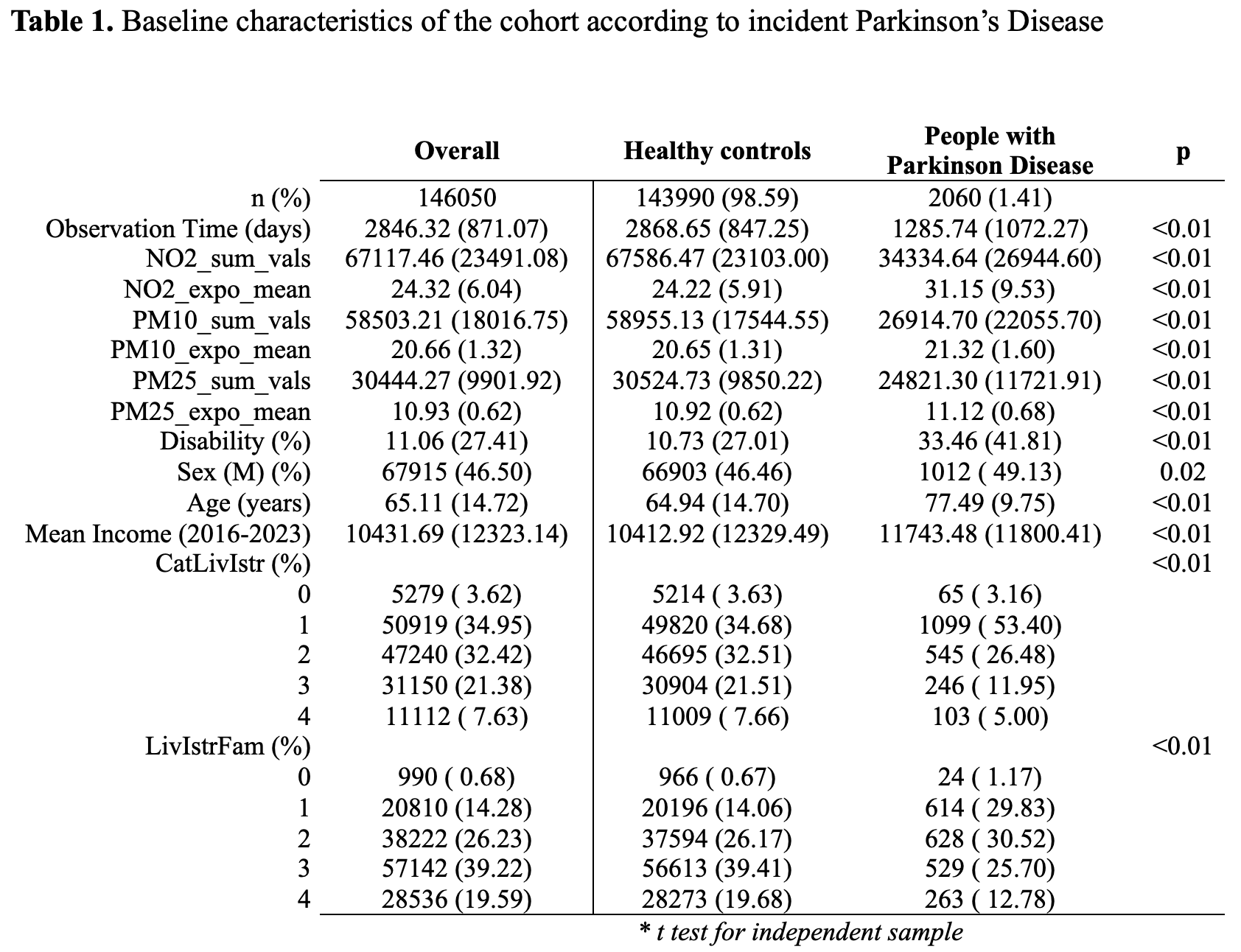
Table 1
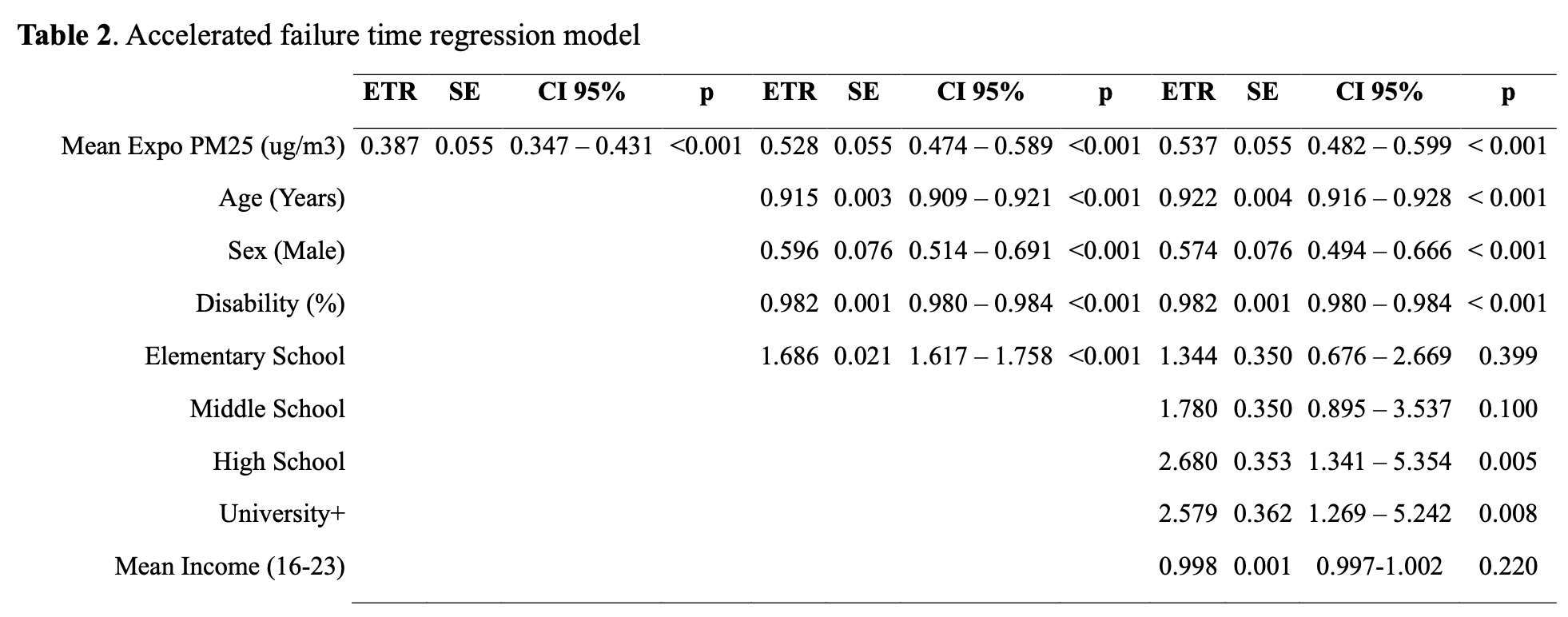
Table 2
References: [1] Murata H, Barnhill LM, Bronstein JM. Air Pollution and the Risk of Parkinson’s Disease: A Review. Mov Disord. 2022 May;37(5):894-904. doi: 10.1002/mds.28922. Epub 2022 Jan 19. PMID: 35043999; PMCID: PMC9119911.
[2] Krzyzanowski B, Mullan AF, Turcano P, Camerucci E, Bower JH, Savica R. Air Pollution and Parkinson Disease in a Population-Based Study. JAMA Netw Open. 2024 Sep 3;7(9):e2433602. doi: 10.1001/jamanetworkopen.2024.33602. PMID: 39283636; PMCID: PMC11406396.
To cite this abstract in AMA style:
C. Santoro, M. Pesare, F. Catino, F. Castellana, N. Pilolli, A. Macerollo, G. Boero, R. Sardone. Long-term exposure to fine particulate matter (PM2.5) is associated with earlier onset of Parkinson’s disease: a retrospective population-based cohort study [abstract]. Mov Disord. 2026; 41 (suppl 1). https://www.mdsabstracts.org/abstract/long-term-exposure-to-fine-particulate-matter-pm2-5-is-associated-with-earlier-onset-of-parkinsons-disease-a-retrospective-population-based-cohort-study/. Accessed October 1, 2026.« Back to 2026 International Congress
MDS Abstracts - https://www.mdsabstracts.org/abstract/long-term-exposure-to-fine-particulate-matter-pm2-5-is-associated-with-earlier-onset-of-parkinsons-disease-a-retrospective-population-based-cohort-study/