
Category: Dystonia (Other)
Objective: To evaluate the utility of AI-assisted decision-making using Spiral Dx for longitudinal monitoring of patients with tremor syndromes.
Background: Spiral Dx is an artificial intelligence (AI) algorithm developed to detect, quantify, and differentiate tremor syndromes from free-hand spiral drawings. Although validated in hospital settings, randomized controlled trials (RCTs) are required to establish its safety and effectiveness in real-world clinical practice. We hypothesize that AI-assisted monitoring using Spiral Dx will be non-inferior to usual clinical monitoring using rating scales in improving quality of life in patients with Essential Tremor (ET) over 1 year.
Method: This pragmatic, multicentric, randomized parallel-group non-inferiority trial with blinded outcome assessment will enroll adults (>18 years) with ET or ET-plus and QUEST-SI >11.25 from movement disorder clinics. Participants will be randomized (1:1) to AI-assisted monitoring (AM) or usual monitoring (UM) using computer-generated, stratified block randomization with concealed allocation. All patients will continue neurologist-directed treatment and be followed at 3, 6, 9, and 12 months. At each visit, spiral drawings will be analyzed by Spiral Dx and tremor severity assessed using FTM-TRS. In the AM arm, clinicians will receive the Spiral Dx score to guide therapy, while in the UM arm, management will rely on FTM-TRS. Based on a minimal clinically important difference of 4.47 in QUEST, a non-inferiority margin of 4.5, SD 19.2, 80% power, and α=0.05, 452 participants are required; accounting for 10% attrition, 500 participants will be recruited across six centres. Data will be securely stored in REDCap at the All India Institute of Medical Sciences, New Delhi.
Results: The primary outcome is tremor-related quality of life (QUEST-SI) at 12 months. Secondary outcomes include QUEST subdomains, patient and clinician global impression of change, patient satisfaction, time for assessments, medication changes, adverse events, and correlations between Spiral Dx scores and FTM-TRS and QUEST indices.
Conclusion: This study aims to validate a clinically deployable AI system that analyzes hand-drawn spirals to objectively assess tremor severity and support real-world clinical decision-making.
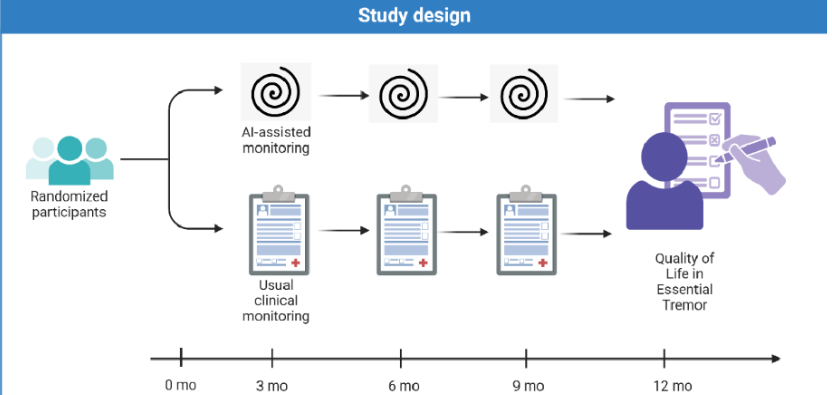
Figure 1
References: 1. https://www.zotero.org/google-docs/?ZSQveS
2. https://www.zotero.org/google-docs/?mXurTq
3. Anandapadmanabhan R, Vishnoi A, Raman G, Thachan J, Gangaraju BA, Radhakrishnan D, Vishnu VY, Kamble N, Holla V, James P, Srivastava A, Joshi D, Mahabal A, Krishnan S, Kumar Pal P, Rajan R. Deep Learning-Based Artificial Intelligence Algorithm to Classify Tremors from Hand-Drawn Spirals. Mov Disord. 2025 Jun;40(6):1172-1181. doi: 10.1002/mds.30176. Epub 2025 Mar 17. PMID: 40095435.
4. How medical AI devices are evaluated: limitations and recommendations from an analysis of FDA approvals – PubMed [Internet]. [cited 2025 Apr 3]. Available from: https://pubmed.ncbi.nlm.nih.gov/33820998/
To cite this abstract in AMA style:
S. Xxxx, P. Xxxx, A. Hussain, T. Radhakrishnan, A. Reghu, A. Upadhyay, N. Kamble, P. Pal, S. Mehta, H. Kumar, S. Desai, D. Joshi, D. Radhakrishnan, R. Rajan. Spiral Dx: Real-world Evaluation of an Artificial Intelligence aLgorithm for Tremor detection and classification from hand-drawn spIrals [RE-AI-LTI]- Protocol of a randomised control trial [abstract]. Mov Disord. 2026; 41 (suppl 1). https://www.mdsabstracts.org/abstract/spiral-dx-real-world-evaluation-of-an-artificial-intelligence-algorithm-for-tremor-detection-and-classification-from-hand-drawn-spirals-re-ai-lti-protocol-of-a-randomised-control-trial/. Accessed October 1, 2026.« Back to 2026 International Congress
MDS Abstracts - https://www.mdsabstracts.org/abstract/spiral-dx-real-world-evaluation-of-an-artificial-intelligence-algorithm-for-tremor-detection-and-classification-from-hand-drawn-spirals-re-ai-lti-protocol-of-a-randomised-control-trial/