
Category: Parkinson’s Disease: Clinical Trials
Objective: To assess the effects of opicapone (OPC: 50 mg, once-daily) on sleep in patients with Parkinson’s disease (PD) and motor fluctuations.
Background: OPC is approved as an adjunctive treatment to levodopa/carbidopa (LD/CD) in patients with PD experiencing OFF-episodes. Nighttime OFF-episodes can contribute to sleep impairment, which is a common and poorly addressed problem in patients with PD. Prior analyses of data from two Phase 3 studies (BIPARK-1, BIPARK-2) indicated that OPC 50 mg decreased the cumulative duration of OFF-episodes during sleep, thereby providing a rationale for assessing its potential effects on sleep.
Method: Participants received 14-15 weeks of once-daily OPC or placebo (PBO) added to their current LD/CD regimen. Descriptive analyses at baseline and end of treatment (Wk14/15) were conducted on the pooled Phase 3 study population in participants who had ≥1 awakening after falling asleep, based on 24-hour patient diaries. Outcomes included: number of times that participants awoke after sleep onset in an OFF-episode, total wake time after sleep onset (WASO), and percent of sleep time spent awake.
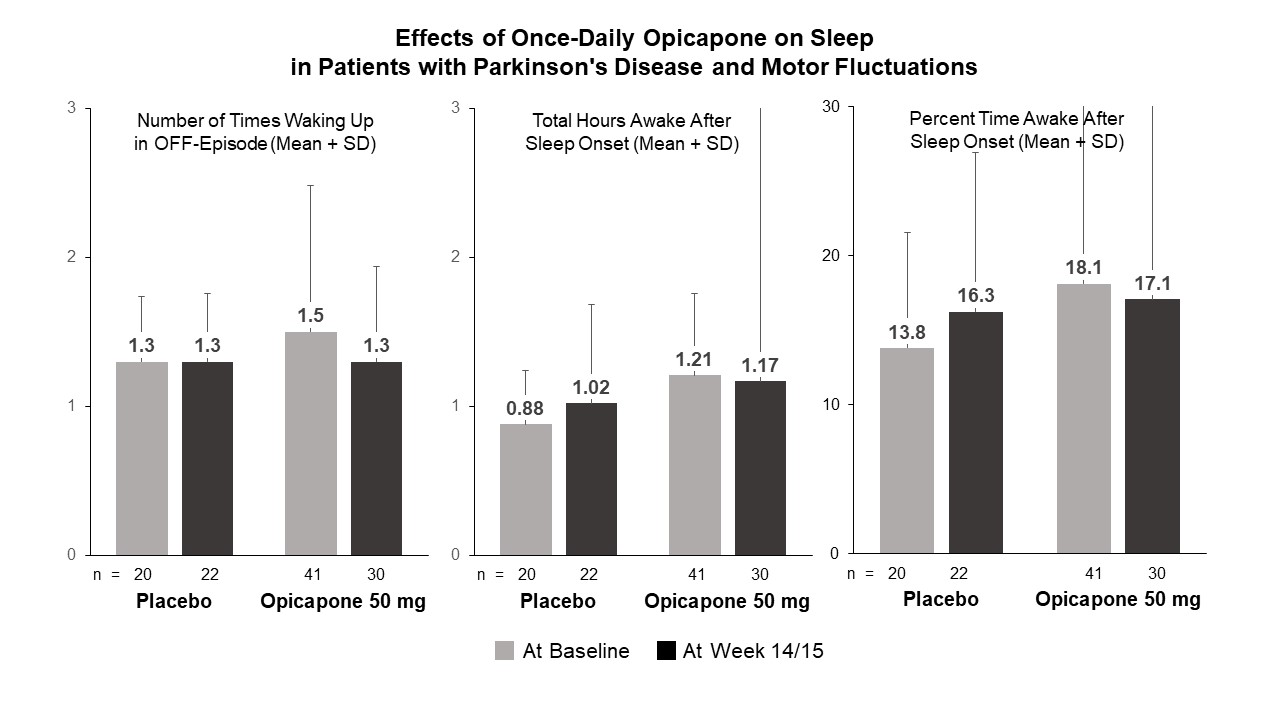
Results: At baseline in the pooled population (PBO, n=257; OPC, n=265), 14.8% (77/522) woke up after sleep onset and 79.2% (61/77) of these participants woke up in an OFF-episode. Although the effects were modest, the mean number of times that participants woke up in an OFF-episode was lower at Wk14/15 than at baseline for OPC, but not PBO [Figure]. The mean total amount of time and percentage of time that participants were awake (WASO duration) also suggested improved outcomes with OPC [Figure].
Conclusion: In this pooled analysis of patients with PD and OFF-episodes from BIPARK-1/BIPARK-2, a majority of those with ≥1 awakening after falling asleep were experiencing an OFF-episode. The addition of once-daily OPC 50 mg to LD/CD decreased the frequency of awakenings and WASO duration, although the effects were modest and limited by small sample sizes. More research is needed to better understand the effects of OPC on sleep in patients with PD who are experiencing motor fluctuations.
To cite this abstract in AMA style:
R. Hauser, A. Videnovic, P. Soares-da-Silva, G. Liang, K. Olson, E. Jen, JF. Rocha, O. Klepitskaya. Effects of Opicapone on Sleep in Patients with Parkinson’s Disease and Motor Fluctuations [abstract]. Mov Disord. 2021; 36 (suppl 1). https://www.mdsabstracts.org/abstract/effects-of-opicapone-on-sleep-in-patients-with-parkinsons-disease-and-motor-fluctuations/. Accessed October 3, 2026.« Back to MDS Virtual Congress 2021
MDS Abstracts - https://www.mdsabstracts.org/abstract/effects-of-opicapone-on-sleep-in-patients-with-parkinsons-disease-and-motor-fluctuations/