
Category: Parkinsonism, Atypical: PSP, CBD
Objective: This retrospective study aims to characterize the natural history of PSP and to find predictors of shorter survival and faster decline of activity of daily living.
Background: Progressive Supranuclear Palsy (PSP) is a rare movement disorder with poor prognosis. This retrospective study aims to characterize the natural history of PSP and to find predictors of shorter survival and faster decline of activity of daily living.
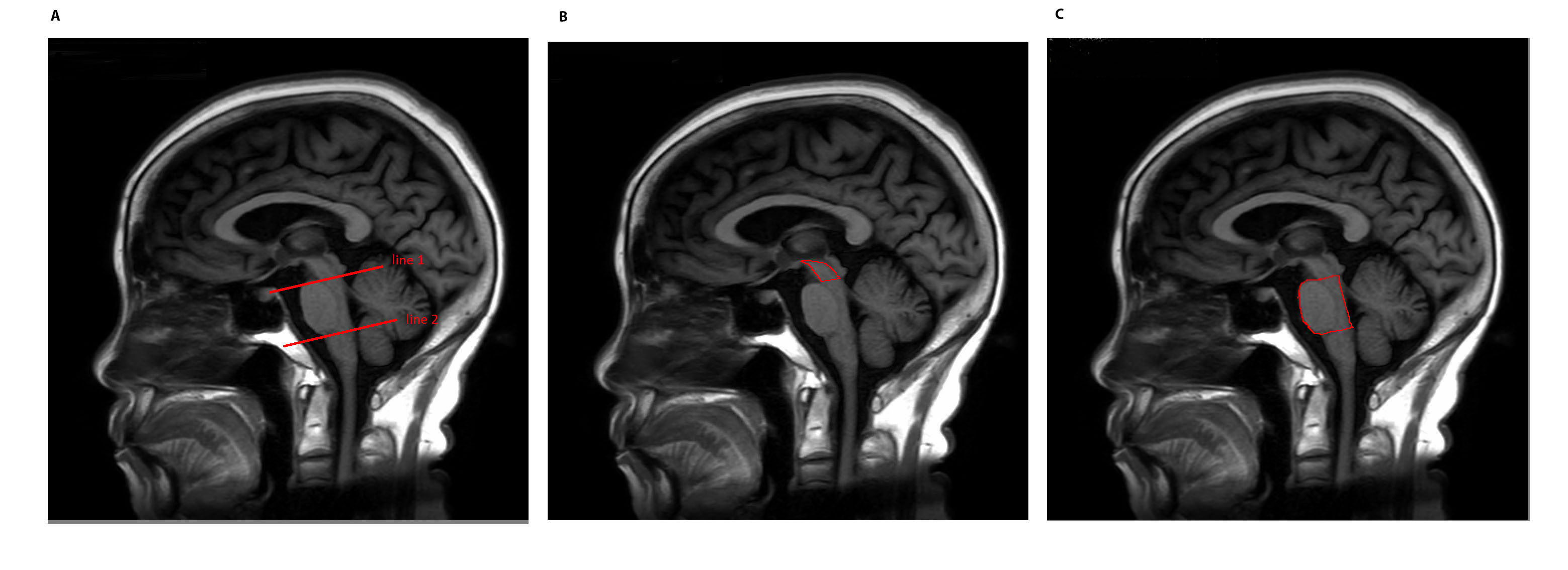
Method: All patients recruited fulfilled the movement disorder society (MDS) clinical diagnostic criteria for PSP (MDS-PSP criteria) for probable and possible PSP with median 12 years. Data were obtained including age, gender, date of onset, age at onset (AAO), interval from onset to brain MRI, side of onset, symptoms reported at first visit and follow-up, date of death and date of institutionalization. Magnetic resonance imaging was collected at the first visit and midbrain/pons (M/P) area ratio was performed on midsagittal TI-weighted MRI with Mricro (Figure 1). Endpoints were death and institutionalization. Kaplan-Meier method and Cox proportional hazard model were used to explore factors associated with early death and institutionalization.
Results: 59 patients fulfilling MDS-PSP criteria were enrolled in our study. 19 patients (32.2%) had died and 31 patients (52.5%) were institutionalizedl by the end of the follow-up. In K-M methods, patients with early falls, early bulbar palsy, early apathy and early incontinence showed shorter survival time (log-rank: p=0.032, p=0.013, p=0.018, p=0.001) compared to patients without this feature within 3 years, while patients with early bulbar palsy, early apathy, early incontinence showed shorter time from onset to institutionalization (p=0.016, p=0.027, p=0,003).In Cox proportional hazard model, predictors associated with poorer survival were late-onset PSP (OR=2.087, p=0.016) and decreased M/P area ratio (OR=0.808, P=0.005), while predictors associated with earlier institutionalization were older AAO (OR=1.476, p=0.004) and decreased M/P area ratio(OR=0.925, P=0.046).
Conclusion: Older AAO and decreased M/P area ratio were predictors for earlier dearth and institutionalization in PSP. The neuroimaging biomarker M/P area ratio was a predictor for prognosis in PSP.
To cite this abstract in AMA style:
S-S. Cui, Y-Y. Tan, S.D Chen. Midbrain/pons area ratio and clinical features predict the prognosis of Progressive Supranuclear Palsy [abstract]. Mov Disord. 2020; 35 (suppl 1). https://www.mdsabstracts.org/abstract/midbrain-pons-area-ratio-and-clinical-features-predict-the-prognosis-of-progressive-supranuclear-palsy/. Accessed October 6, 2026.« Back to MDS Virtual Congress 2020
MDS Abstracts - https://www.mdsabstracts.org/abstract/midbrain-pons-area-ratio-and-clinical-features-predict-the-prognosis-of-progressive-supranuclear-palsy/