
Session Information
Date: Tuesday, June 6, 2017
Session Title: Technology
Session Time: 1:45pm-3:15pm
Location: Exhibit Hall C
Objective: To demonstrate that PD patients can be clustered based on their performance on smartphone-enabled active tests.
Background: Treatment decisions of PD require granular information about an individual’s symptom profile and disease severity changes over time. Currently, severity is assessed through subjective, episodic rating scales performed primarily in clinic. New tools are needed to enable high frequency assessments out of clinic that add insight into the relationships in PD progression between similar patients.
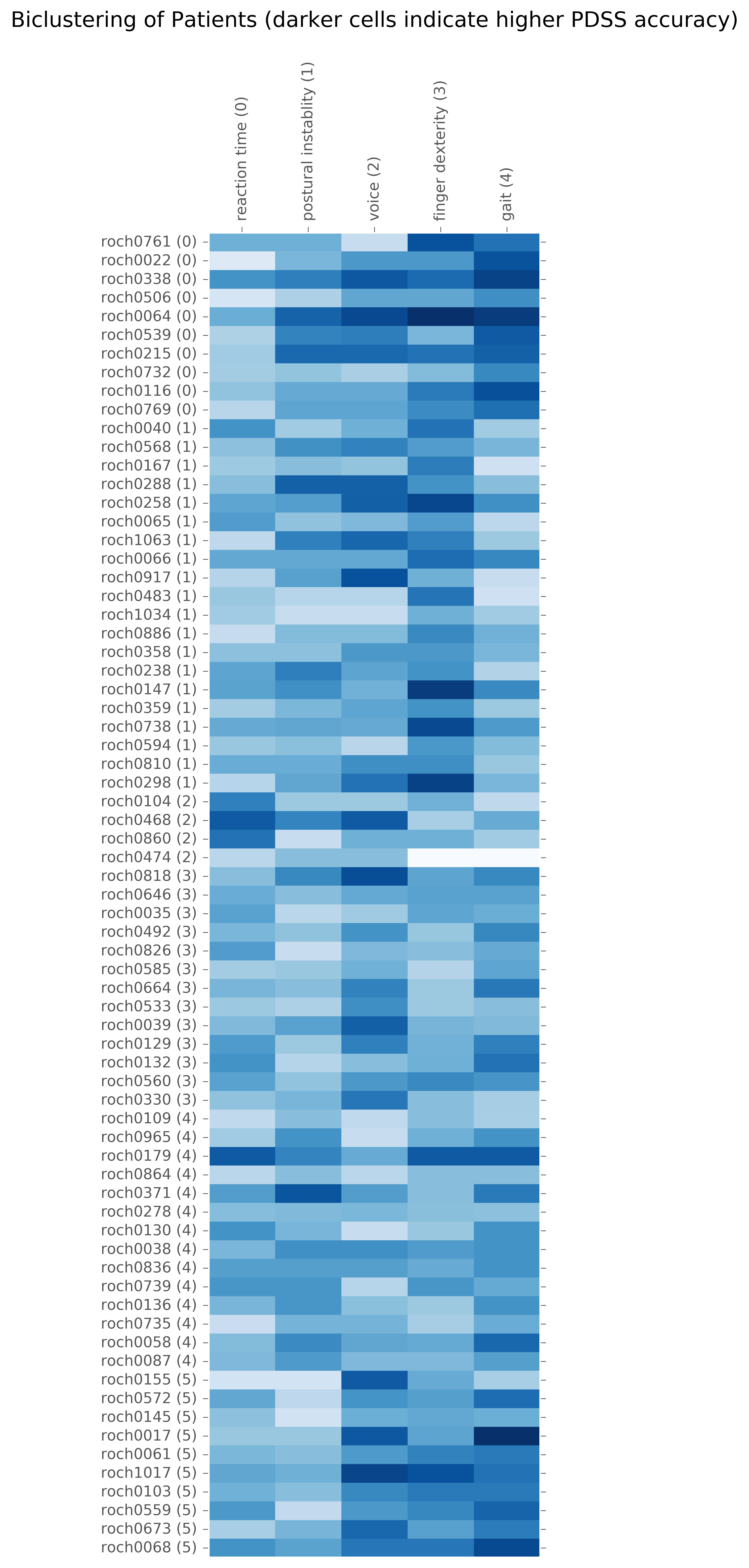
Methods: Using the HopkinsPD app [1], 71 individuals on medication record measurements from 5,800 self-administered active tests in pairs — right before and within one hour after their first dose — to measure aspects of motor function such as gait, voice, dexterity, and reaction time. A novel machine learning algorithm for disease severity score learning (DSSL) [2] is used to train five models that map this vector of measurements to a scalar severity score, the PDSS. The algorithm assumes that the severity ordering, before and after medication, is correct in the majority of training examples provided. Model accuracy is defined as the ratio of active tests in which PDSS decreases after the first dose. A biclustering algorithm is used to cluster patients on their accuracy across the 5 active tests. Common in gene expression profiling, it permutes the rows and columns of a matrix such that rows with similar characteristics across a subset of columns are grouped together.
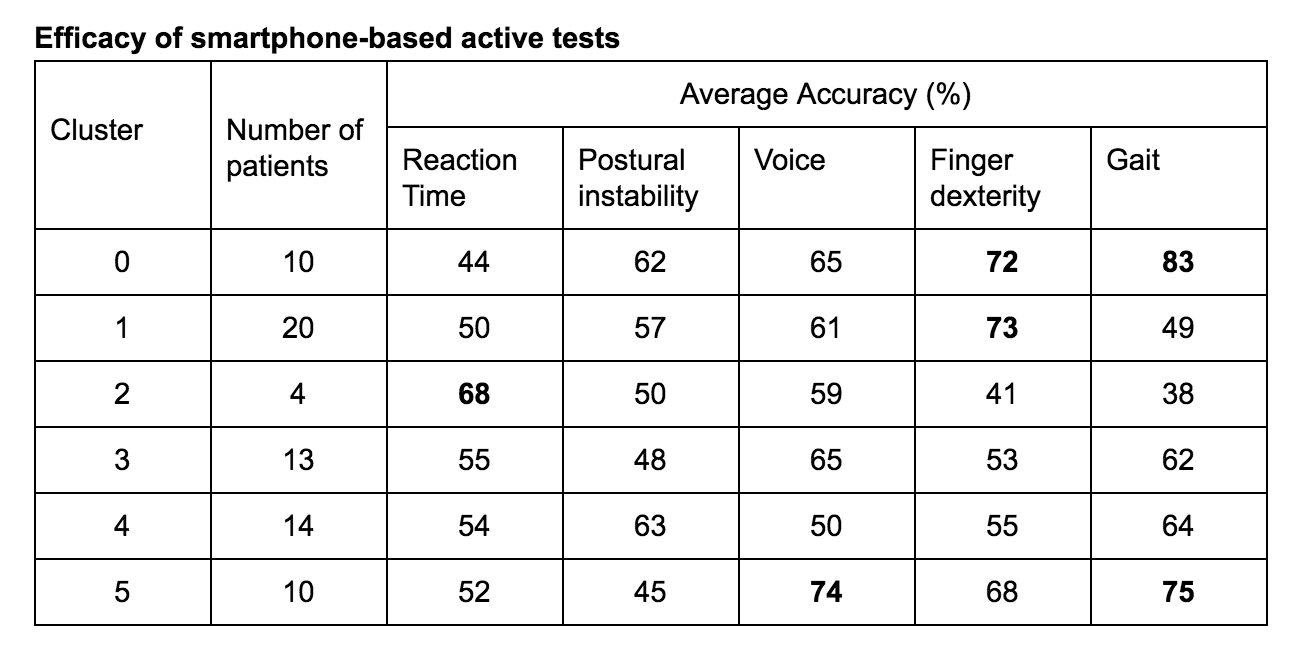
Results: Shown in Table 1 and Figure 1, 71 patients were clustered into six different groups based on their performance across the 5 smartphone-enabled tests. The darker the region, the more effective PDSS was in detecting motor fluctuation for that patient. While we notice individuals for whom all tests were effective (roch0338), there are others for whom none were (roch1034). Moreover, relationships exist at an intra-cluster level as well. Patients from Cluster 0 show strong severity fluctuation on both the finger dexterity and gait tests. Those from Cluster 5, however, experience strong severity fluctuation on the voice and gait tests instead.
[table1]
[figure1]
Conclusions: That 6 unique clusters account for patient performance across the 5 tests is promising. Exploration of the relationships between intra-cluster PDSS trends will allow clinicians to study tailored treatment regimens on distinct subgroups of the population
References: [1] A. Zhan, MA Little, DA Harris, SO Abiola, E Dorsey, S. Saria, and A. Terzis, “High Frequency Remote Monitoring of Parkinson’s Disease via Smartphone: Platform Overview and Medication Response Detection”, arXiv preprint arXiv:1601.00960, 2016.
[2] D. Kirill, and S. Saria. “Learning (predictive) risk scores in the presence of censoring due to interventions.” Machine Learning 102.3 (2016): 323-348.
To cite this abstract in AMA style:
A. Zhan, S. Mohan, M. Elson, E. Dorsey, A. Terzis, S. Saria. Patient Clustering through a Mobile-based PD Severity Score [abstract]. Mov Disord. 2017; 32 (suppl 2). https://www.mdsabstracts.org/abstract/patient-clustering-through-a-mobile-based-pd-severity-score/. Accessed October 20, 2026.« Back to 2017 International Congress
MDS Abstracts - https://www.mdsabstracts.org/abstract/patient-clustering-through-a-mobile-based-pd-severity-score/