
Session Information
Date: Wednesday, June 7, 2017
Session Title: Parkinson's Disease: Psychiatric Manifestations
Session Time: 1:15pm-2:45pm
Location: Exhibit Hall C
Objective: Our goal was to examine the relationship between suicidality and motor fluctuations in Parkinson’s disease (PD) patients.
Background: On/off motor fluctuations in PD are an inevitable consequence of dopaminergic therapy and can be associated with mood fluctuations, including severe dysphoria. These affective symptoms may be overlooked in the treatment of motor fluctuations.
Methods: We analyzed data from the Methods of Optimal Depression Detection in Parkinson’s Disease (MOOD-PD) study of 223 individuals with PD recruited from three community-based movement disorder clinics. Subjects were asked to report if they experienced motor fluctuations and, if yes, if they had received treatment for these motor fluctuations. Suicidality was measured using items from three clinician-rated depression scales: the Hamilton Depression Rating Scale (HAM-D-17); the Montgomery-Åsberg Depression Rating Scale (MADRS); and the Inventory for Depressive Symptomatology (IDS-C). Multivariate Poisson regression analyses tested whether self-reported motor fluctuations and their treatment status were associated with suicidality while controlling for recognized risk factors.
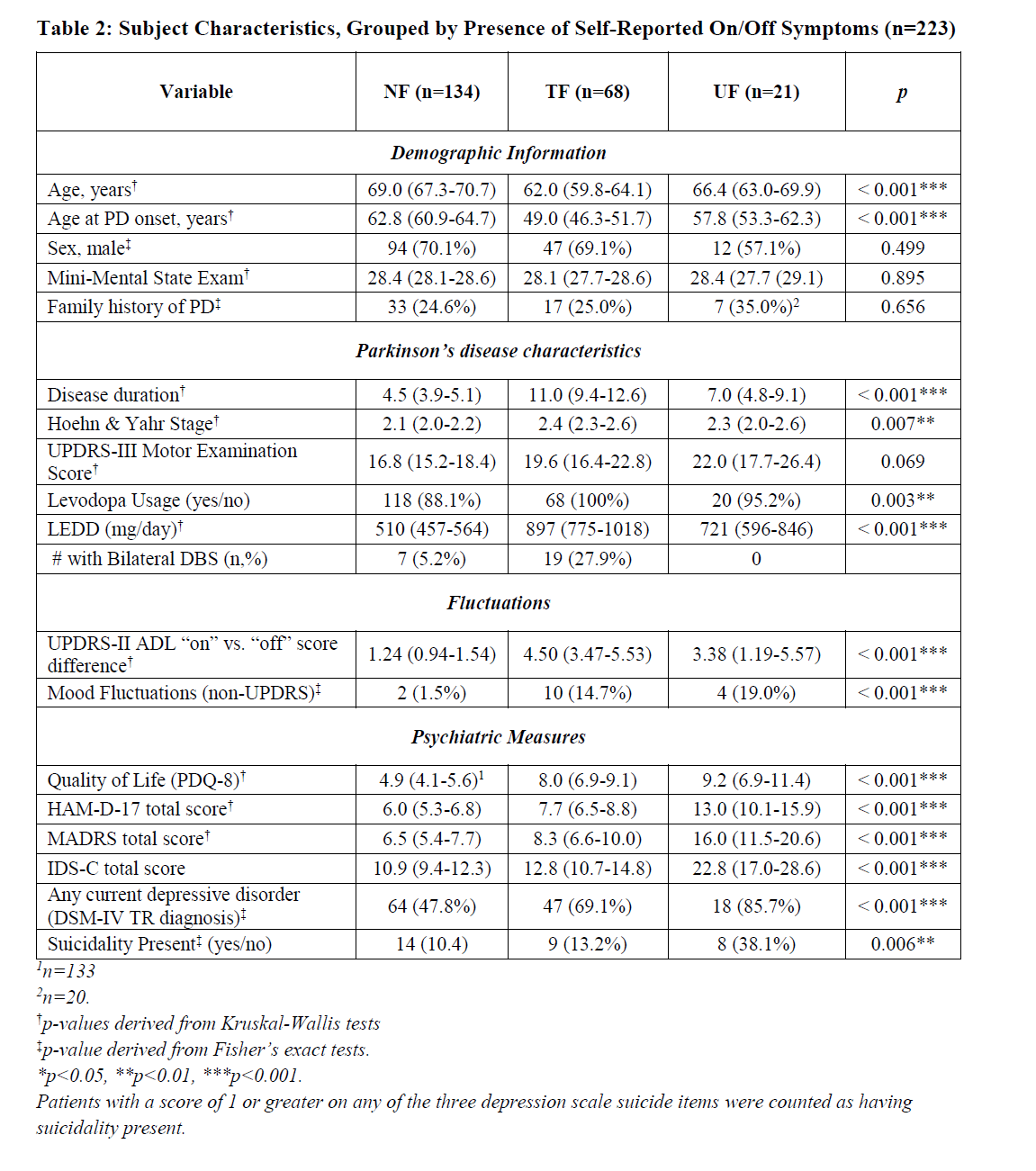
Results: Thirty-one patients (13.9%) reported suicidal thoughts and 89 (39.5%) self-reported motor fluctuations, of whom 21 (23.6%) perceived their fluctuations as untreated. Patients with untreated motor fluctuations more frequently had a current depressive disorder (p < 0.001) and endorsed suicidality (p = 0.006) than patients with treated or no motor fluctuations. They also had significantly higher total scores on the HAM-D-17, MADRS, and IDS-C depression scales (p < 0.001 for each). Regression analyses showed significant associations between untreated motor fluctuations and higher scores on each suicide question extracted from the HAM-D-17, MADRS, and IDS-C (p < 0.05 for each).
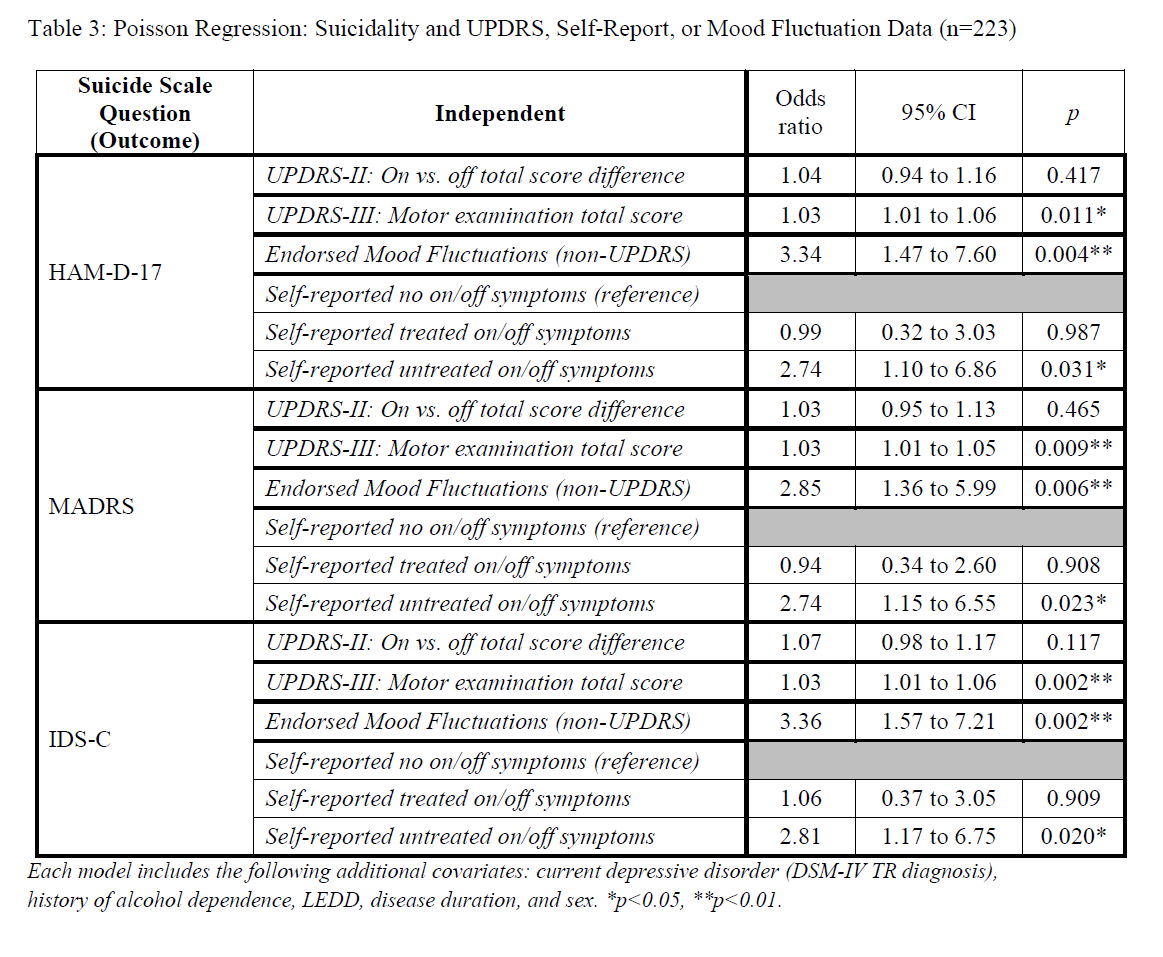
Conclusions: Suicidal thoughts may be more likely in PD patients who recognize motor fluctuations but have not received treatment for them. Our findings underscore the importance of inquiring about mood changes once a patient begins to experience motor fluctuations.
To cite this abstract in AMA style:
J. Hinkle, K. Perepezko, Z. Mari, L. Marsh, G. Pontone. Perceptions of Fluctuation Treatment in Parkinson’s Disease Impact Suicidality [abstract]. Mov Disord. 2017; 32 (suppl 2). https://www.mdsabstracts.org/abstract/perceptions-of-fluctuation-treatment-in-parkinsons-disease-impact-suicidality/. Accessed October 15, 2026.« Back to 2017 International Congress
MDS Abstracts - https://www.mdsabstracts.org/abstract/perceptions-of-fluctuation-treatment-in-parkinsons-disease-impact-suicidality/