
Category: Parkinson's Disease: Neuroimaging
Objective: We aimed to evaluate the influence of cortical thickness (CT) and white matter lesions (WML) on working memory training (WMT) success in cognitively unimpaired patients with Parkinson’s Disease (PD).
Background: Patients with PD are highly vulnerable for cognitive decline [1]. Thus, early intervention may be crucial for long-term preservation of cognition. While prediction of training responsiveness is important for tailored treatment [2], the influence of structural brain properties, i.e. CT and WML, on WMT success has not been studied.
Method: Behavioural and structural imaging (T1, FLAIR) data of 46 patients with PD, 21 of which engaged in home-based adaptive WMT, were analysed. The relationships of demographic and disease-related measures with CT and WML (number and volume of lesions) were estimated. For the intervention group, the effect of CT and WML on training success was investigated.
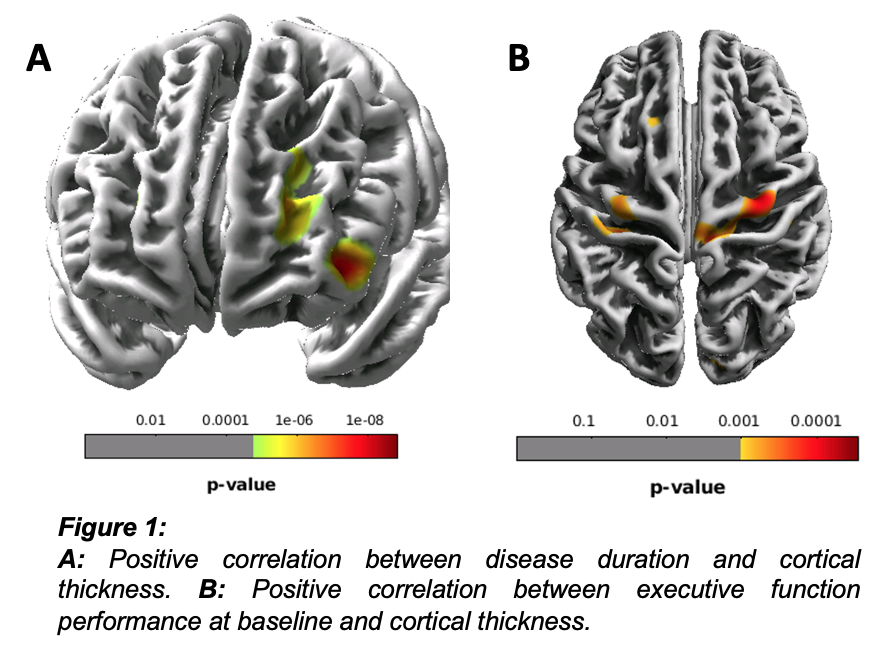
Results: Generally, increasing age had a negative effect on the brain indicated by more WML and less CT, while sex had an effect on CT in the right frontal cortex only (CT in females > males). Interestingly, when corrected for age and sex, disease duration was positively correlated with CT in right middle frontal gyrus [figure 1A]. For cognition, better executive function performance at baseline was associated with greater CT in pre-central gyrus [figure 1B]. However, CT and WML did not influence any other measure, nor the performance increase due to WMT.
Conclusion: While structural brain properties might influence cognitive performance at baseline, they do not seem to determine WMT success in this cohort.
References: [1] Aarsland D, Creese B, Politis M, Chaudhuri KR, Ffytche DH, Weintraub D, Ballard C. Cognitive decline in Parkinson disease. Nature Reviews Neurology. 2017 Apr;13(4):217-31.
[2] Ophey A, Rehberg S, Giehl K, Eggers C, Reker P, van Eimeren T, Kalbe E. Predicting working memory training responsiveness in Parkinson’s disease: both “System Hardware” and room for improvement are needed. Neurorehabilitation and Neural Repair. 2021 Feb;35(2):117-30.
To cite this abstract in AMA style:
K. Giehl, H. Theis, A. Ophey, J. Hammes, P. Reker, C. Eggers, E. Kalbe, T. van Eimeren. Is working memory training success in Parkinson’s disease determined by cortical thickness and white matter lesions? [abstract]. Mov Disord. 2023; 38 (suppl 1). https://www.mdsabstracts.org/abstract/is-working-memory-training-success-in-parkinsons-disease-determined-by-cortical-thickness-and-white-matter-lesions/. Accessed October 24, 2026.« Back to 2023 International Congress
MDS Abstracts - https://www.mdsabstracts.org/abstract/is-working-memory-training-success-in-parkinsons-disease-determined-by-cortical-thickness-and-white-matter-lesions/