
Objective: To evaluate the effects of istradefylline on motor function and freezing of gait (FOG) in patients with Parkinson’s disease (PD).
Background: FOG is a debilitating symptom in PD that significantly affects mobility and increases fall risk. Istradefylline, an adenosine A2A receptor antagonist, is approved as an adjunct therapy for motor fluctuations in PD, but its specific impact on FOG remains unclear.
Method: A systematic review and meta-analysis were conducted using PubMed to identify randomized controlled trials and clinical studies assessing istradefylline’s effects on FOG. Studies were included if they evaluated PD patients with FOG treated with istradefylline (20–40 mg daily) compared to placebo or other PD medications. Outcomes analyzed included changes in UPDRS Part II (Activities of Daily Living), UPDRS Part III (Motor Examination), and FOG-Q scores. Effect sizes were pooled using a random-effects model, with heterogeneity assessed via I² statistics.
Results: Three studies (PMID: 31039621, 29031781, and 38021343) met the inclusion criteria, with a total of 878 patients [Figure 1]. After one month of istradefylline treatment, UPDRS Part II scores improved from 9.35 ± 5.34 to 8.59 ± 5.71 (mean change: -0.77 ± 0.29), and UPDRS Part III scores improved from 17.46 ± 8.35 to 16.82 ± 8.97 (mean change: -0.64 ± 0.22). Notably, FOG-Q scores showed a more substantial reduction from 11.92 ± 5.51 to 10.70 ± 6.38 (mean change: -1.23 ± 1.13). Adverse events were mild and comparable to placebo, with no significant increase in dyskinesia or psychiatric symptoms.
Conclusion: Istradefylline demonstrated a modest improvement in UPDRS scores and a more pronounced effect on FOG-Q scores, suggesting potential benefits for FOG in PD. These findings highlight the need for more extensive randomized controlled trials to confirm istradefylline’s efficacy in managing gait disturbances in PD patients.
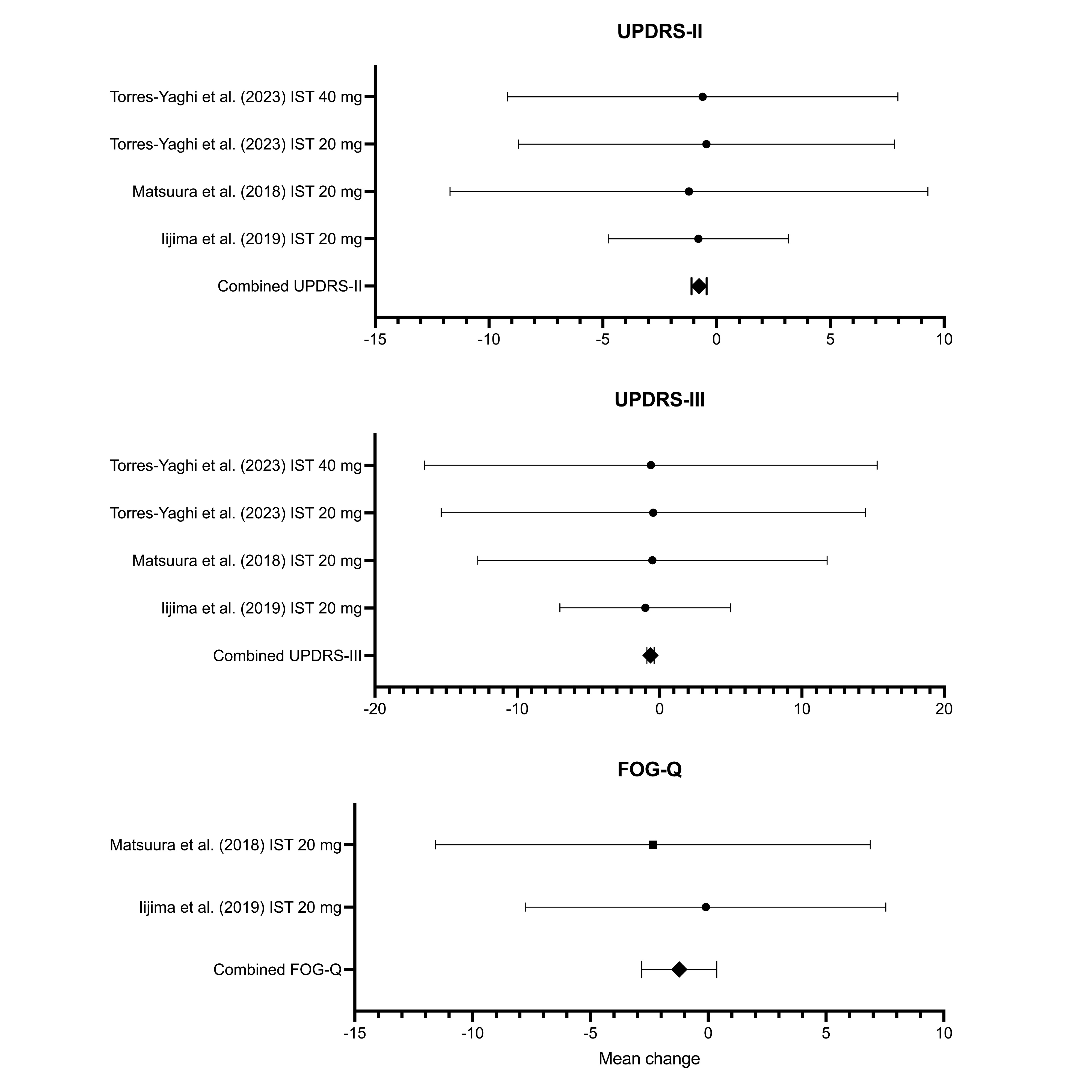
Figure 1
To cite this abstract in AMA style:
A. Fornari Caprara, J. Pitton Rissardo. Istradefylline for Freezing of Gait in Parkinson’s Disease: A Systematic Review and Meta-Analysis [abstract]. Mov Disord. 2025; 40 (suppl 1). https://www.mdsabstracts.org/abstract/istradefylline-for-freezing-of-gait-in-parkinsons-disease-a-systematic-review-and-meta-analysis/. Accessed October 22, 2026.« Back to 2025 International Congress
MDS Abstracts - https://www.mdsabstracts.org/abstract/istradefylline-for-freezing-of-gait-in-parkinsons-disease-a-systematic-review-and-meta-analysis/