
Objective: To identify progression-oriented non-motor symptom subtypes in PD using a probabilistic Subtype and Stage Inference (SuStaIn) model applied to routinely available clinical assessments.
Background: Non-motor symptoms (NMS) are major contributors to disability in Parkinson’s disease (PD) and exhibit substantial inter-individual heterogeneity. However, most previous subtype classifications rely on cross-sectional clustering and do not capture progression structure. Analytical frameworks capable of inferring disease progression from clinically accessible measures are needed.
Method: We analyzed cross-sectional data from 687 patients with idiopathic PD and 316 healthy controls. Motor severity, global non-motor burden, cognition, affective symptoms, and sleep-related measures (UPDRS-III, NMSS, MoCA, MMSE, HAMA, HAMD, ESS, PDSS, RBDQ) were included. All variables were z-score normalized relative to healthy controls. A mixture SuStaIn model was applied to infer subtype-specific probabilistic event sequences and individual disease stages. Model selection was guided by cross-validation information criterion (CVIC) and test-set log-likelihood. Uncertainty in event ordering was estimated using Markov chain Monte Carlo sampling.
Results: A three-subtype solution provided the optimal balance between model fit and interpretability.
Subtype 1 (47.3%) exhibited early sleep abnormalities (RBDQ) followed by motor and affective involvement, with later cognitive decline.
Subtype 2 (29.8%) demonstrated a compact progression pattern, with multiple domains becoming abnormal within a narrow stage range.
Subtype 3 (21.8%) showed early affective symptoms and global non-motor burden preceding sleep and motor worsening.
Healthy controls were predominantly assigned to early inferred stages, whereas advanced stages were primarily observed in PD patients, supporting clinical plausibility. Stage-specific associations with excessive daytime sleepiness differed across subtypes, indicating distinct progression dynamics.
Conclusion: Using only clinically accessible measures, we identified three probabilistic non-motor progression subtypes in PD. Although inferred from cross-sectional data, the robust cross-validation performance and clear stage separation support the stability of this framework. Progression-oriented stratification may facilitate subtype-specific monitoring strategies and future longitudinal validation.
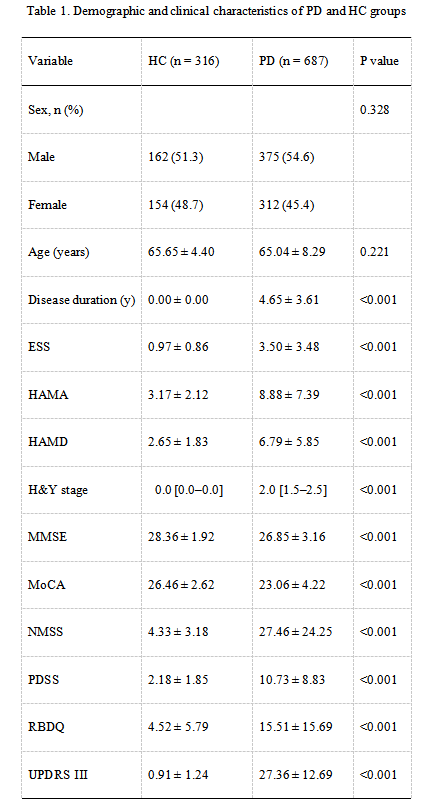
Demographic and clinical characteristics.
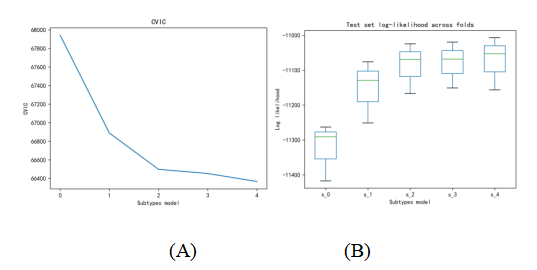
Model selection.
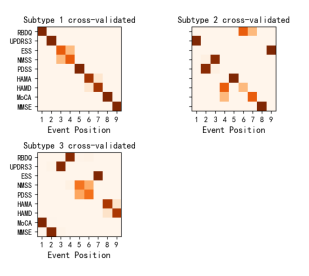
Cross-validated positional density plots.
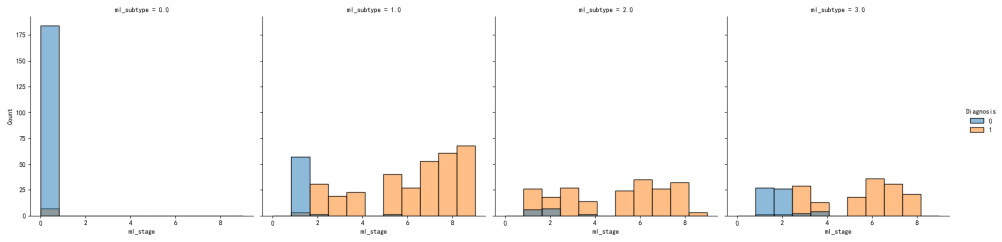
Cross-validated positional density plots.
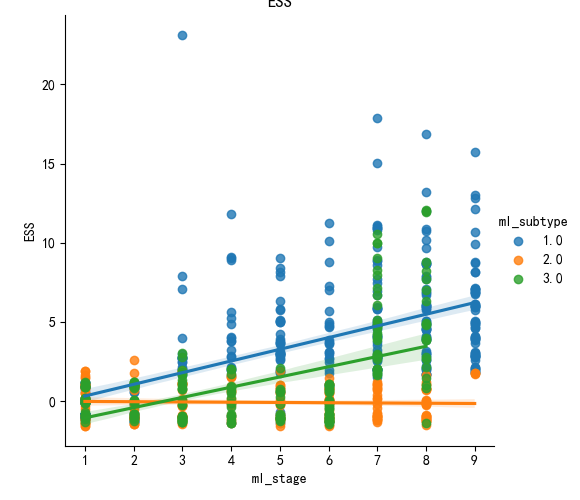
Association.
To cite this abstract in AMA style:
JY. Liu, AQ. Huang, SY. Liu, Z. Ruan, P. Chan. Distinct Non-Motor Symptom Progression Subtypes in Parkinson’s Disease Identified Using a Data-Driven SuStaIn Model [abstract]. Mov Disord. 2026; 41 (suppl 1). https://www.mdsabstracts.org/abstract/distinct-non-motor-symptom-progression-subtypes-in-parkinsons-disease-identified-using-a-data-driven-sustain-model/. Accessed October 1, 2026.« Back to 2026 International Congress
MDS Abstracts - https://www.mdsabstracts.org/abstract/distinct-non-motor-symptom-progression-subtypes-in-parkinsons-disease-identified-using-a-data-driven-sustain-model/