
Objective: We investigated patients with RBD to identify mild motor impairments through the objective quantification of sensitive motor control assays.
Background: It is established that one of the best predictors of a future diagnosis of Parkinson’s disease (PD) is a current diagnosis of rapid eye movement behavior disorder (RBD). In such patients, this provides a unique opportunity to study behavioral motor features and sensitive motor control assays of RBD that may precede early-stage PD. Such assays can then be helpful to monitor in other cohorts in future studies.
Method: We included a cohort of 41 healthy controls (CON), 46 RBD, and 35 PD. Participants performed (a) a tremor task and (b) an upper limb pegboard task (Figure 1A). The tremor task included assessments of seated rest tremor (Figure 1B) and seated postural tremor (Figure 1C), which were performed under both single-task (no cognitive load) and dual-task (concurrent backward counting) conditions. During these tasks, we quantified movement kinematics using the standard deviation (SD) of triaxial acceleration (Figure 1D) measured bilaterally from the dominant and non-dominant upper and lower limbs. A greater SD of acceleration during the tremor tasks represents a larger tremor amplitude. Conversely, a reduced SD of acceleration during the Purdue Pegboard task is indicative of slower movements (bradykinesia).
Results: In the upper limb, the PD group exhibited a significantly greater SD of acceleration during both the seated rest (Figure 2A) and postural (Figure 2B) tremor tasks compared to the CON and RBD groups. Similarly, in the lower limb, the PD group showed a significantly greater SD of acceleration during both the seated rest (Figure 3A) and postural (Figure 3B) tremor tasks compared to the CON and RBD groups. In contrast, during the Purdue Pegboard Both Hands task, we observed significant differences in both the SD of acceleration (Figure 4A) and Purdue Pegboard scores (Figure 4B) among all three groups (CON > RBD > PD). Our correlation findings revealed a significant negative relationship between Purdue Pegboard scores and MDS-UPDRS Parts I–III total scores in the RBD and PD groups, whereas no significant relationship was observed in the CON group (Figure 5).
Conclusion: These findings provide new and important insights into mild motor impairments in RBD and PD, informing future biomarker studies.
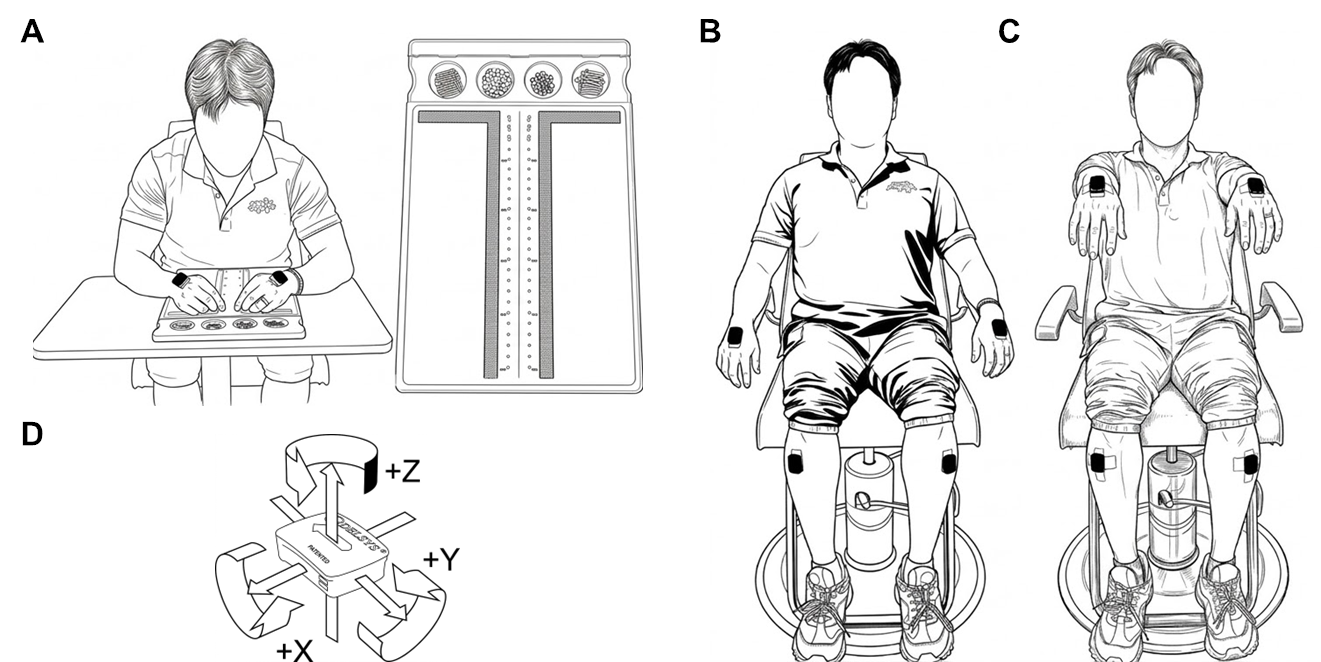
Figure 1
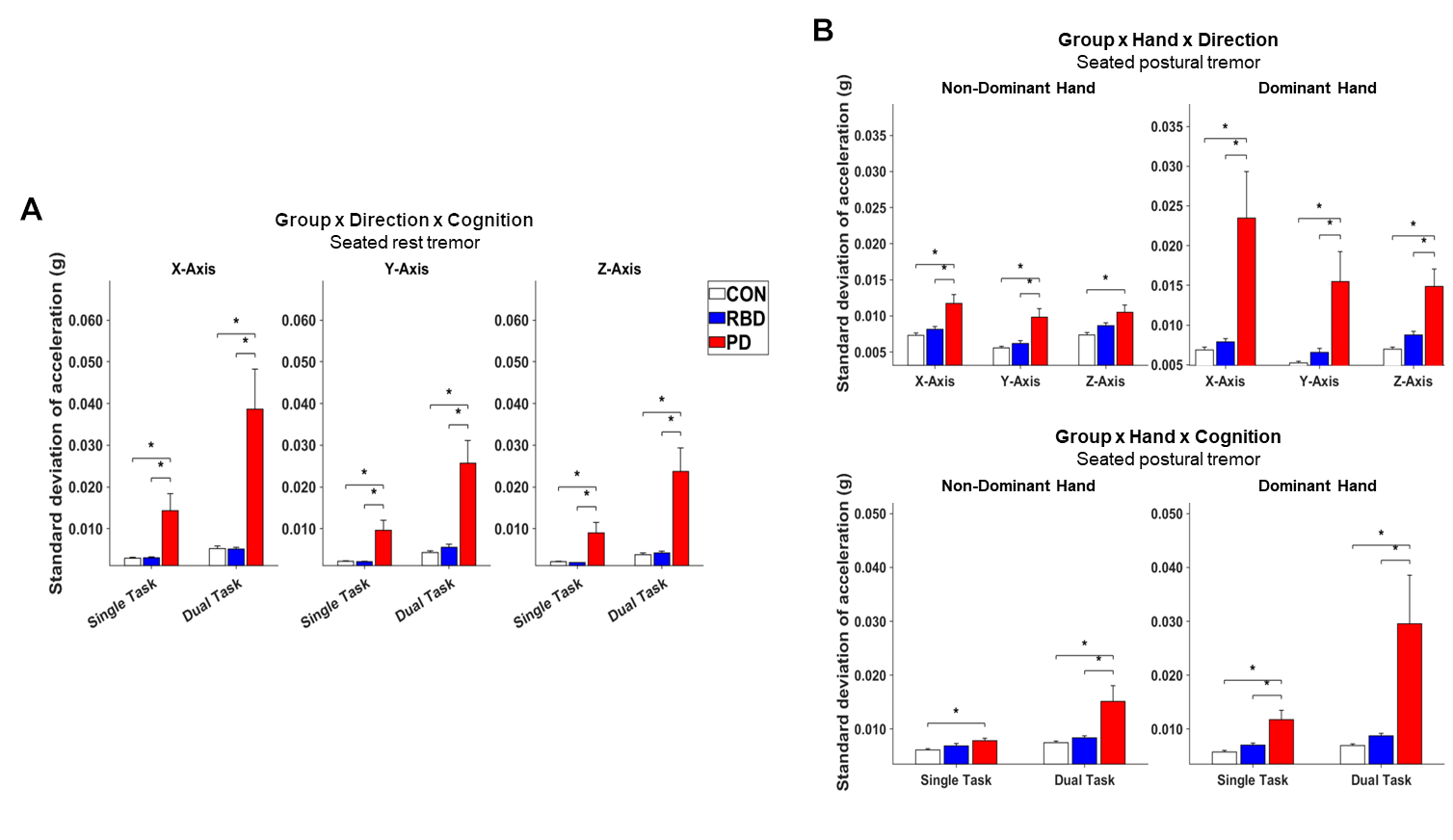
Figure 2
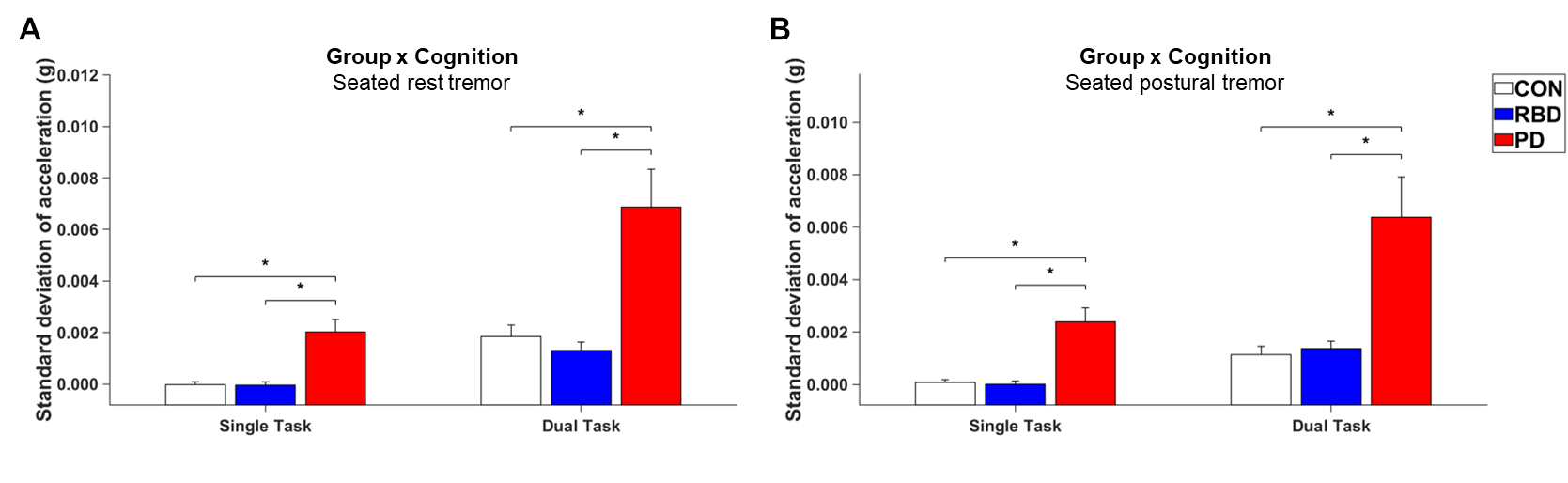
Figure 3
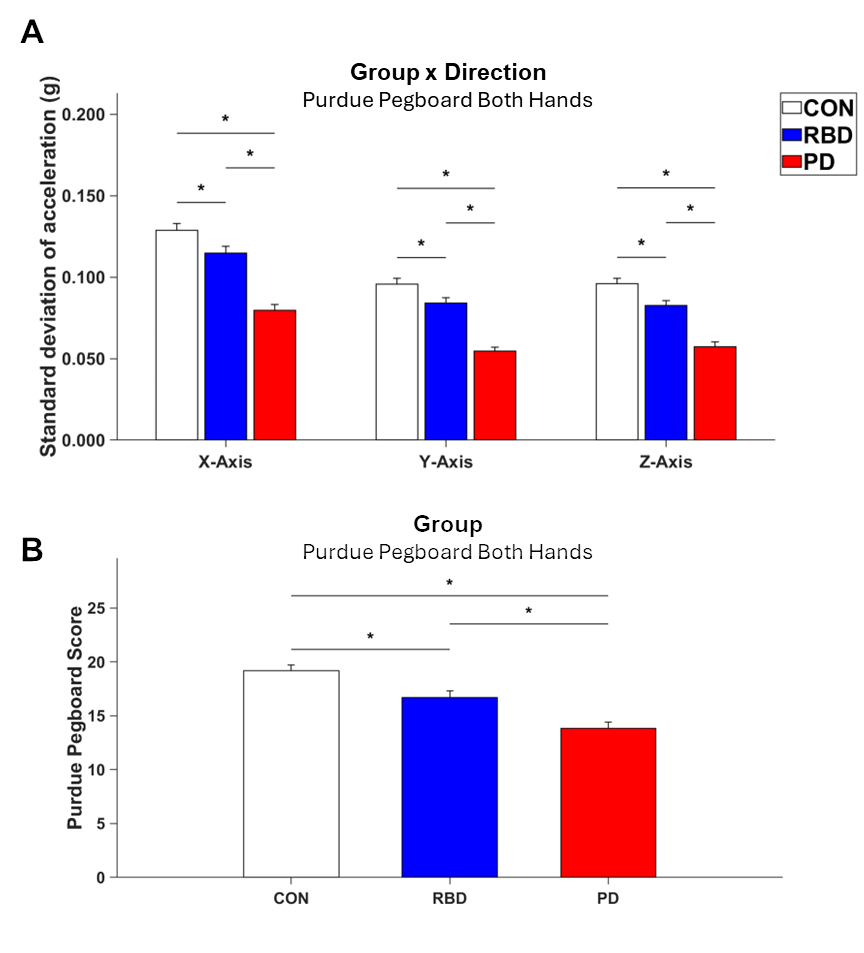
Figure 4
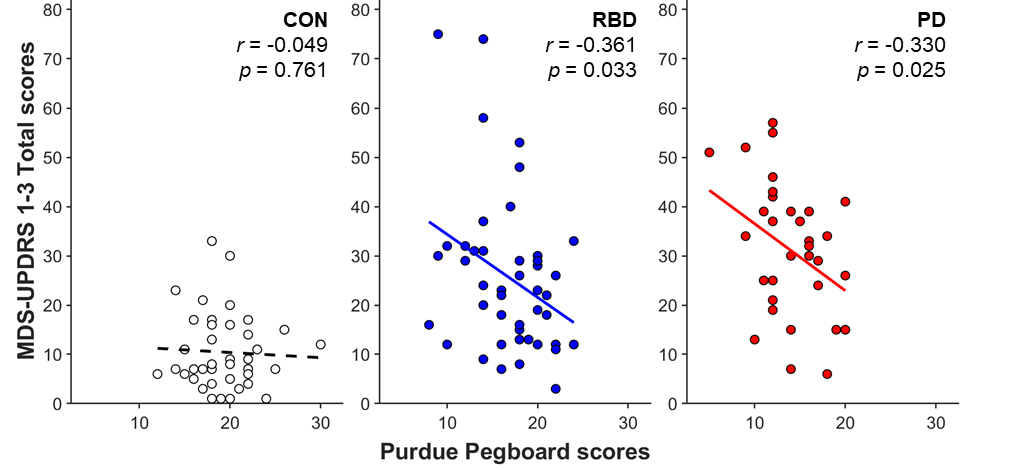
Figure 5
To cite this abstract in AMA style:
JH. Lee, ER. Tobin, EA. Christou, XY. Lou, M. Louis, LH. Le, MF. Presti, MS. Jaffee, DE. Vaillancourt. Mild Motor Impairments in Rapid Eye Movement Behavior Disorder: Tremor and Bradykinesia [abstract]. Mov Disord. 2026; 41 (suppl 1). https://www.mdsabstracts.org/abstract/mild-motor-impairments-in-rapid-eye-movement-behavior-disorder-tremor-and-bradykinesia/. Accessed October 1, 2026.« Back to 2026 International Congress
MDS Abstracts - https://www.mdsabstracts.org/abstract/mild-motor-impairments-in-rapid-eye-movement-behavior-disorder-tremor-and-bradykinesia/