
Category: Parkinson's Disease: Surgical Therapy
Objective: To characterize longitudinal changes in globus pallidus internus (GPi) finely tuned gamma (FTG) oscillations during chronic deep brain stimulation (DBS) in a patient with Parkinson’s disease (PD).
Background: FTG oscillations in the basal ganglia have been proposed as an electrophysiological biomarker to power adaptive DBS paradigms. However, the long-term stability of FTG signals during chronic stimulation remains unknown.
Method: We report a case of a 73-year-old man with an 11-year history of PD treated with bilateral GPi DBS for motor fluctuations and dystonia. Chronic neural recordings were obtained from a sensing-enabled neurostimulator (Medtronic Percept) while the patient remained on dopaminergic therapy. Resting local field potentials (LFPs) were recorded for 20 seconds with the DBS turned off during routine programming visits. Power spectra were computed using Welch’s method (1000 ms window, 500 ms overlap). Significant FTG were defined by normalizing against an estimated aperiodic 1/f baseline and FTG center frequencies identified with confidence interval-based spectral criteria. Band power in theta (4–8 Hz), alpha (8–12 Hz), low beta (13–20 Hz), and high beta (21–35 Hz) ranges was compared between recordings with and without FTG using Welch’s t-tests and Mann–Whitney U tests. Gamma peak frequencies were averaged within sessions and tracked longitudinally by hemisphere.
Results: Thirty-two recordings over two years were analyzed. FTGs were detected in 68.8% of recordings (22/32). Longitudinal GPi LFP recordings demonstrated evolving FTG dynamics. The initial native FTG frequency was 80.5 Hz and gradually shifted downward to 66.0 Hz over two years. During this period, stimulation frequency initially ranged between 125-165 Hz but after optimization settled to 125 Hz. LFPs with FTG were associated with increased theta and alpha band power compared with non-FTG LFP recordings (p<0.05).
Conclusion: This case study is the first to report FTG detected from the GPi LFP recordings may not necessarily be a stable signal and can evolve over time. FTG peaks may gradually entrain toward the chronic stimulation frequency. These findings suggest adaptive DBS strategies may require periodic recalibration and ongoing monitoring to account for longitudinal shifts in electrophysiological biomarkers. Further investigation is needed to clarify the clinical relevance of long-term FTG dynamics and optimize DBS programming in PD.
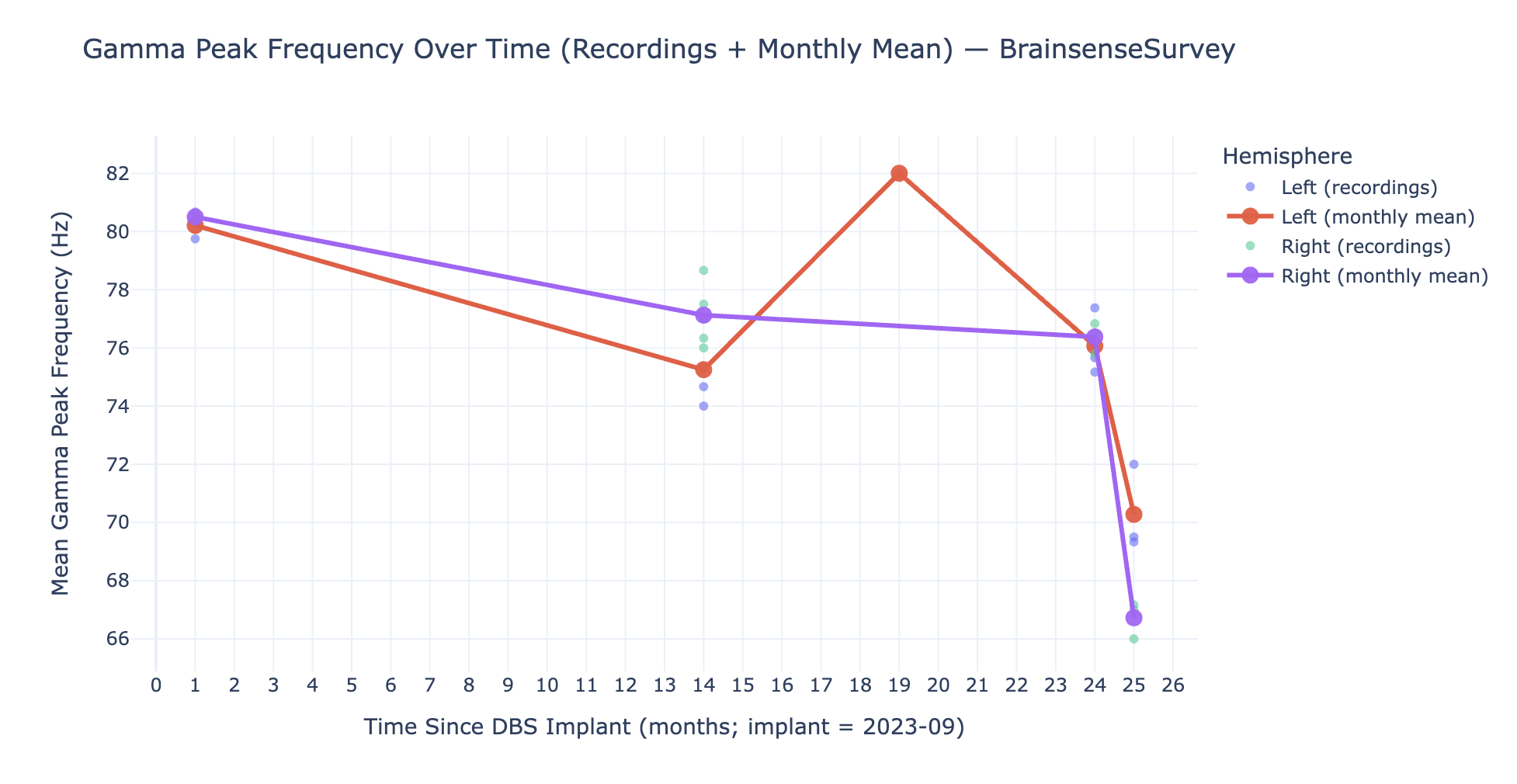
Gamma Peak Frequency Over Time
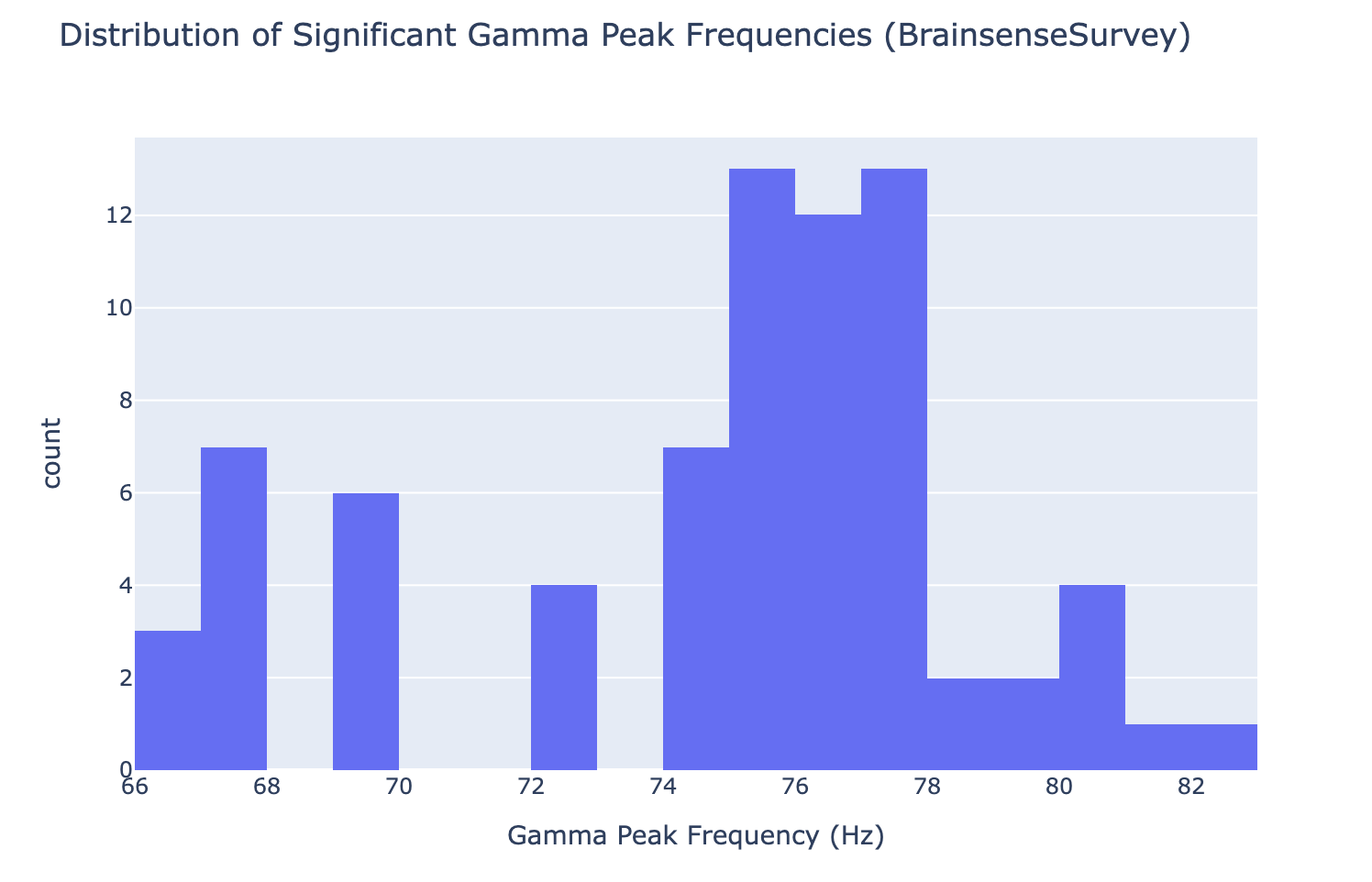
Distribution of Significant Gamma Peak Frequencies
To cite this abstract in AMA style:
Q. Yuan, J. Dang, T. Mehta, J. Cagle, C. de Hemptinne, J. Wong. Long-Term Instability of GPi Gamma Oscillations in Parkinson’s Disease: A Case Study [abstract]. Mov Disord. 2026; 41 (suppl 1). https://www.mdsabstracts.org/abstract/long-term-instability-of-gpi-gamma-oscillations-in-parkinsons-disease-a-case-study/. Accessed October 1, 2026.« Back to 2026 International Congress
MDS Abstracts - https://www.mdsabstracts.org/abstract/long-term-instability-of-gpi-gamma-oscillations-in-parkinsons-disease-a-case-study/