
Category: Myoclonus/Tics/Stereotypies
Objective: To report a case of secondary adult-onset stereotypies with cortical myoclonus associated with an underlying neurological disorder.
Background: Stereotypies are repetitive, patterned, rhythmic, non–goal-directed movements that may occur spontaneously or be triggered by external stimuli or cognitive tasks. While commonly described in children, adult-onset stereotypies are less frequent and often suggest an underlying neurological disorder [1], particularly when accompanied by additional movement abnormalities such as cortical myoclonus.
Method: A 60-year-old woman was admitted for progressive behavioral changes over three years, initially presenting with bilateral hand tremor. She developed worsening memory impairment, failed to recognize relatives, and exhibited inconsistent speech. Family members reported wandering behavior, emotional lability with inappropriate laughter, apathy, psychomotor slowing, reduced empathy, diminished social engagement, and stereotyped speech with repetitive responses. One month prior to admission, while watching television, the patient had a generalized seizure. She was treated with levetiracetam 500 mg twice daily.
During examination, when asked to perform serial subtraction (100–7), she repeatedly used her right hand to stroke a pillow or nearby object in a stereotyped manner. Asymmetric cortical myoclonus was observed (left > right). She had finger agnosia, impaired attention, ideomotor apraxia, bilateral paratonia, and frontal release signs.
Brain magnetic resonance imaging (MRI) demonstrated a right parieto-occipital lobar hemorrhage, right frontal encephalomalacia suggestive of prior hemorrhage, and multiple small chronic hemorrhagic foci in the right frontal and left parieto-occipital lobes.
[figure1]
Results: The patient was diagnosed with a behavioral variant frontotemporal dementia (bvFTD)-like syndrome with epilepsy in the setting of probable sporadic cerebral amyloid angiopathy (CAA), fulfilling Boston Criteria version 2.0 (2022).
Conclusion: Although stereotypies are common in children, their occurrence in adults should prompt careful evaluation for structural causes. In this case, comprehensive clinical assessment and recognition of movement disorder features initially suggested a bvFTD-like syndrome; however, neuroimaging supported probable cerebral amyloid angiopathy (CAA), which more adequately explained the overall presentation.
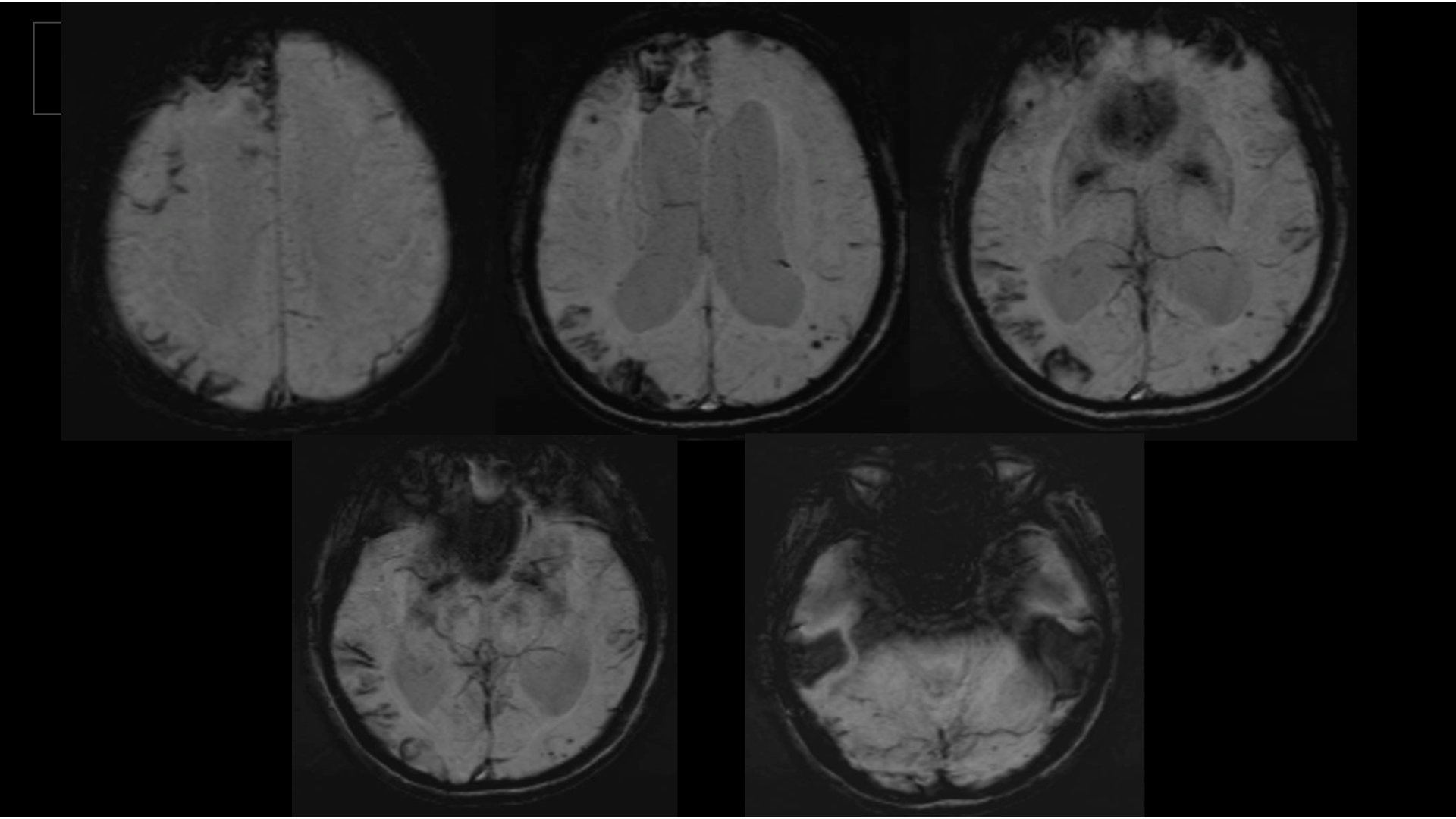
Figure 1 – Patient’s imaging Brain MRI
References: [1] Shukla T, Pandey S. Stereotypies in adults: a systematic review. Neurol Neurochir Pol. 2020;54(4):294-304. doi:10.5603/PJNNS.a2020.0058
To cite this abstract in AMA style:
N. Doan, T. Tran. Adult-Onset Stereotypies and Cortical Myoclonus: An Unusual Presentation of Cerebral Amyloid Angiopathy [abstract]. Mov Disord. 2026; 41 (suppl 1). https://www.mdsabstracts.org/abstract/adult-onset-stereotypies-and-cortical-myoclonus-an-unusual-presentation-of-cerebral-amyloid-angiopathy/. Accessed October 1, 2026.« Back to 2026 International Congress
MDS Abstracts - https://www.mdsabstracts.org/abstract/adult-onset-stereotypies-and-cortical-myoclonus-an-unusual-presentation-of-cerebral-amyloid-angiopathy/