
Objective: To investigate if a dual-task posturography protocol can effectively differentiate postural instability within functional movement disorder (FMD) from cerebellar ataxia (CA).
Background: Functional movement disorders (FMD) are highly disabling neurological conditions characterized by impaired postural control and abnormal movements that are clinically incongruent with organic disease. Because bedside tests may be subjective, more objective tools for assessing postural control are needed. Computerized posturography is promising, but optimal testing protocols and stabilometric parameters remain unclear.
Method: 13 patients with СA and 15 patients with FA, identified among patients with FMD, underwent posturographic study on the Wii Balance Board using a six-condition protocol previously described for patients with FMD and healthy controls only [1]. The protocol combined eyes open or closed with quiet stance, a motor dual task involving rhythmic tapping on the thigh with the dominant hand, and a cognitive dual task with serial subtraction of 7 from 100. Raw Wii Balance Board data were exported using the SWARII protocol [2] and processed with CU BrainBLoX software. For each of the six recordings, 72 stabilometric variables were calculated and grouped into positional, dynamic, frequency, and stochastic groups; statistically significant parameters were then identified for between-group comparison [3]. Dual-task effect (DTE) coefficients were also calculated [1].
Results: In quiet stance, patients with FA showed greater postural instability than patients with CA. The cognitive dual task worsened postural control in the CA group but slightly improved it in the FA group [figure1]. The motor dual task showed a similar but less pronounced pattern. Among the 72 variables assessed in each recording, significant between-group differences were found for several stabilometric variables, predominantly stochastic parameters [table1], and for selected DTE coefficients [table2].
Conclusion: The proposed posturography protocol may serve as a useful fine-tuned instrument for the objective differential diagnosis of functional and organic postural disturbances. The cognitive dual task demonstrated greater diagnostic value, and several stochastic and other stabilometric parameters appeared to be more reliable markers. However, results of previous studies differ somewhat from our findings; therefore, further research with larger cohorts is required.
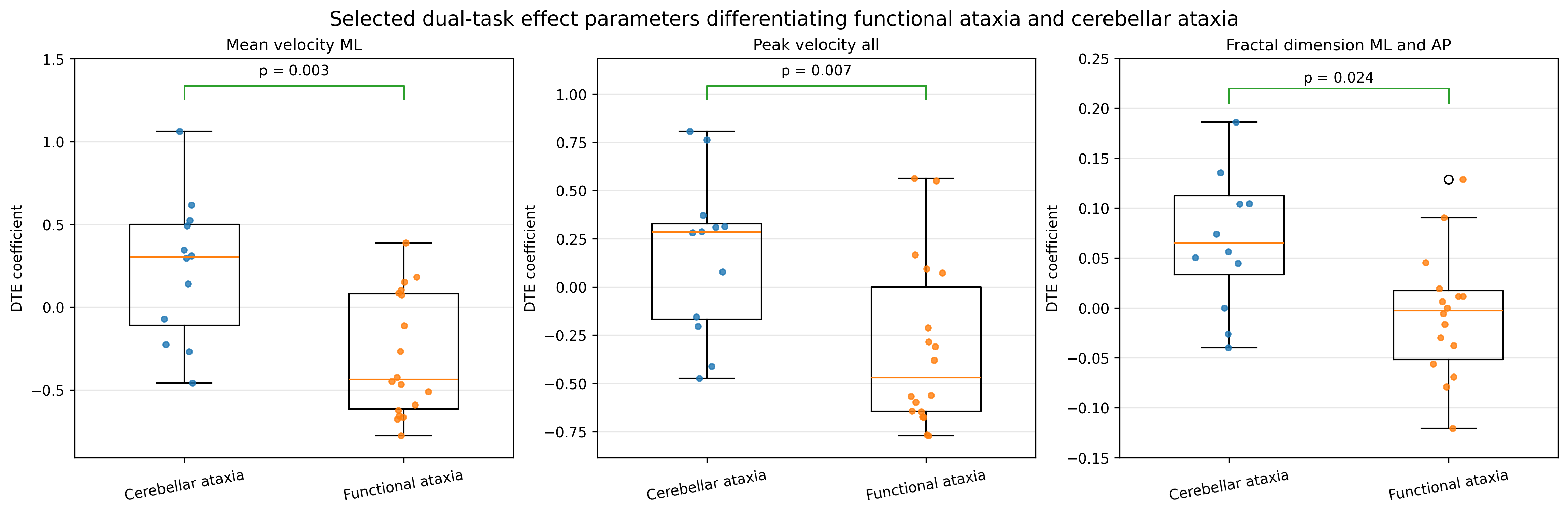
Figure 1. Significant cognitive DTE markers
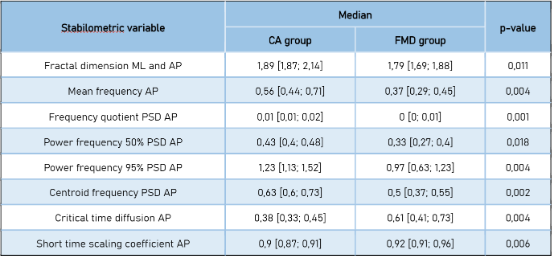
Table 1. Significant stabilometric variables
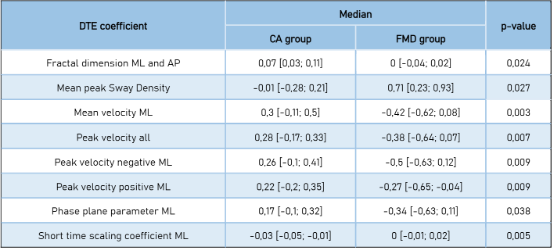
Table 2. Significant DTE coefficients
References: 1. Gandolfi M, Geroin C, Valè N, Boldrini P, Dimitrova E, Picelli A, et al. Motor dual task with eyes closed improves postural control in patients with functional motor disorders: A posturographic study. Gait Posture. 2021;88:286-291.
2. Audiffren J, Contal E. Preprocessing the Nintendo Wii Board Signal to Derive More Accurate Descriptors of Statokinesigrams. Sensors (Basel). 2016;16(8):1208. doi:10.3390/s16081208.
3. Quijoux F, Nicolaï A, Chairi I, Bargiotas I, Ricard D, Yelnik A, et al. A review of center of pressure variables to quantify standing balance in elderly people: Algorithms and open-access code. Physiol Rep. 2021;9(22):e15067.
To cite this abstract in AMA style:
A. Mezenchuk, K. Evdokimov, A. Belyakova-Bodina, E. Nuzhnyi, E. Fedotova, A. Broutian, S. Illarioshkin. Dual Task Effect in Posturography Enhances Diagnosis of Functional Ataxia [abstract]. Mov Disord. 2026; 41 (suppl 1). https://www.mdsabstracts.org/abstract/dual-task-effect-in-posturography-enhances-diagnosis-of-functional-ataxia/. Accessed October 1, 2026.« Back to 2026 International Congress
MDS Abstracts - https://www.mdsabstracts.org/abstract/dual-task-effect-in-posturography-enhances-diagnosis-of-functional-ataxia/