
Category: Parkinson's Disease: Surgical Therapy
Objective: To evaluate the effect of unilateral STN-MRgFUS on ipsilateral motor symptoms at 6 and 12 months post-procedure.
Background: In patients with Parkinson’s disease (PD) and suboptimal motor control despite optimized therapy, several subthalamic-targeted interventions are available. Unilateral subthalamic deep brain stimulation and unilateral radiofrequency subthalamotomy have been reported to produce ipsilateral benefit [1-14], although this effect was mild and transient with the latter. With the increasing use of unilateral MRgFUS subthalamotomy (STN-MRgFUS), it remains unclear whether a comparable ipsilateral effect may occur [15-19].
Method: We analyzed PD patients treated with unilateral STN-MRgFUS at our center. Motor function was assessed using the MDS-UPDRS Part III at baseline and at 6 and 12 months. The primary outcome was the change in untreated-side motor score in the OFF-medication state. Secondary outcomes included untreated-side scores in the ON state, untreated hemibody subscores (rigidity, bradykinesia, and tremor), total and treated-side motor scores, Levodopa Equivalent Daily Dose (LEDD) [20], and safety at 12 months.
Results: A total of 39 patients were included. Baseline demographic, clinical and surgical characteristics are summarized in [Table 1]. No significant improvement was observed in untreated-side OFF MDS-UPDRS motor scores at 6 or 12 months (p = 1.00 for both comparisons), nor in subscores or ON motor scores [Table 2]. Significant improvement in total motor scores was driven by marked reductions in treated-side motor scores. LEDD was significantly reduced at both visits, and no disabling adverse events were reported at 12 months [Table 3].
Conclusion: Unilateral STN-MRgFUS did not provide ipsilateral motor benefit. Its therapeutic effect appears limited to the contralateral side, with significant and sustained improvement. Given the absence of ipsilateral benefit, some patients may require treatment of the opposite side over time, which should be clearly discussed during preoperative counseling [1,21].
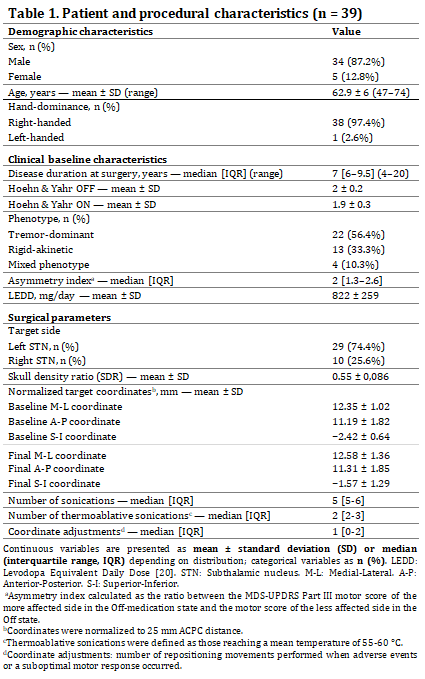
Table 1. Baseline characteristics.
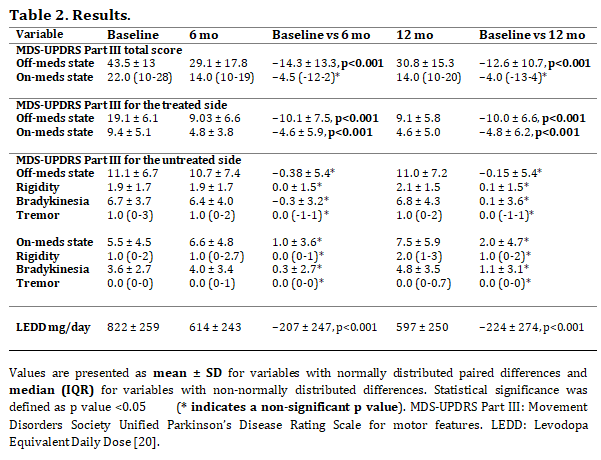
Table 2. Results (n=39).
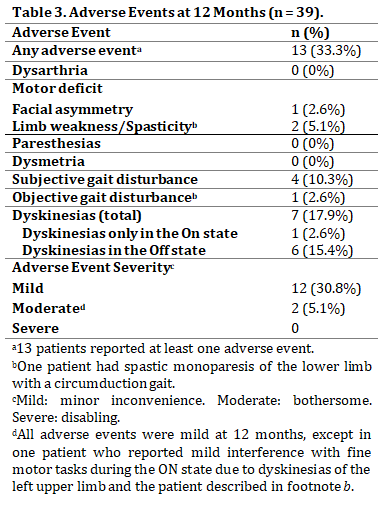
Table 3. Adverse Events at 12 Months (n = 39).
References: [1] Vetkas A, Yang A, Boutet A, Cheyuo C, Santyr B, Sarica C, et al. One side or two? A systematic review of deep brain stimulation approaches in movement disorders. Mov Disord Clin Pract. 2025;12(12):2080-2091.
[2] Ehm G, Kim HJ, Kim JY, Lee JY, Kim HJ, Yun JY, et al. Effect of unilateral subthalamic deep brain stimulation in highly asymmetrical Parkinson’s disease: 7-year follow-up. J Neurosurg. 2019;131(5):1508-1513.
[3] Taba HA, Wu SS, Foote KD, Hass CJ, Fernandez HH, Malaty IA, et al. A closer look at unilateral versus bilateral deep brain stimulation: results of the National Institutes of Health COMPARE cohort. J Neurosurg. 2010;113(6):1224-1229.
[4] Kim HJ, Paek SH, Kim JY, Lee JY, Lim YH, Kim DG, et al. Two-year follow-up on the effect of unilateral subthalamic deep brain stimulation in highly asymmetric Parkinson’s disease. Mov Disord. 2009;24(3):329-335.
[5] Walker HC, Watts RL, Guthrie S, Wang D, Guthrie BL. Bilateral effects of unilateral subthalamic deep brain stimulation on Parkinson’s disease at 1 year. Neurosurgery. 2009;65(2):302-310.
[6] Tabbal SD, Ushe M, Mink JW, Revilla FJ, Wernle AR, Hong M, et al. Unilateral subthalamic nucleus stimulation has a measurable ipsilateral effect on rigidity and bradykinesia in Parkinson disease. Exp Neurol. 2008;211(1):234-242.
[7] Slowinski JL, Putzke JD, Uitti RJ, Lucas JA, Turk MF, Kall BA, et al. Unilateral deep brain stimulation of the subthalamic nucleus for Parkinson disease. J Neurosurg. 2007;106(4):626-632.
[8] Chung SJ, Jeon SR, Kim SR, Sung YH, Lee MC. Bilateral effects of unilateral subthalamic nucleus deep brain stimulation in advanced Parkinson’s disease. Eur Neurol. 2006;56(2):127-132.
[9] Alberts JL, Elder CM, Okun MS, Vitek JL. Comparison of pallidal and subthalamic stimulation on force control in patients with Parkinson’s disease. Mot Control. 2004;8(4):484-499.
[10] Germano IM, Gracies JM, Weisz DJ, Tse W, Koller WC, Olanow CW. Unilateral stimulation of the subthalamic nucleus in Parkinson disease: a double-blind 12-month evaluation study. J Neurosurg. 2004;101(1):36-42.
[11] Kumar R, Lozano AM, Sime E, Halket E, Lang AE. Comparative effects of unilateral and bilateral subthalamic nucleus deep brain stimulation. Neurology. 1999;53(3):561-566.
[12] Jourdain VA, Schechtmann G, Di Paolo T. Subthalamotomy in the treatment of Parkinson’s disease: clinical aspects and mechanisms of action. J Neurosurg. 2014;120(1):140-151.
[13] Alvarez L, Macias R, Pavón N, López G, Rodríguez-Oroz MC, Rodríguez R, et al. Therapeutic efficacy of unilateral subthalamotomy in Parkinson’s disease: results in 89 patients followed for up to 36 months. J Neurol Neurosurg Psychiatry. 2009;80(9):979-985.
[14] Su PC, Tseng HM, Liu HM, Yen RF, Liou HH. Treatment of advanced Parkinson’s disease by subthalamotomy: one-year results. Mov Disord. 2003;18(5):531-538.
[15] Martínez-Fernández R, Rodríguez-Rojas R, del Álamo M, Hernández-Fernández F, Pineda-Pardo JA, Dileone M, et al. Focused ultrasound subthalamotomy in patients with asymmetric Parkinson’s disease: a pilot study. Lancet Neurol. 2018;17(1):54-63.
[16] Martínez-Fernández R, Máñez-Miró JU, Rodríguez-Rojas R, del Álamo M, Shah BB, Hernández-Fernández F, et al. Randomized trial of focused ultrasound subthalamotomy for Parkinson’s disease. N Engl J Med. 2020;383(26):2501-2513.
[17] Martínez-Fernández R, Natera-Villalba E, Máñez Miró JU, Rodriguez-Rojas R, del Alamo M, Pineda-Pardo JA, et al. Prospective long-term follow-up of focused ultrasound unilateral subthalamotomy for Parkinson disease. Neurology. 2023;100(13): e1395-e1405.
[18] Campins-Romeu M, Conde-Sardón R, Sastre-Bataller I, Morata-Martínez C, Losada-López M, León-Guijarro JL, et al. MRgFUS subthalamotomy in Parkinson’s disease: an approach aimed at minimizing lesion volume. NPJ Parkinsons Dis. 2024;10:230.
[19] Armengou-Garcia L, Sanchez-Catasus CA, Aviles-Olmos I, Jiménez-Huete A, Montoya-Murillo G, Gorospe A, et al. Unilateral Magnetic Resonance-Guided Focused Ultrasound Lesion of the Subthalamic Nucleus in Parkinson’s Disease: A Prospective Study. Mov Disord. 2024 Dec;39(12):2230-2241.
[20] Schade S, Mollenhauer B, Trenkwalder C. Levodopa equivalent dose conversion factors: an updated proposal including opicapone and safinamide. Mov Disord Clin Pract. 2020;7(3):343-345.
[21] Santyr B, Boutet A, Abbass M, Vetkas A, Germann J, Ajala A, et alM. Functional network diffrences between unilateral and bilateral deep brain stimulation of the subthalamic nucleus. NPJ Parkinsons Dis. 2025 Jul 17;11(1):215.
To cite this abstract in AMA style:
E. Navarro-Mocholí, M. Campins-Romeu, R. Conde-Sardón, I. Sastre-Bataller, M. Losada-López, C. Morata-Martínez, MJ. Ibáñez-Julià, MN. Afkir-Ortega, AM. Lozano, A. Gutiérrez-Martín, I. Martínez-Torres. Does Unilateral MR-Guided Focused Ultrasound Subthalamotomy Provide Bilateral Motor Benefit in Parkinson Disease [abstract]. Mov Disord. 2026; 41 (suppl 1). https://www.mdsabstracts.org/abstract/does-unilateral-mr-guided-focused-ultrasound-subthalamotomy-provide-bilateral-motor-benefit-in-parkinson-disease/. Accessed October 1, 2026.« Back to 2026 International Congress
MDS Abstracts - https://www.mdsabstracts.org/abstract/does-unilateral-mr-guided-focused-ultrasound-subthalamotomy-provide-bilateral-motor-benefit-in-parkinson-disease/