
Category: Parkinson’s Disease: Clinical Trials
Objective: To assess the safety, tolerance, and effectiveness of an oil extract of Cannabis sativa L. on pain and other non-motor symptoms (NMS) in people with Parkinson’s disease (PD).
Background: Pain is a frequent in PD, affecting about 20% of patients at diagnosis and up to 80% over the disease course, with a substantial impact on quality of life. Other NMS are also common and are often less responsive to therapy than motor. There is a lack of treatments for pain and NMM in people with PD.
Method: This was a phase II, randomized, double-blind, placebo-controlled trial evaluating an oral formulation of cannabidiol (CBD) and Δ9-tetrahydrocannabinol (THC), conducted from November 2022 to July 2025 at the Hospital das Clínicas, University of São Paulo. PD patients with pain complaints received a Cannabis extract (CBD 96mg/mL;THC 2.1mg/mL) for 9 weeks. The primary outcome was assessed by between-group differences in PD–Pain Classification System scores (PCS) at the final visit. Secondary outcomes included the Brief Pain Inventory (BPI) severity and interference scores, the proportion of participants achieving ≥ 30% reduction in pain intensity, MDS-Non-motor Symptoms Scale, the Scale for Outcomes in PD-Autonomic Dysfunction, the Hospital Anxiety and Depression Scale, the Montreal Cognitive Assessment, PD Questionnaire (PDQ-8), and the Patient Global Impression of Change. Motor symptoms were assessed with part III MDS-UPDRS, the New Freezing of Gait Questionnaire, and the Timed Up-and-Go scale.
Results: A total of 101 participants were randomized (50 were assigned to the CBD/THC group and 51 to the placebo group) and 87 completed the study. The median age was 63 years (IQR:54-70), 34% were female, and the median PD duration was seven years (IQR:1-32). There was no significant difference in PD-PCS scores between the CBD/THC and placebo groups (p=0.757). Moreover, there were no differences in the BPI (p =0.776), non-motor, and motor scales. Both groups showed improvements in pain from baseline to the final visit. There were no differences in adverse events, except for irritability in the CBD/THC group (p = 0.005).
Conclusion: In this study, an oral Cannabis oil formulation did not improve pain or other NMS in people with PD. Studies with different formulations and dosing should further explore the relevance of Cannabis oil for PD non-motor symptoms.
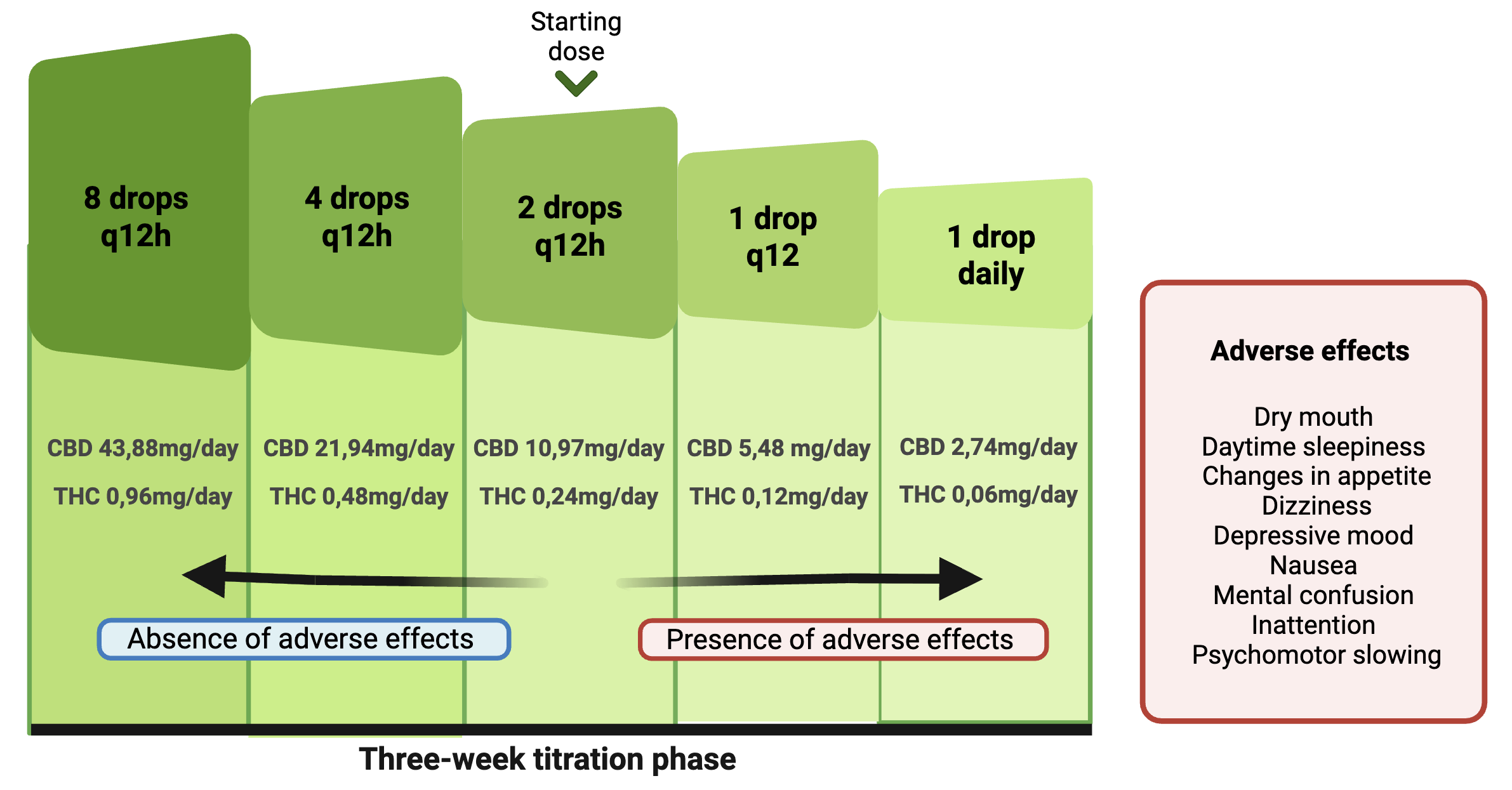
Flow of study participants.
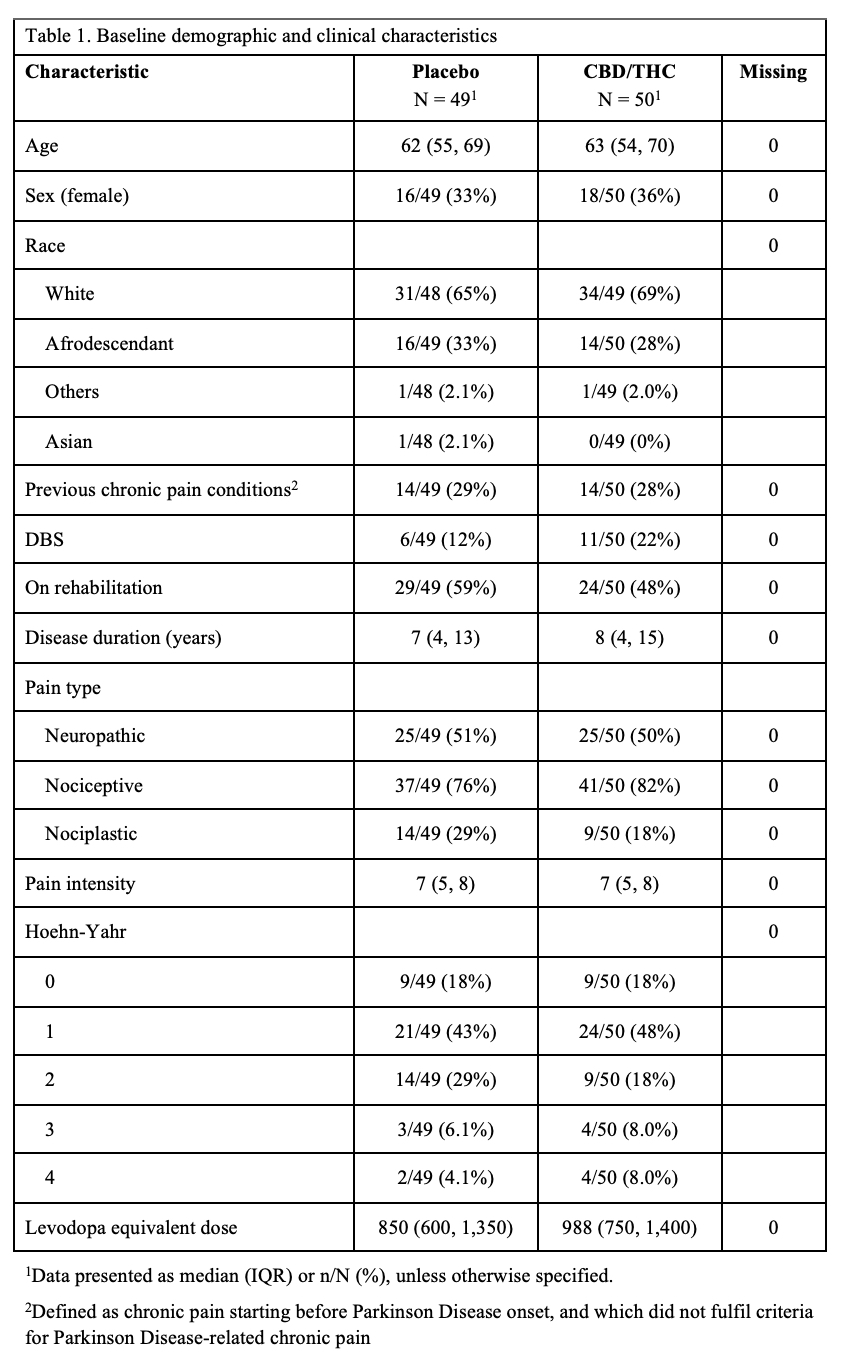
Baseline demographic and clinical characteristics
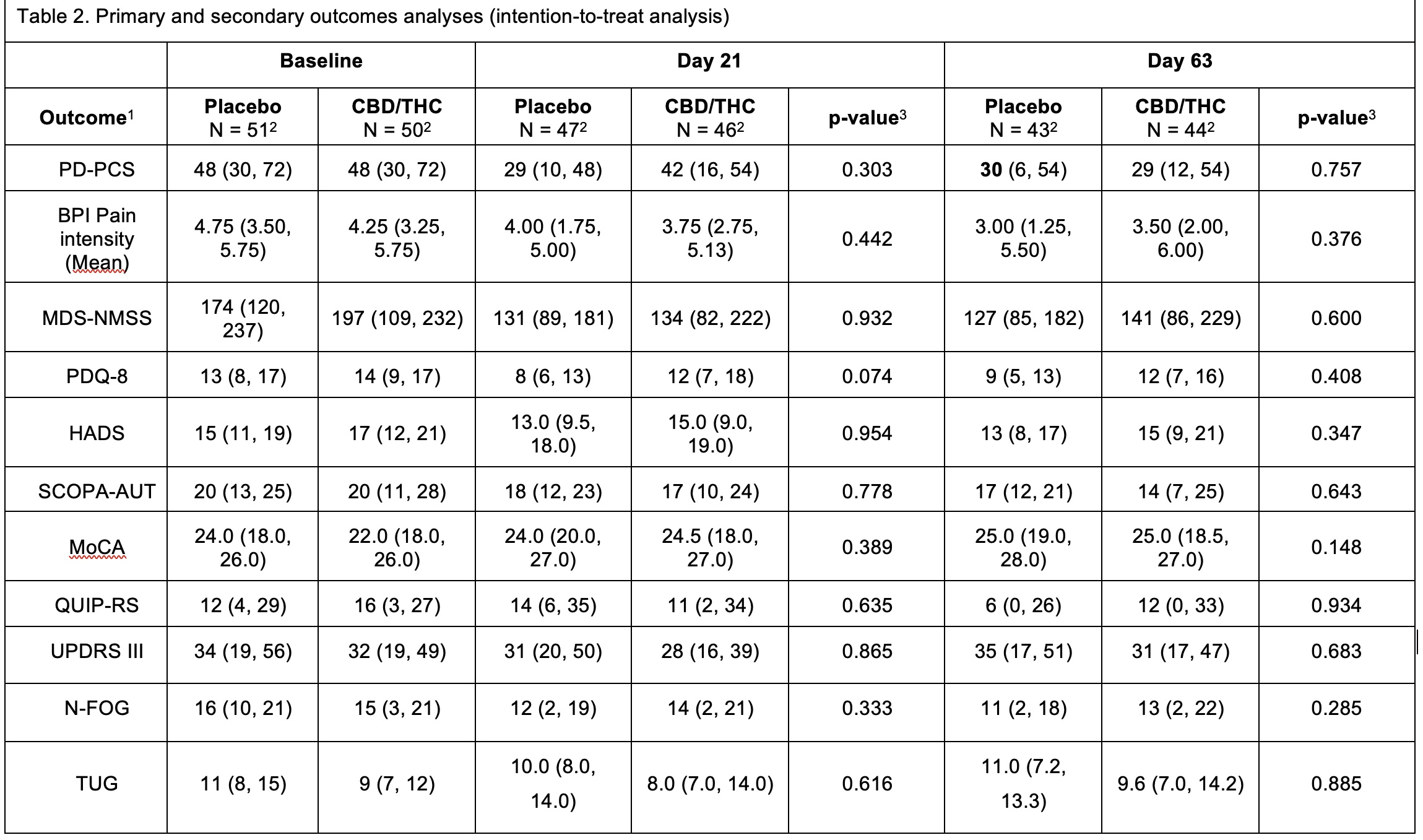
Primary and secondary outcomes
References: 1. de Andrade DC, Mylius V, Perez-Lloret S, et al. Pain in Parkinson disease: mechanistic substrates, main classification systems, and how to make sense out of them. Pain. 2023;164(11):2425-2434.
2. Schapira AHV, Chaudhuri KR, Jenner P. Non-motor features of Parkinson disease. Nat Rev Neurosci. 2017;18(8):509.
3. Seppi K, Ray Chaudhuri K, Coelho M, et al. Update on treatments for nonmotor symptoms of Parkinson’s disease-an evidence-based medicine review. Mov Disord. 2019;34(2):180-198.
4. de Faria SM, de Morais Fabrício D, Tumas V, et al. Effects of acute cannabidiol administration on anxiety and tremors induced by a Simulated Public Speaking Test in patients with Parkinson’s disease. J Psychopharmacol. 2020;34(2):189-196.
5. Lotan I, Treves TA, Roditi Y, Djaldetti R. Cannabis (medical marijuana) treatment for motor and non-motor symptoms of Parkinson disease: an open-label observational study. Clin Neuropharmacol. 2014;37(2):41-44.
6. Liu Y, Bainbridge J, Sillau S, et al. Short-term cannabidiol with Δ-9-tetrahydrocannabinol in Parkinson’s disease: A randomized trial. Mov Disord. 2024;39(5):863-875.
7. Chagas MHN, Eckeli AL, Zuardi AW, et al. Cannabidiol can improve complex sleep-related behaviours associated with rapid eye movement sleep behaviour disorder in Parkinson’s disease patients: a case series. J Clin Pharm Ther. 2014;39(5):564-566.
8. Di Luca DG, Gilmour GS, Fearon C, et al. A phase Ib, double blind, randomized study of cannabis oil for pain in Parkinson’s disease. Mov Disord Clin Pract. 2023;10(7):1114-1119.
9. Peball M, Krismer F, Knaus HG, et al. Non-Motor Symptoms in Parkinson’s Disease are Reduced by Nabilone. Ann Neurol. 2020;88(4):712-722.
10. Zuardi AW, Crippa JAS, Hallak JEC, et al. Cannabidiol for the treatment of psychosis in Parkinson’s disease. J Psychopharmacol. 2009;23(8):979-983.
11. Connor JP, Stjepanović D, Le Foll B, Hoch E, Budney AJ, Hall WD. Cannabis use and cannabis use disorder. Nat Rev Dis Primers. 2021;7(1). doi:10.1038/s41572-021-00247-4
12. Buhmann C, Mainka T, Ebersbach G, Gandor F. Evidence for the use of cannabinoids in Parkinson’s disease. J Neural Transm (Vienna). 2019;126(7):913-924.
13. de Freitas MET, Fox SH. Advice to people with Parkinson’s in my clinic: Cannabis. J Parkinsons Dis. 2024;14(4):873-881.
14. Abame MA, He Y, Wu S, et al. Chronic administration of synthetic cannabidiol induces antidepressant effects involving modulation of serotonin and noradrenaline levels in the hippocampus. Neurosci Lett. 2021;744(135594):135594.
15. Pertwee RG. The diverse CB1 and CB2 receptor pharmacology of three plant cannabinoids: delta9-tetrahydrocannabinol, cannabidiol and delta9-tetrahydrocannabivarin. Br J Pharmacol. 2008;153(2):199-215.
16. Postuma RB, Berg D, Stern M, et al. MDS clinical diagnostic criteria for Parkinson’s disease. Mov Disord. 2015;30(12):1591-1601.
17. Korwisi B, Barke A, Rief W, Treede RD, Kleinstäuber M. Chronic pain in the 11th Revision of the International Classification of Diseases : users’ questions answered. Pain. 2022;163(9):1675-1687.
18. Mylius V, Perez Lloret S, Cury RG, et al. The Parkinson disease pain classification system: results from an international mechanism-based classification approach: results from an international mechanism-based classification approach. Pain. 2021;162(4):1201-1210.
19. Rocha R De O, Teixeira MJ, Yeng LT, Cantara MG, Faria VG, Liggieri V. Thoracic sympathetic block for the treatment of complex regional pain syndrome type I: a double-blind randomized controlled study. Pain. 2014;155(11):2274-2281.
20. Bhaskar A, Bell A, Boivin M, et al. Consensus recommendations on dosing and administration of medical cannabis to treat chronic pain: results of a modified Delphi process. J Cannabis Res. 2021;3(1):22.
21. Ferreira KA, Teixeira MJ, Mendonza TR, Cleeland CS. Validation of brief pain inventory to Brazilian patients with pain. Support Care Cancer. 2011;19(4):505-511.
22. Chaudhuri KR, Schrag A, Weintraub D, et al. The movement disorder society nonmotor rating scale: Initial validation study. Mov Disord. 2020;35(1):116-133.
23. Visser M, Marinus J, Stiggelbout AM, Van Hilten JJ. Assessment of autonomic dysfunction in Parkinson’s disease: the SCOPA-AUT. Mov Disord. 2004;19(11):1306-1312.
24. Botega NJ, Bio MR, Zomignani MA, Garcia C Jr, Pereira WA. Mood disorders among inpatients in ambulatory and validation of the anxiety and depression scale HAD. Rev Saude Publica. 1995;29(5):355-363.
25. Nasreddine ZS, Phillips NA, Bédirian V, et al. The Montreal Cognitive Assessment, MoCA: a brief screening tool for mild cognitive impairment: Moca: A brief screening tool for MCI. J Am Geriatr Soc. 2005;53(4):695-699.
26. Goetz CG, Tilley BC, Shaftman SR, et al. Movement Disorder Society-sponsored revision of the Unified Parkinson’s Disease Rating Scale (MDS-UPDRS): scale presentation and clinimetric testing results. Mov Disord. 2008;23(15):2129-2170.
27. Baggio JAO, Curtarelli MB, Rodrigues GR, Tumas V. Validity of the Brazilian version of the freezing of gait questionnaire. Arq Neuropsiquiatr. 2012;70(8):599-603.
28. Podsiadlo D, Richardson S. The timed “Up & Go”: a test of basic functional mobility for frail elderly persons. J Am Geriatr Soc. 1991;39(2):142-148.
29. Jenkinson C, Fitzpatrick R, Peto V, Greenhall R, Hyman N. The PDQ-8: Development and validation of a short-form parkinson’s disease questionnaire. Psychol Health. 1997;12(6):805-814.
30. Scott W, McCracken LM. Patients’ impression of change following treatment for chronic pain: global, specific, a single dimension, or many? J Pain. 2015;16(6):518-526.
31. Bouhassira D, Attal N, Alchaar H, et al. Comparison of pain syndromes associated with nervous or somatic lesions and development of a new neuropathic pain diagnostic questionnaire (DN4). Pain. 2005;114(1-2):29-36.
32. Weintraub D, Mamikonyan E, Papay K, Shea JA, Xie SX, Siderowf A. Questionnaire for Impulsive-Compulsive Disorders in Parkinson’s Disease-Rating Scale. Mov Disord. 2012;27(2):242-247.
33. Martin G, Copeland J, Gates P, Gilmour S. The Severity of Dependence Scale (SDS) in an adolescent population of cannabis users: reliability, validity and diagnostic cut-off. Drug Alcohol Depend. 2006;83(1):90-93.
34. American Psychiatric Association. Diagnostic and Statistical Manual of Mental Disorders (DSM-5 (R)). 5th ed. American Psychiatric Association Publishing; 2013.
35. Whiting PF, Wolff RF, Deshpande S, et al. Cannabinoids for medical use: A systematic review and meta-analysis. JAMA. 2015;313(24):2456-2473.
36. De Andrade DC, Martins PN, Parmera JB, Cury RG, Kubota GT. Treatment of non-motor symptoms of Parkinson’s disease with Cannabidiol – RBR-3tvjjkx – Statistical Analysis Plan. Published online July 3, 2025. doi:10.17605/OSF.IO/BQRWF
37. Karst M, Meissner W, Sator S, Keßler J, Schoder V, Häuser W. Full-spectrum extract from Cannabis sativa DKJ127 for chronic low back pain: a phase 3 randomized placebo-controlled trial. Nat Med. Published online September 29, 2025. doi:10.1038/s41591-025-03977-0
38. Iwaki H, Ando R, Tada S, et al. A double-blind, randomized controlled trial of duloxetine for pain in Parkinson’s disease. J Neurol Sci. 2020;414(116833):116833.
39. Trenkwalder C, Chaudhuri KR, Martinez-Martin P, et al. Prolonged-release oxycodone-naloxone for treatment of severe pain in patients with Parkinson’s disease (PANDA): a double-blind, randomised, placebo-controlled trial. Lancet Neurol. 2015;14(12):1161-1170.
40. Tsuboi Y, Koebis M, Kogo Y, et al. Effects of safinamide adjunct therapy on pain in patients with Parkinson’s disease: Post hoc analysis of a Japanese phase 2/3 study. J Neurol Sci. 2021;429(118070):118070.
41. Soliman N, Haroutounian S, Hohmann AG, et al. Systematic review and meta-analysis of cannabinoids, cannabis-based medicines, and endocannabinoid system modulators tested for antinociceptive effects in animal models of injury-related or pathological persistent pain. Pain. 2021;162(Suppl 1):S26-S44.
42. Shohet A, Khlebtovsky A, Roizen N, Roditi Y, Djaldetti R. Effect of medical cannabis on thermal quantitative measurements of pain in patients with Parkinson’s disease. Eur J Pain. 2017;21(3):486-493.
43. Fisher E, Moore RA, Fogarty AE, et al. Cannabinoids, cannabis, and cannabis-based medicine for pain management: a systematic review of randomised controlled trials. Pain. 2021;162(Suppl 1):S45-S66.
44. Häuser W, Welsch P, Klose P, Radbruch L, Fitzcharles MA. Efficacy, tolerability and safety of cannabis-based medicines for cancer pain : A systematic review with meta-analysis of randomised controlled trials. Schmerz. 2019;33(5):424-436.
45. Mücke M, Phillips T, Radbruch L, Petzke F, Häuser W. Cannabis-based medicines for chronic neuropathic pain in adults. Cochrane Database Syst Rev. 2018;3:CD012182.
46. Evans K, Colloca L, Pecina M, Katz N. What can be done to control the placebo response in clinical trials? A narrative review. Contemp Clin Trials. 2021;107(106503):106503.
47. Domen CH, Sillau S, Liu Y, et al. Cognitive safety data from a randomized, double-blind, parallel-group, placebo-controlled phase IIb study of the effects of a cannabidiol and Δ9-tetrahydrocannabinol drug on Parkinson’s disease-related motor symptoms. Mov Disord. 2023;38(7):1341-1346.
48. Qian Y, Gurley BJ, Markowitz JS. The potential for pharmacokinetic interactions between cannabis products and conventional medications. J Clin Psychopharmacol. 2019;39(5):462-471.
49. Perucca E, Bialer M. Critical aspects affecting cannabidiol oral bioavailability and metabolic elimination, and related clinical implications. CNS Drugs. 2020;34(8):795-800.
50. Crippa JAS, Zuardi AW, Guimarães FS, et al. Efficacy and safety of cannabidiol plus standard care vs standard care alone for the treatment of emotional exhaustion and burnout among frontline health care workers during the COVID-19 pandemic: A randomized clinical trial. JAMA Netw Open. 2021;4(8):e2120603.
To cite this abstract in AMA style:
A. Alves, J. Parmera, G. Kubota, P. Martins, M. Deltreggia, A. Falcone, A. Santana, M. Falcão, M. Dias, L. Moreira, P. Filho, E. Figueiredo, E. Barbosa, R. Cury, D. Andrade. Cannabis-based Oil for Pain and Other Non-motor Symptoms in Parkinson’s Disease: a Randomized Controlled Trial [abstract]. Mov Disord. 2026; 41 (suppl 1). https://www.mdsabstracts.org/abstract/cannabis-based-oil-for-pain-and-other-non-motor-symptoms-in-parkinsons-disease-a-randomized-controlled-trial/. Accessed October 1, 2026.« Back to 2026 International Congress
MDS Abstracts - https://www.mdsabstracts.org/abstract/cannabis-based-oil-for-pain-and-other-non-motor-symptoms-in-parkinsons-disease-a-randomized-controlled-trial/