
Objective: To evaluate if integrating electronic health record (EHR) data with markerless 3D gait kinematics improves prediction of Parkinson’s disease (PD) motor symptom severity.
Background: Markerless 3D pose estimation enables extraction of PD gait features [1], allowing more objective motor assessment than bedside scoring. However, kinematics alone may miss patient-level clinical context. Dopaminergic medications and deep brain stimulation (DBS) are strong modulators of motor severity in PD [2,3] and may contextualize these features. Whether integrating EHR variables with kinematics improves severity prediction remains unestablished.
Method: 34 PD patients (age 69.4±8.3 years, 17 female, disease duration 5.7±4.5 years, LEDD 850±588 mg, 5 with DBS) performed MDS-UPDRS-III gait tasks recorded via a markerless 3D multicamera system. 15 gait features were extracted and pruned via variance filtering, correlation screening, and VIF thresholding. EHR variables included age, sex, disease duration, levodopa equivalent daily dose (LEDD), and DBS status. LEDD was computed from EHR medication records using standard conversion factors [4,5]. Ridge regression with leave-one-out cross-validation predicted MDS-UPDRS-III gait ratings from: 1) kinematics only, 2) EHR only, 3) kinematics + EHR, and 4) kinematics + LEDD + DBS.
Results: Kinematics alone predicted MDS-UPDRS-III gait scores with R2=0.573 (p<0.001). EHR alone achieved R2=0.225 (p=0.006). The combined model yielded the best performance (R2=0.667, p<0.001) [figure1], with LEDD and DBS as primary contributors (R2=0.660). Predicted scores closely tracked actual clinician ratings across the severity range [figure2]. Leg flexion posture correlated with LEDD after controlling for MDS-UPDRS-III and disease duration (p=0.033) [figure3], indicating LEDD captures gait-relevant motor information beyond clinical ratings.
Conclusion: Integrating EHR data with markerless 3D gait kinematics improves prediction of PD motor severity beyond kinematics or clinical ratings alone. The independent association between LEDD and gait after controlling for MDS-UPDRS-III suggests standard ratings do not fully capture medication-dependent motor variation. Combining objective kinematic measures with EHR-derived treatment context may enable more comprehensive and personalized PD motor assessments.
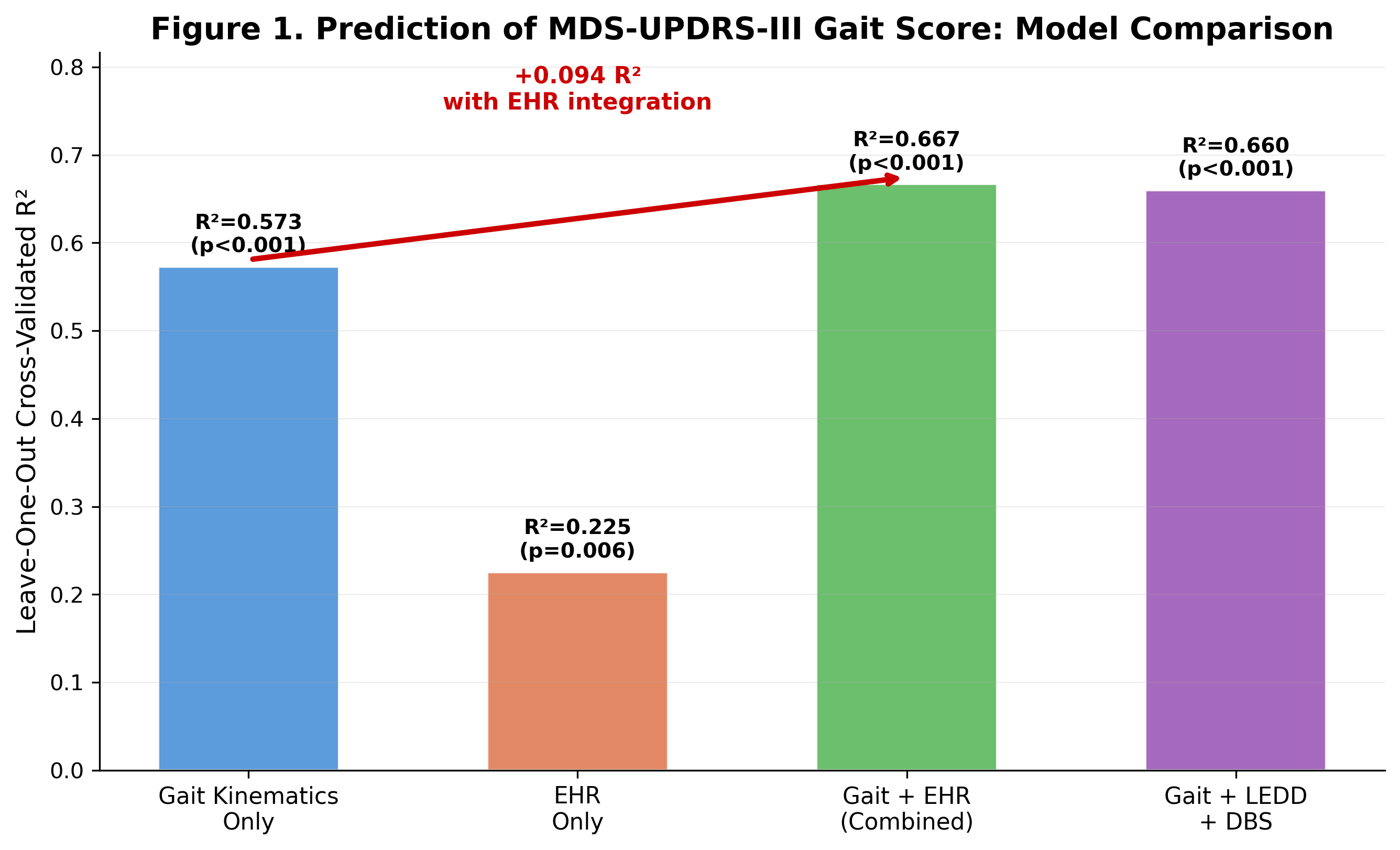
Figure 1
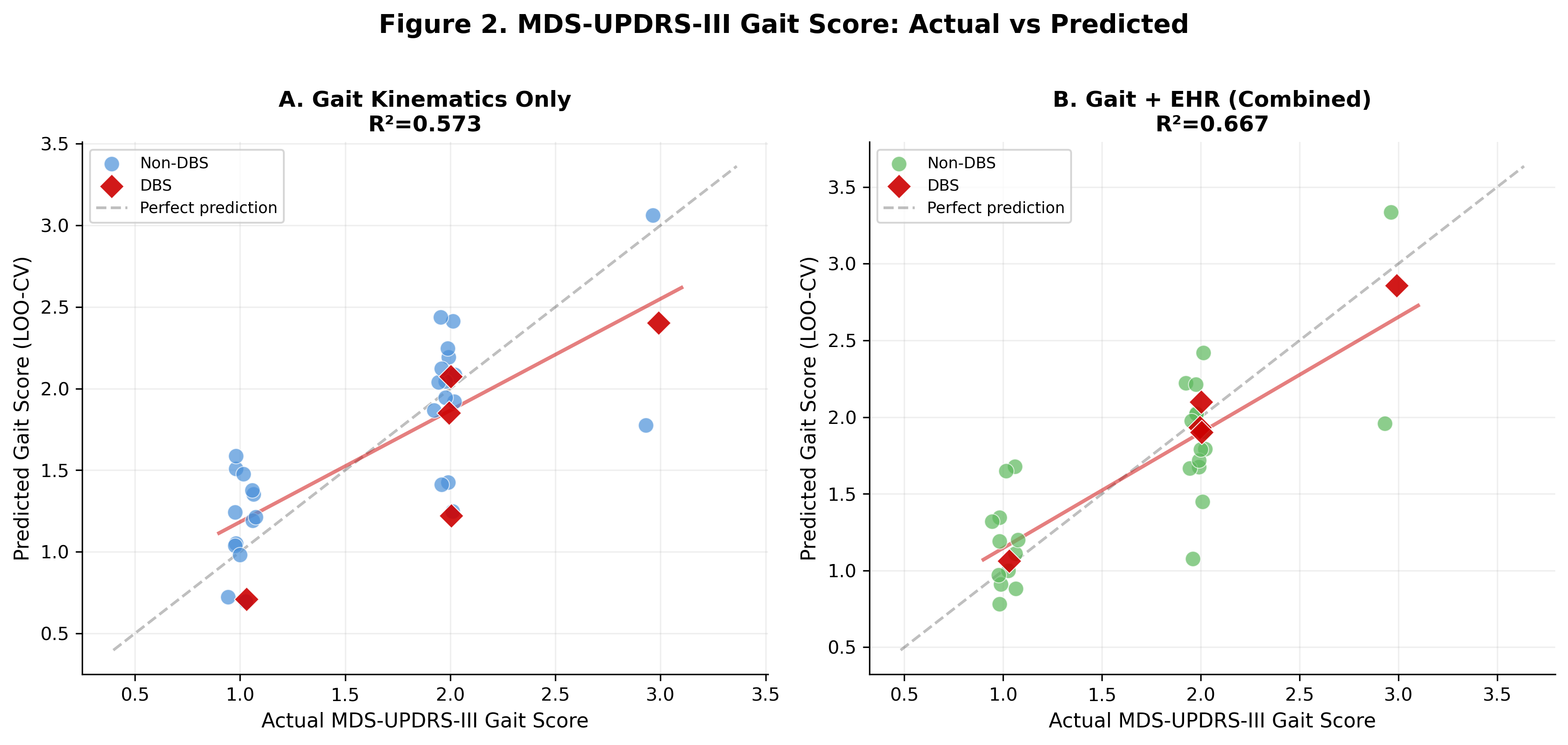
Figure 2
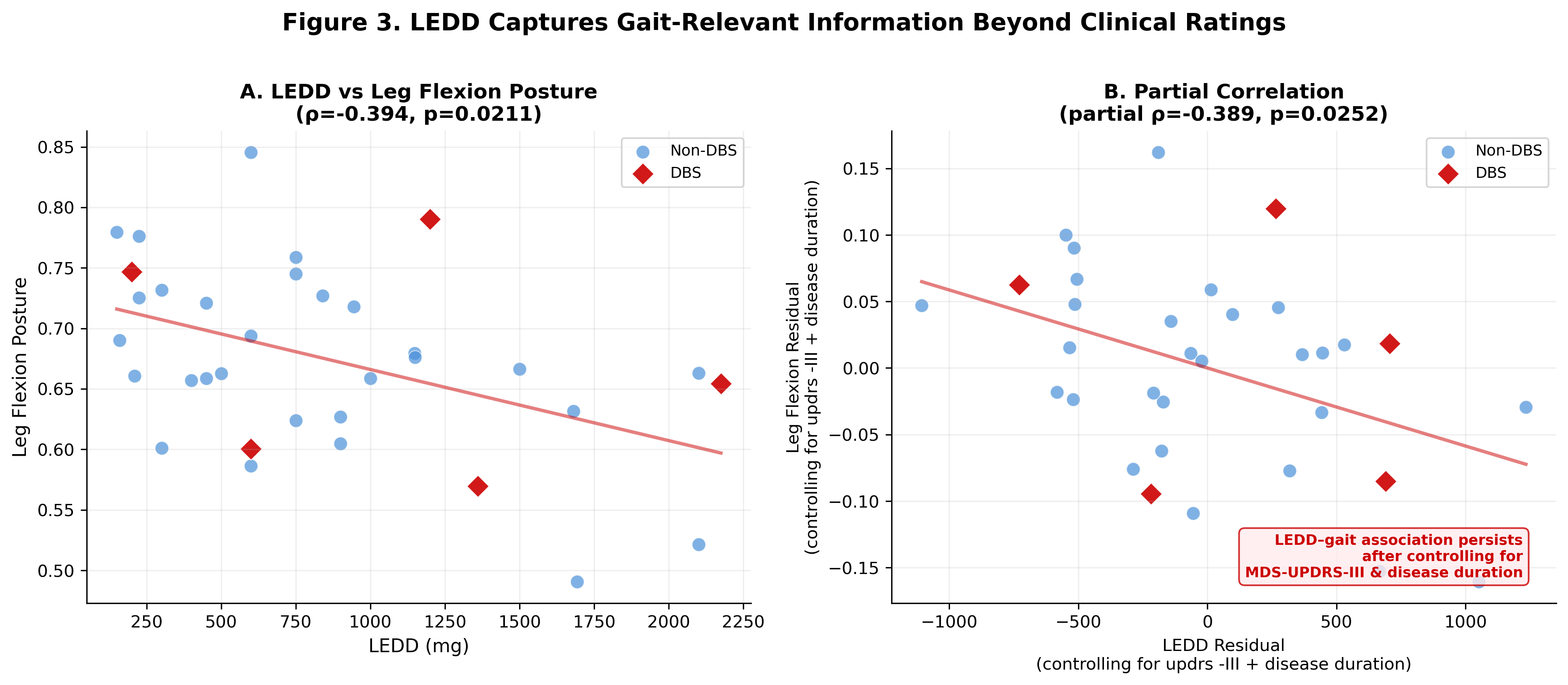
Figure 3
References: [1] Kim, Kyungdo, et al. “TULIP: Multi-Camera 3D Precision Assessment of Parkinson’s Disease.” Proceedings of the IEEE/CVF Conference on Computer Vision and Pattern Recognition. 2024.
[2] Vizcarra JA, Situ-Kcomt M, Artusi CA, et al. Subthalamic deep brain stimulation and levodopa in Parkinson’s disease: a meta-analysis of combined effects. J Neurol. 2019;266(2):289-297.
[3] Smulders K, Dale ML, Carlson-Kuhta P, Nutt JG, Horak FB. Pharmacological treatment in Parkinson’s disease: effects on gait. Parkinsonism Relat Disord. 2016;31:3-13.
[4] Tomlinson CL, Stowe R, Patel S, et al. Systematic review of levodopa dose equivalency reporting in Parkinson’s disease. Mov Disord. 2010;25(15):2649-53.
[5] Jost ST, Kaldenbach MA, Antonini A, et al. Levodopa dose equivalency in Parkinson’s disease: updated systematic review and proposals. Mov Disord. 2023;38(7):1236-1252.
To cite this abstract in AMA style:
L. Lim, K. Kim, Y. Wen, S. Lyu, Y. Shi, K. Mitchell, T. Dunn. Electronic Health Record Integration Improves Markerless 3D Gait-Based Prediction of Parkinson’s Disease Motor Symptom Severity [abstract]. Mov Disord. 2026; 41 (suppl 1). https://www.mdsabstracts.org/abstract/electronic-health-record-integration-improves-markerless-3d-gait-based-prediction-of-parkinsons-disease-motor-symptom-severity/. Accessed October 1, 2026.« Back to 2026 International Congress
MDS Abstracts - https://www.mdsabstracts.org/abstract/electronic-health-record-integration-improves-markerless-3d-gait-based-prediction-of-parkinsons-disease-motor-symptom-severity/