
Category: Parkinson’s Disease: Clinical Trials
Objective: To evaluate the efficacy and safety of once-daily opicapone as adjunct to levodopa in Chinese patients with Parkinson’s disease (PD) and wearing-off, and to assess whether the overall efficacy profile is trend-consistent with global pivotal evidence (BIPARK-1/2).
Background: In global randomized trials, Opicapone 50 mg reduced diary-recorded daily OFF time versus placebo by 60.8 min (BIPARK-1) and 54.3 min (BIPARK-2), with increased total ON time(BIPARK-1: +71.9 min; BIPARK-2: +52.6 min)[1,2].This phase 3 study evaluated Opicapone in a Chinese PD wearing-off population and contextualized the efficacy profile relative to global findings.
Method: Multicenter, randomized, double-blind, placebo-controlled phase 3 trial in Chinese PD patients with wearing-off on stable levodopa/DDCI. Patients received once-daily Opicapone 25 mg, Opicapone 50 mg, or placebo for 14–16 weeks. Primary endpoint: change from baseline in absolute daily OFF time (patient diaries). Key secondary endpoints: change in total ON time and responder rates (≥1 h OFF reduction; ≥1 h ON increase).Safety: TEAEs.
Results: A total of 250 patients were randomized (Opicapone 25 mg, n=100; Opicapone 50 mg, n=99; placebo, n=51). Placebo-adjusted LS mean change in OFF time at end of treatment was −44.7 min (Opicapone 25 mg) and −46.2 min (Opicapone 50 mg), supporting an overall efficacy profile in line with pooled global BIPARK-1/2 results.Total ON time increased by +29.3 min (25 mg) and +45.8 min (50 mg) versus placebo. OFF responders were 60.2% (25 mg) and 62.5% (50 mg) vs 43.2% (placebo); ON responders were 56.8% and 62.5% vs 47.7%, respectively. TEAEs occurred in 68.0% (25 mg), 69.7% (50 mg), and 58.8% (placebo), with no new safety signals.
Conclusion: In Chinese PD patients with wearing-off, once-daily Opicapone (25/50 mg) reduced daily OFF time and increased ON time versus placebo, with an efficacy profile trend-consistent with global pivotal evidence (BIPARK-1/2) and acceptable tolerability.
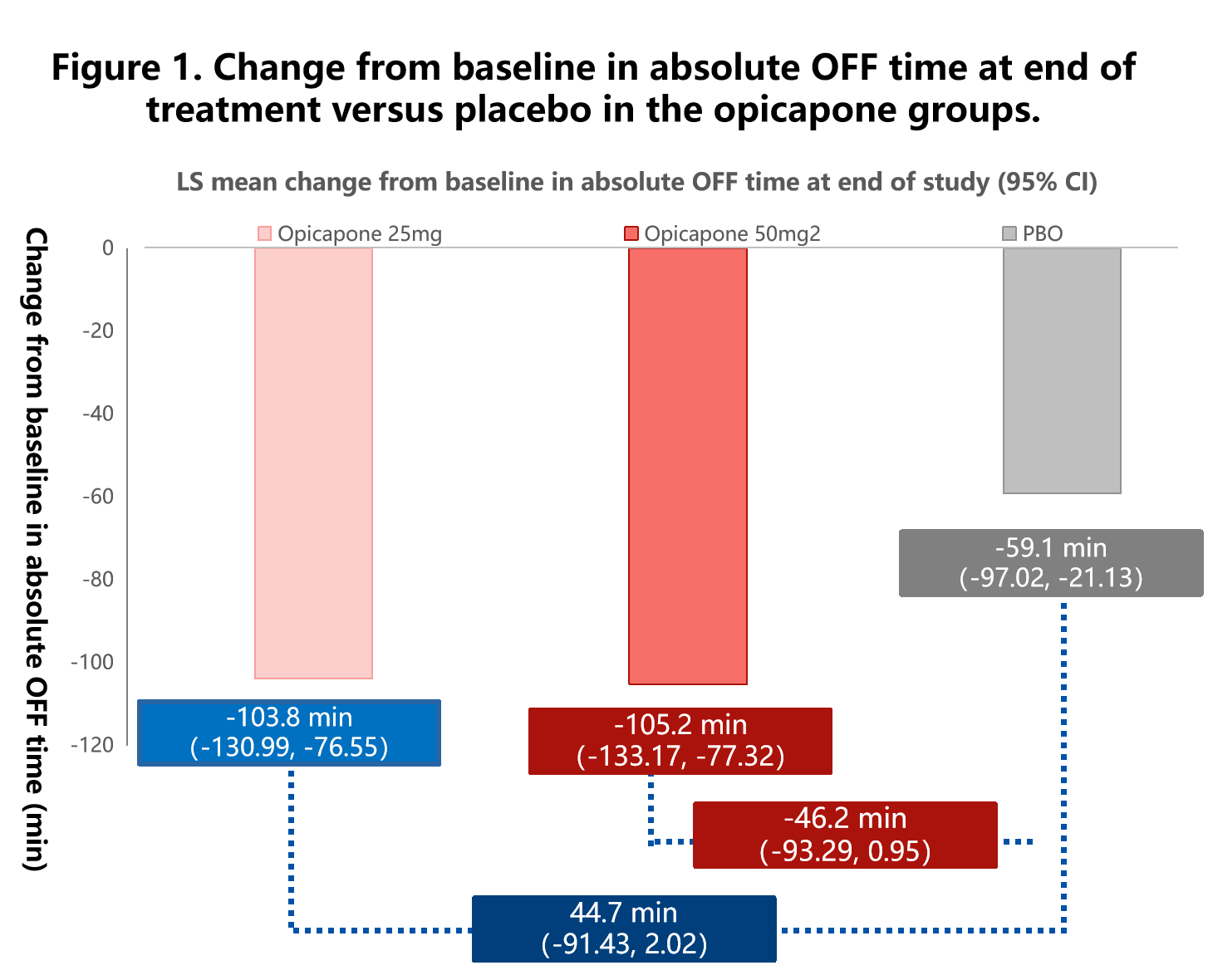
Change from baseline in absolute OFF time
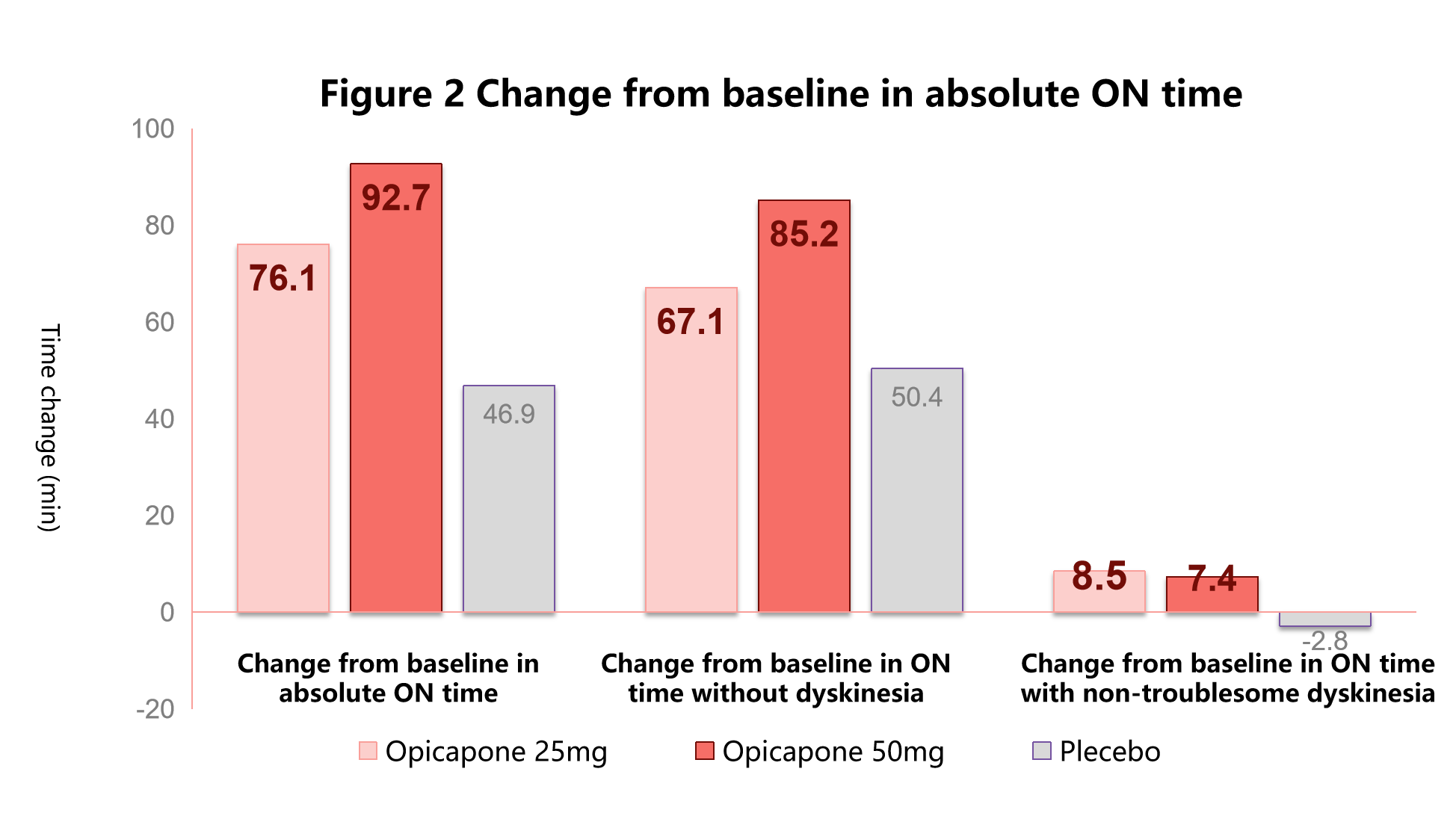
Change from baseline in absolute ON time
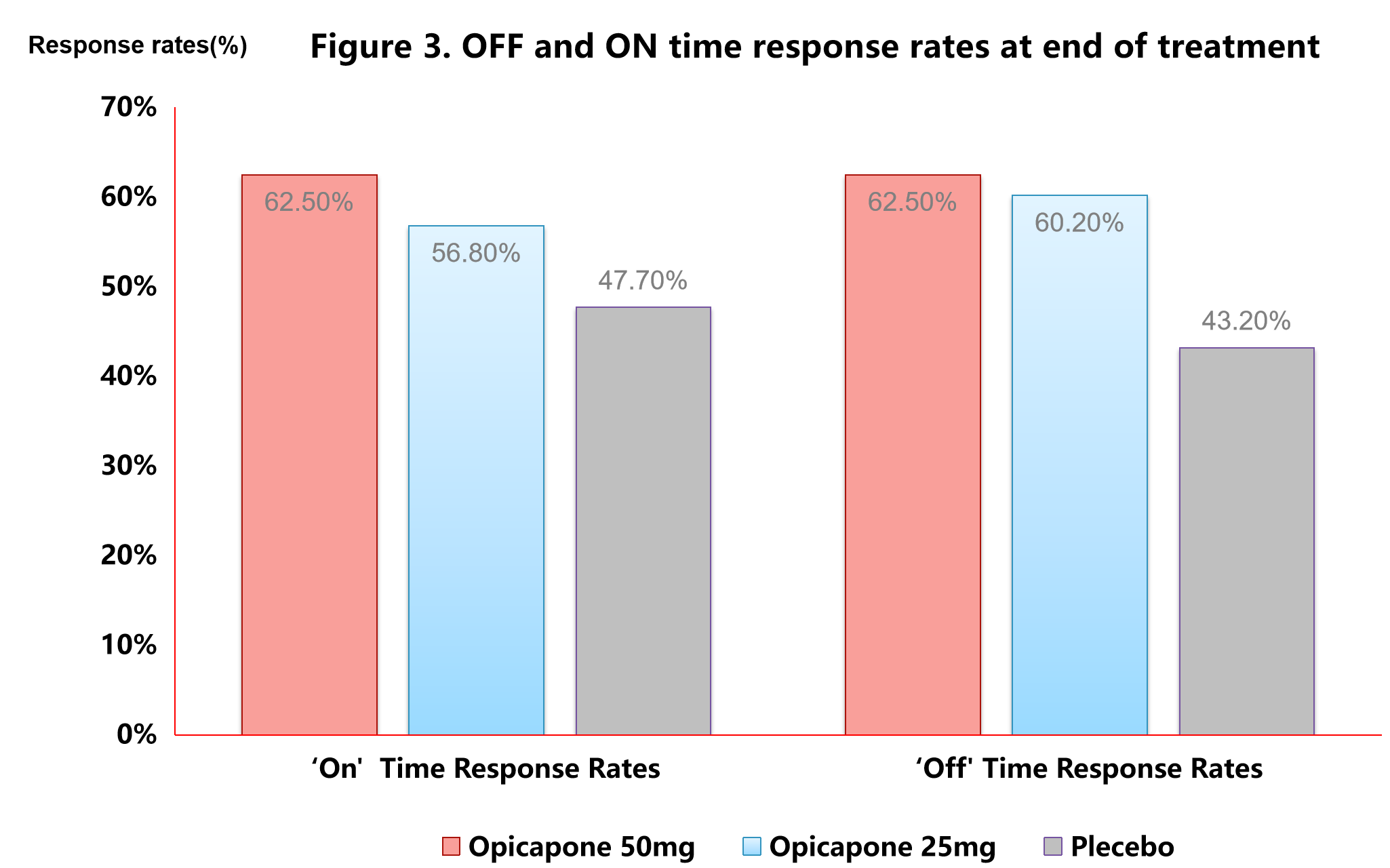
OFF and ON time response rates at end of treatment
References: 1.Ferreira JJ, Lees A, Rocha JF, Poewe W, Rascol O, Soares-da-Silva P, for the BIPARK 1 investigators. Opicapone as an adjunct to levodopa in patients with Parkinson’s disease and end-of-dose motor fluctuations: a randomised, double-blind, controlled trial. Lancet Neurol. 2016;15:154-165.
2.Lees AJ, Ferreira J, Rascol O, Poewe W, Rocha JF, McCrory M, Soares-da-Silva P, for the BIPARK-2 Study Investigators. Opicapone as adjunct to levodopa therapy in patients with Parkinson disease and motor fluctuations: a randomized clinical trial. JAMA Neurol. Published online December 27, 2016. doi:10.1001/jamaneurol.2016.4703.
To cite this abstract in AMA style:
S. Chen, Y. Tan. Opicapone as adjunct to levodopa in Chinese patients with Parkinson’s disease and wearing-off: a randomized, double-blind, placebo-controlled phase 3 trial [abstract]. Mov Disord. 2026; 41 (suppl 1). https://www.mdsabstracts.org/abstract/opicapone-as-adjunct-to-levodopa-in-chinese-patients-with-parkinsons-disease-and-wearing-off-a-randomized-double-blind-placebo-controlled-phase-3-trial/. Accessed October 1, 2026.« Back to 2026 International Congress
MDS Abstracts - https://www.mdsabstracts.org/abstract/opicapone-as-adjunct-to-levodopa-in-chinese-patients-with-parkinsons-disease-and-wearing-off-a-randomized-double-blind-placebo-controlled-phase-3-trial/