
Category: Parkinson’s Disease: Clinical Trials
Objective: To evaluate the achievement of complete elimination of troublesome dyskinesia (TSD) and associated changes in Off time, motor aspects of experiences of daily living (M-EDL), and quality of life (QoL) in people with advanced Parkinson’s disease (aPD) receiving foslevodopa/foscarbidopa (LDp/CDp).
Background: Prolonged oral levodopa use in people with PD often leads to the development or worsening of dyskinesia. Dyskinesias are categorized as non-troublesome (non-TSD) or troublesome (TSD), with TSD significantly interfering with daily functioning, motor activities, and QoL [1]. In phase 3 studies, 24‑hour/day continuous subcutaneous LDp/CDp resulted in improved symptom control, including increased “good On” time (On time without TSD) [2,3]. However, long-term data on complete TSD elimination with continuous LDp/CDp remain limited.
Method: This post hoc subgroup analysis examined data from participants (≥30 years old with ≥2.5 hours Off time/day) with aPD who received LDp/CDp in a 52-week, phase 3, open-label trial (NCT03781167). Self-reported On (with TSD) and Off times were measured using PD diaries normalized to a 16-hour waking day. The proportion of participants with complete resolution of On time with TSD was assessed, along with changes in Off time, M-EDL (MDS-UPDRS II), and PD-related QoL (PDQ-39). Outcomes were reported as change from baseline (CFB) to last available assessment.
Results: Over one-third of study participants (99/244, 41%) had TSD at baseline and were analyzed. Of these, a greater proportion achieved complete TSD elimination by final visit (61/99, 62%) compared with those who did not (38/99, 38%). Baseline PD duration and normalized Off time were similar between patients with or without TSD at final visit (Table 1). Participants with TSD at baseline whose TSD were fully eliminated at final visit experienced significant and sustained Off time reduction at week 52 (CFB:-2.3h, P≤.001***), while improvements in MDS-UPDRS II (CFB:-2.2, P=.085) and PDQ-39 (CFB:-4.8, P=.0844) were numerical but not statistically significant (Table 2).
Conclusion: A substantial proportion of participants with aPD achieved complete TSD elimination after long-term continuous, 24-hour/day dopaminergic stimulation with LDp/CDp, accompanied by a reduction in motor fluctuations.
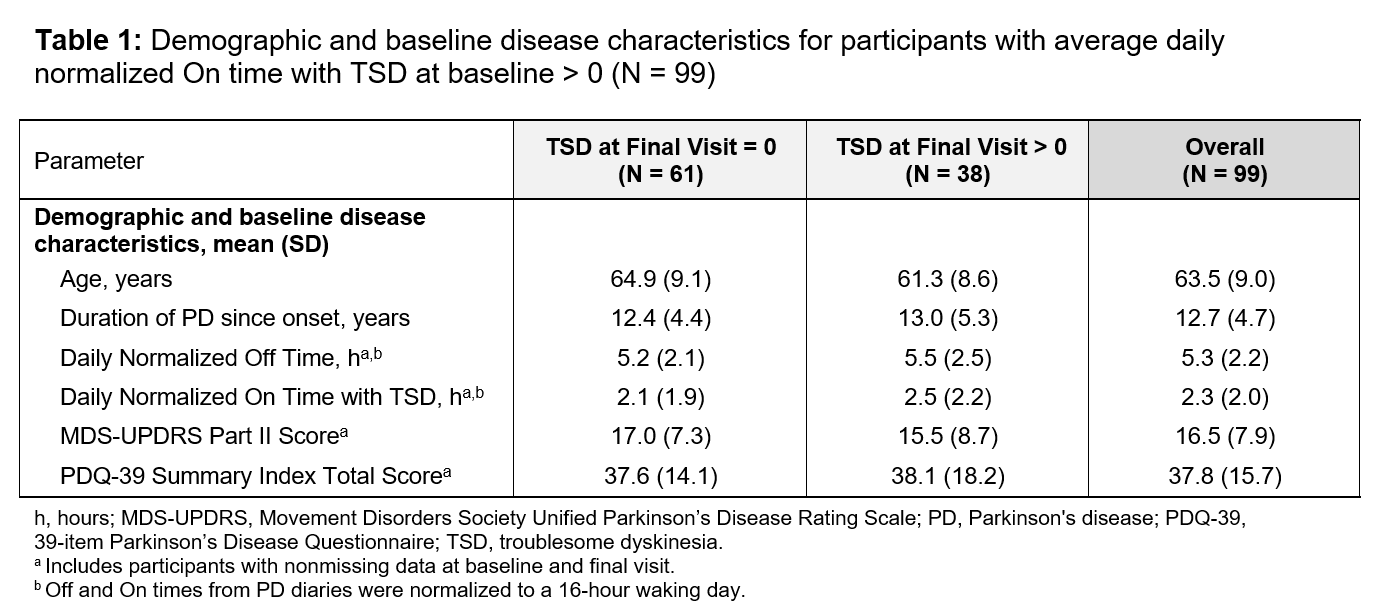
Table1
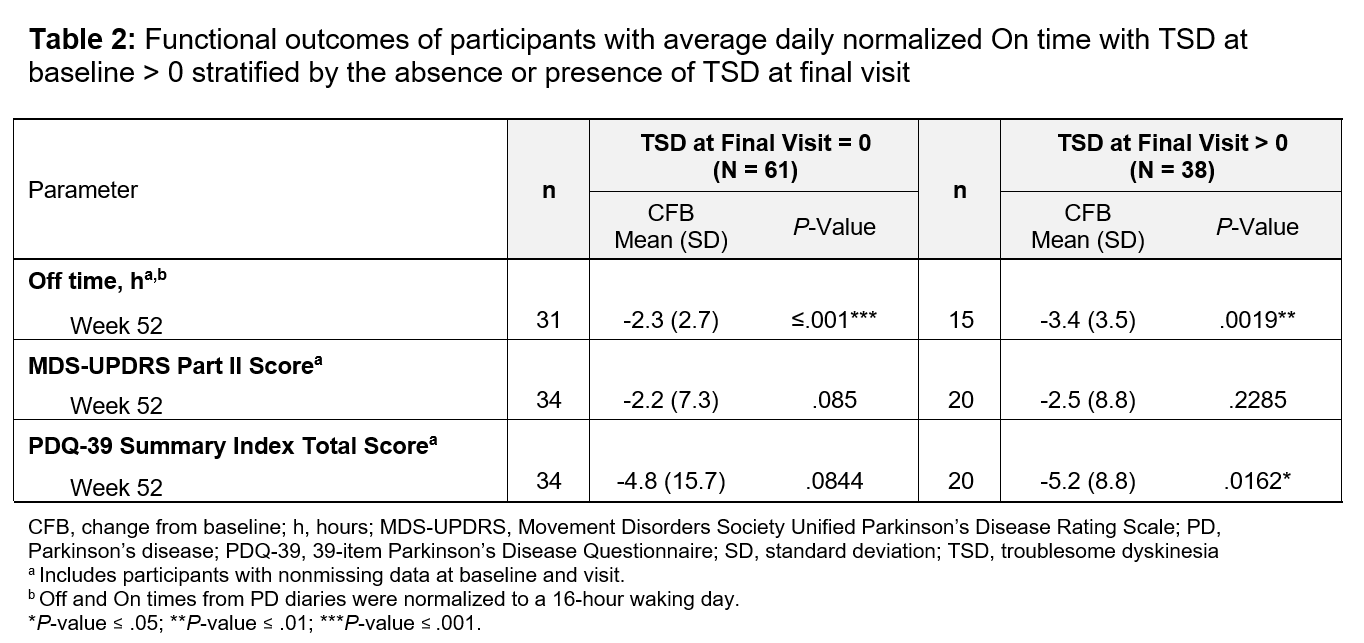
Table2
References: 1. Freire-Alvarez E, Vanni P, Egon Kurca E, et al. Dyskinesia and Pain in Advanced Parkinson’s Disease: Post Hoc Analysis from the Phase 3b, Open-Label, Randomized DYSCOVER Study. Neurol Ther. 2024;13:437–447.
2. Soileau MJ, Aldred J, Budur K, et al. Safety and efficacy of continuous subcutaneous foslevodopa/foscarbidopa in patients with advanced Parkinson’s disease: a randomised, double‑blind, active‑controlled, phase 3 trial. Lancet Neurol. 2022;21(12):1099–109.
3. Aldred J, Freire‑Alvarez E, Amelin AV, et al. Continuous subcutaneous foslevodopa/foscarbidopa in Parkinson’s disease: safety and efficacy results from a 12‑month, single‑arm, open‑label, phase 3 study. Neurol Ther. 2023;12(6):1937–58.
To cite this abstract in AMA style:
R. Hauser, A. Antonini, D. Di Luca, E. Freire-Alvarez, M. Oliveira Fernandes, M. Shah, L. Bergmann, X. Li, M. O’Meara, D. Standaert. Complete Resolution of Troublesome Dyskinesia in People With Advanced Parkinson’s Disease Treated With Foslevodopa/Foscarbidopa: Post Hoc Analysis From a 52-Week Phase 3 Trial [abstract]. Mov Disord. 2026; 41 (suppl 1). https://www.mdsabstracts.org/abstract/complete-resolution-of-troublesome-dyskinesia-in-people-with-advanced-parkinsons-disease-treated-with-foslevodopa-foscarbidopa-post-hoc-analysis-from-a-52-week-phase-3-trial/. Accessed October 1, 2026.« Back to 2026 International Congress
MDS Abstracts - https://www.mdsabstracts.org/abstract/complete-resolution-of-troublesome-dyskinesia-in-people-with-advanced-parkinsons-disease-treated-with-foslevodopa-foscarbidopa-post-hoc-analysis-from-a-52-week-phase-3-trial/