
Objective: To identify balance components associated with the step count change rate during dual task Timed Up and Go in patients with Parkinson’s disease
Background: Dual task gait impairment in Parkinson’s disease is associated with increased fall risk and reduced activities of daily living [1,2]. The Timed Up and Go test (TUG) is widely used to assess dual task gait performance; however, most studies focus on completion time, while changes in step count have been less explored. It remains unclear whether specific balance components contribute to gait strategy adaptation under dual task conditions.
Method: This retrospective cross sectional study was conducted at a single center. Patients with Parkinson’s disease who completed the TUG, dual task TUG, and Mini BESTest without assistance were included. TUG was performed under single and dual task conditions, and time and step count were recorded. During dual task TUG, participants performed serial subtraction while walking. The primary outcome was the step count change rate during dual task TUG, calculated as (dual task step count − single task step count) / single task step count × 100. Balance function was assessed using the Mini BESTest total score and its subsystems. Regression analyses were adjusted for age, sex, Hoehn and Yahr stage, and Mini Mental State Examination.
Results: In simple regression analysis, the Mini-BESTest total score was significantly associated with both the time change rate (n = 394; β = −0.265, p < 0.001) and the step count change rate (n = 388; β = −0.361, p < 0.001). In multiple regression analyses adjusted for age, sex, Hoehn and Yahr stage, and Mini-Mental State Examination (n = 276), reactive postural control (β = −0.144, p = 0.028) and dynamic gait (β = −0.220, p < 0.001) remained independently associated with the step count change rate, whereas anticipatory postural adjustments (β = −0.111, p = 0.083) and sensory orientation (β = −0.066, p = 0.289) were not significant (Tables 1 and 2).
Conclusion: Increased step count during dual task TUG may reflect a compensatory gait stabilization strategy associated with impaired reactive postural control and dynamic gait ability. Step count may provide information complementary to completion time in the assessment of dual task gait performance.
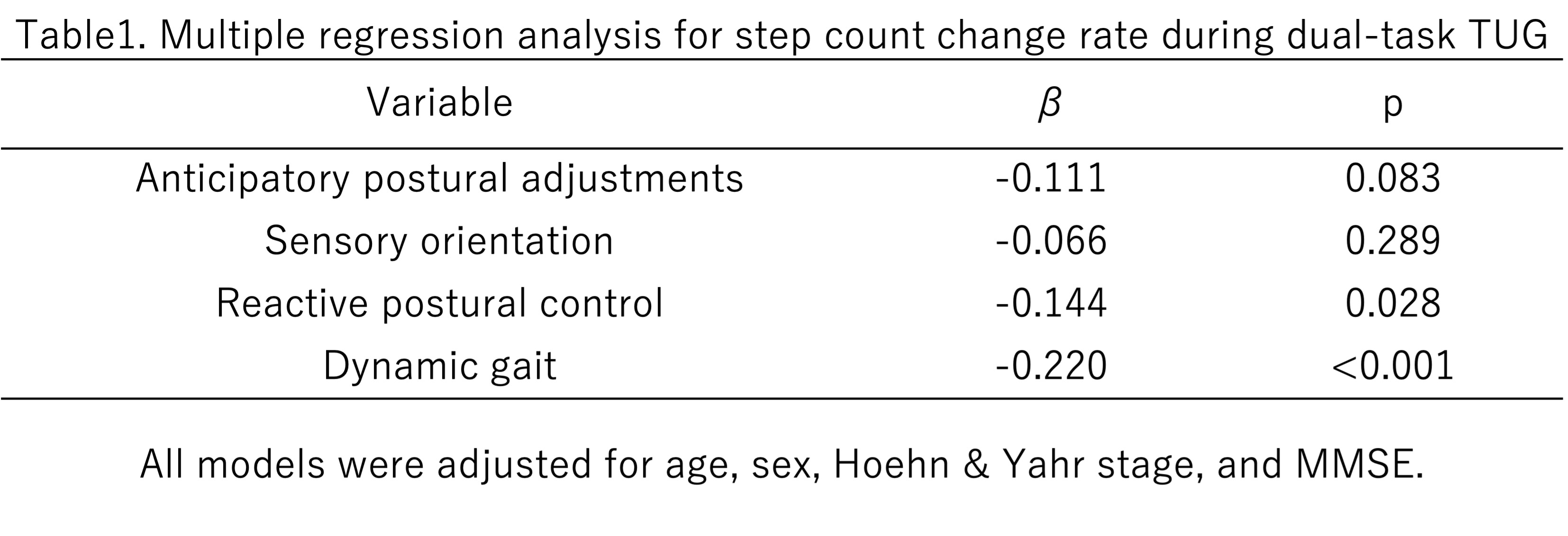
Table1
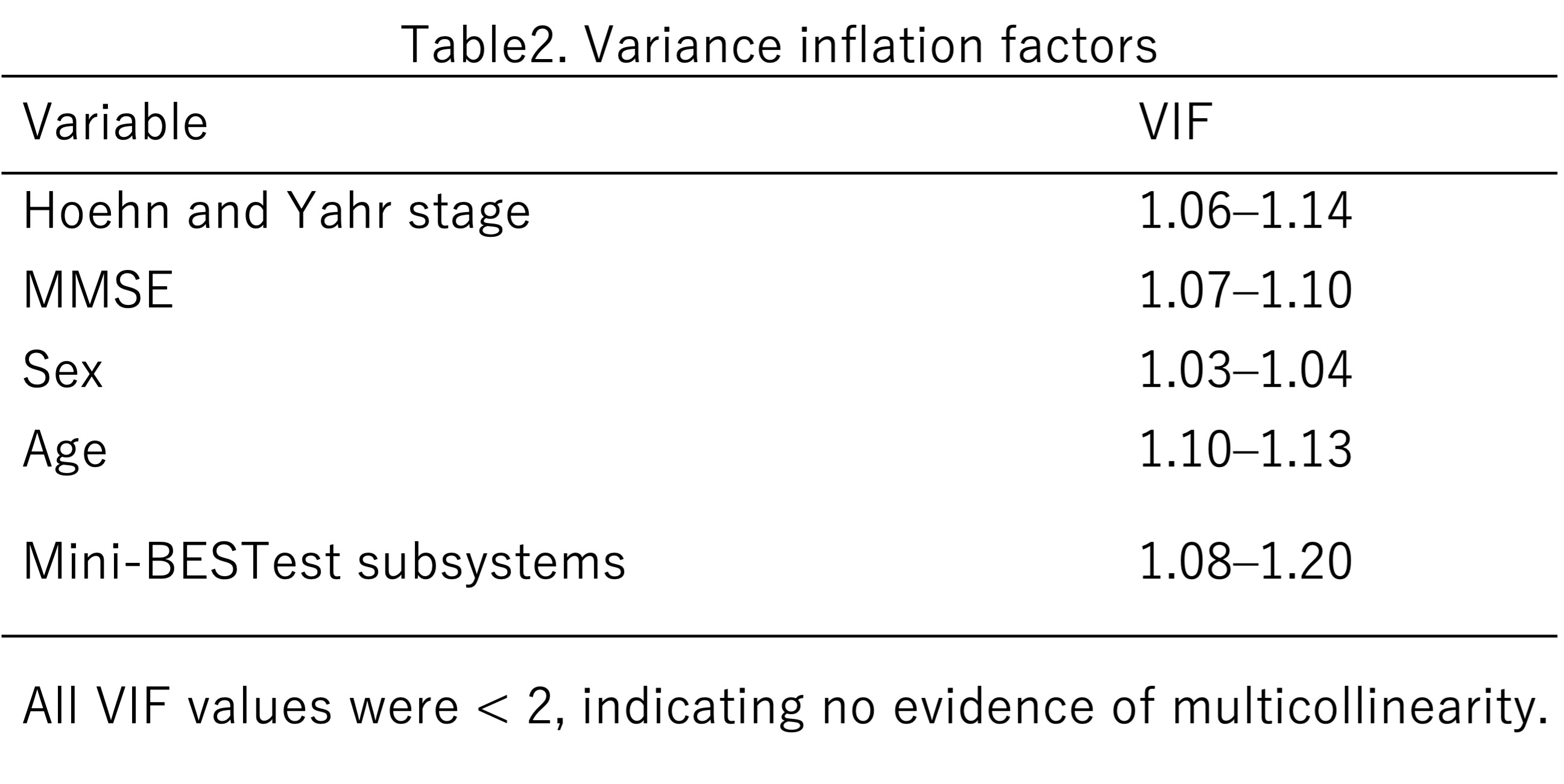
Table2
References: [1] Yogev-Seligmann G, Hausdorff JM, Giladi N. The role of executive function and attention in gait. Movement Disorders. 2008;23(3):329–342.
[2] Montero-Odasso M, Verghese J, Beauchet O, Hausdorff JM. Gait and cognition: a complementary approach to understanding brain function and the risk of falling. Journal of the American Geriatrics Society. 2012;60(11):2127–2136.
[3] Franchignoni F, Horak F, Godi M, Nardone A, Giordano A. Using psychometric techniques to improve the Balance Evaluation Systems Test: the Mini-BESTest. Journal of Rehabilitation Medicine. 2010;42(4):323–331.
To cite this abstract in AMA style:
Y. Yamazaki, T. Nakamura, K. Watanabe, G. Horiguchi, S. Kishimoto, H. Miyamoto, Y. Kameyama, E. Kitahara, K. Haruyama, N. Nishikawa, T. Hatano, N. Hattori, T. Fujiwara. Association Between Step Count Change Rate During Dual Task Timed Up and Go and Balance Components in Parkinson’s Disease [abstract]. Mov Disord. 2026; 41 (suppl 1). https://www.mdsabstracts.org/abstract/association-between-step-count-change-rate-during-dual-task-timed-up-and-go-and-balance-components-in-parkinsons-disease/. Accessed October 1, 2026.« Back to 2026 International Congress
MDS Abstracts - https://www.mdsabstracts.org/abstract/association-between-step-count-change-rate-during-dual-task-timed-up-and-go-and-balance-components-in-parkinsons-disease/