
Category: Parkinson's disease: Neuroimaging
Objective: To elucidate the role of impaired interactions between the basal ganglia and the cerebellum in the PI development in PD patients.
Background: Postural instability (PI) is a significant risk factor for falls in Parkinson’s disease (PD) and has limited response to dopaminergic therapy. Maintaining balance involves a dynamic interaction between higher-order cognition and the specialized circuits of the cerebellar-basal ganglia network, which are critical for postural stability.
Method: 37 PD patients categorized into PI-positive (Group 1) and PI-negative (Group 2), and 20 age-matched controls underwent comprehensive evaluation. Assessment included the TUG test, a 5-point postural stability scale (0–4), and cognitive screening via MoCA and MMSE. Neuroimaging analysis was performed using rs-fMRI (SPM12/CONN toolbox).
Results: Patients with PI had a longer PD duration, poorer TUG performance and more pronounced cognitive decline (Table). Compared to controls, both PD groups demonstrated increased functional connectivity (FC) within cerebellar and cerebello-thalamic circuits (p≤0,001). While cerebellar-basal ganglia FC was extensively reduced in both PD groups. The cerebellar vermis (regions VI-X), showed altered connectivity with the putamen and caudate, reflecting motor and gait impairments. The decrease in FC was most marked in the 1st group and correlated with the PI severity and TUG score. Vermis-somatomotor FC was severely impaired in the 1st group, reaching a complete loss of connectivity between several ROIs, whereas the 2nd group showed upregulated connectivity in these circuits. PD patients with PI exhibited weaker vermis – dorsolateral prefrontal cortex FC compared to 2nd group, and this reduced connectivity significantly correlated with lower MoCA score.
Conclusion: The upregulated FC within the cerebellum and vermis–somatomotor network, occurring alongside diminished cerebello-basal ganglia FC, likely serves as a homeostatic response to basal ganglia dysfunction. This may represent a critical compensatory strategy for maintaining postural stability during the earlier PD stages. Deterioration of the connections between the vermis and somatomotor and dorsolateral prefrontal cortex reflects a failure of compensation during the PD progression. This disruption not only reflects cognitive impairment but also appears to be a key factor in the PI development.
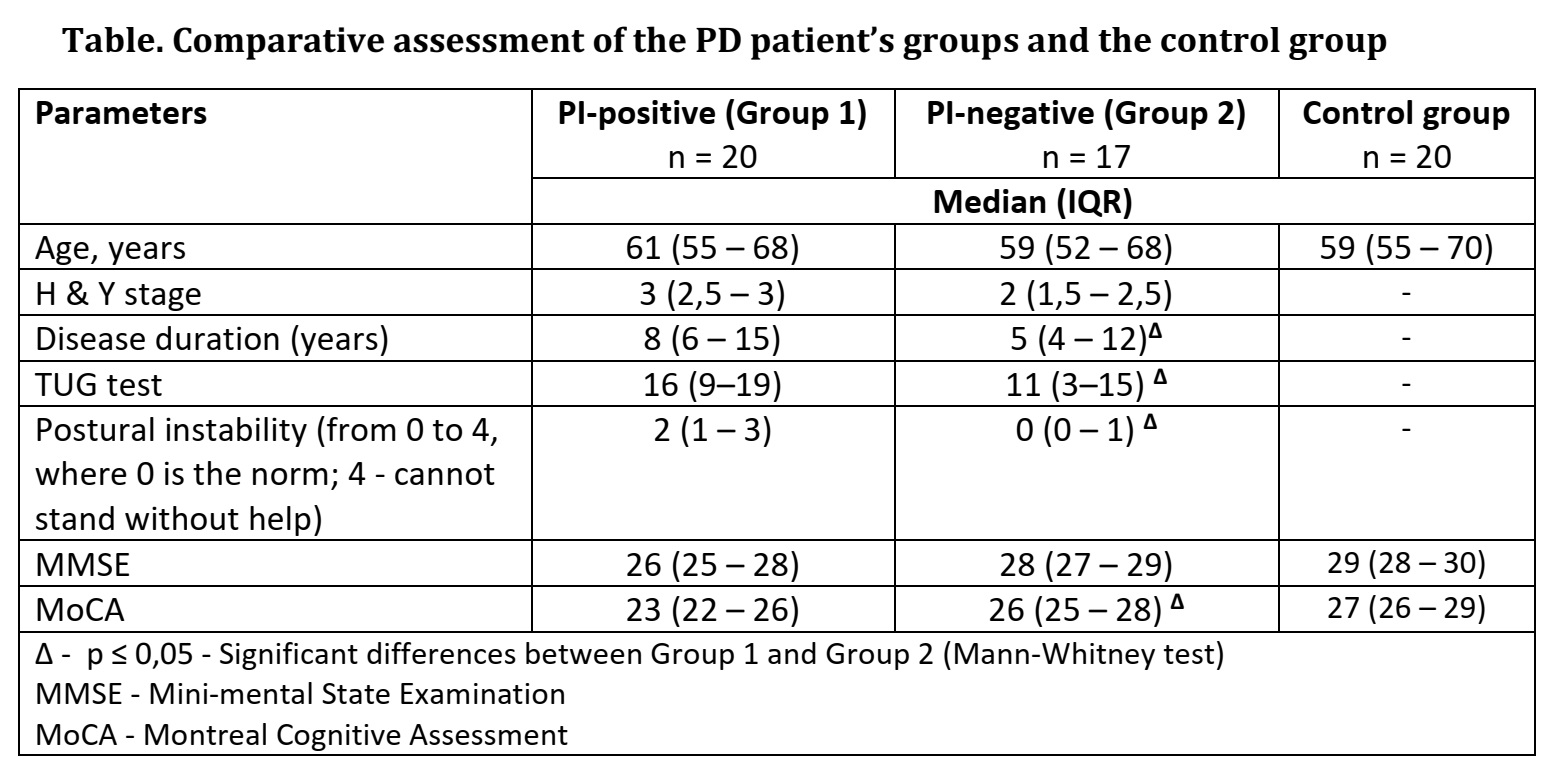
Table. Comparative assessment of patient groups
To cite this abstract in AMA style:
O. Alenikova, A. Chumak, L. Parkhach. Cerebellar-Basal Ganglia Circuitry in the Pathogenesis of Parkinsonian Postural Instability [abstract]. Mov Disord. 2026; 41 (suppl 1). https://www.mdsabstracts.org/abstract/cerebellar-basal-ganglia-circuitry-in-the-pathogenesis-of-parkinsonian-postural-instability/. Accessed October 1, 2026.« Back to 2026 International Congress
MDS Abstracts - https://www.mdsabstracts.org/abstract/cerebellar-basal-ganglia-circuitry-in-the-pathogenesis-of-parkinsonian-postural-instability/