
Objective: We aimed to characterize the domain-specific distribution of autonomic symptoms in newly diagnosed, drug-naive PD and to investigate whether distinct autonomic patterns are associated with axial motor impairment and early functional vulnerability at diagnosis.
Background: Autonomic dysfunction is common in Parkinson’s disease (PD) from its prodromal stage, yet its heterogeneity and relationship with clinical features remain incompletely understood.
Method: We analyzed 88 newly diagnosed, drug-naive PD patients who were assessed using the SCOPA-AUT (The scales for autonomic dysfunction) questionnaire. Motor-related ADL and severity were evaluated using UPDRS parts II and III, with predefined subscores for bradykinesia, rigidity, tremor, and postural instability/gait difficulty (PIGD). Autonomic burdens, especially gastrointestinal (GI) dysautonomia severity, were examined using a median split to define mild and moderate to severe subgroups, and the comparisons between the groups were performed.
Results: SCOPA-AUT scores showed non-normal, right-skewed distributions, indicating substantial heterogeneity in autonomic burden. Among autonomic domains, GI symptoms showed the strongest correlation with activities of daily living (UPDRS II; r=0.64, p<0.001), exceeding other autonomic domains. GI dysautonomia correlated with overall motor severity (r=0.38, p<0.001), bradykinesia (r=0.31, p=0.003), and PIGD score (r=0.28, p=0.008), but not with tremor severity.
Compared with GI-mild patients, the GI-moderate to severe subgroup demonstrated significantly worse UPDRS II and III scores, higher PIGD burden, lower MoCA-K scores, and a higher proportion of PIGD motor subtype, without increased motor asymmetry. In multivariable analysis, functional disability (UPDRS II) and cognitive performance independently predicted GI-moderate to severe status.
Conclusion: In drug-naive PD, GI autonomic dysfunction identifies a distinct axial–functional vulnerability phenotype characterized by greater postural–gait impairment, functional disability, and cognitive vulnerability. Early GI dysautonomia may represent a key clinical marker of PIGD type with higher motor burden at diagnosis.
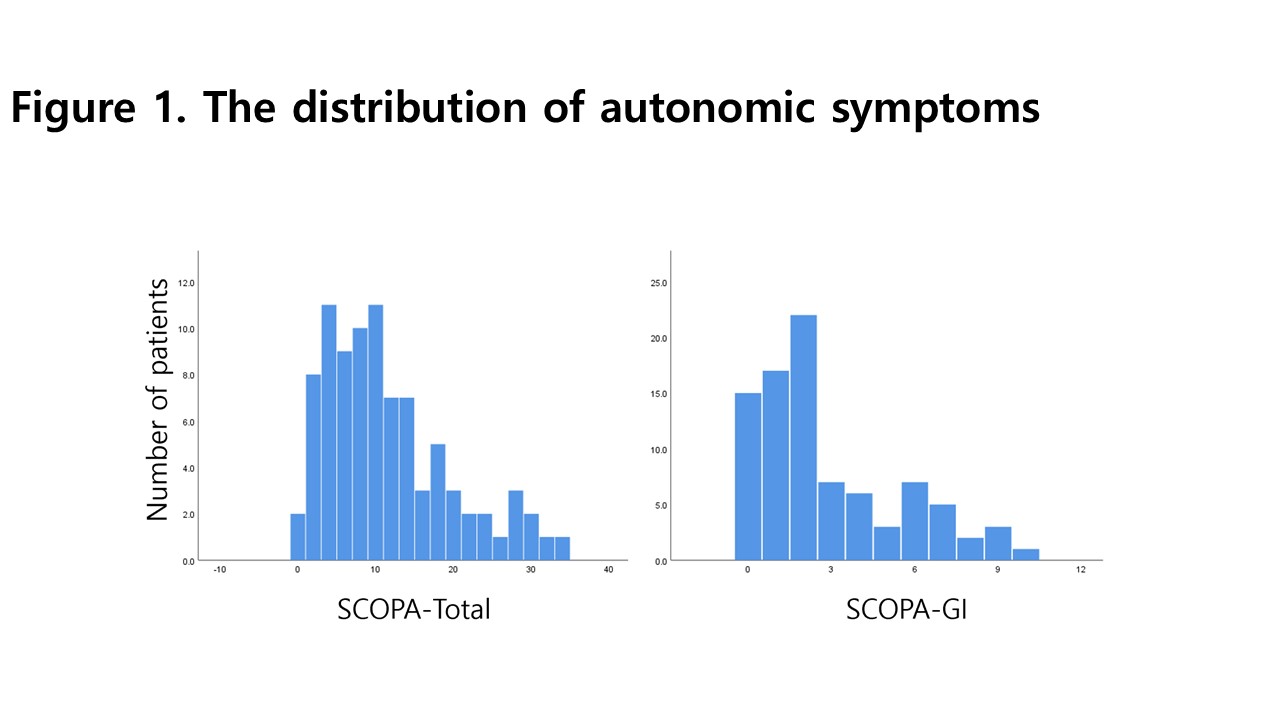
Figure 1
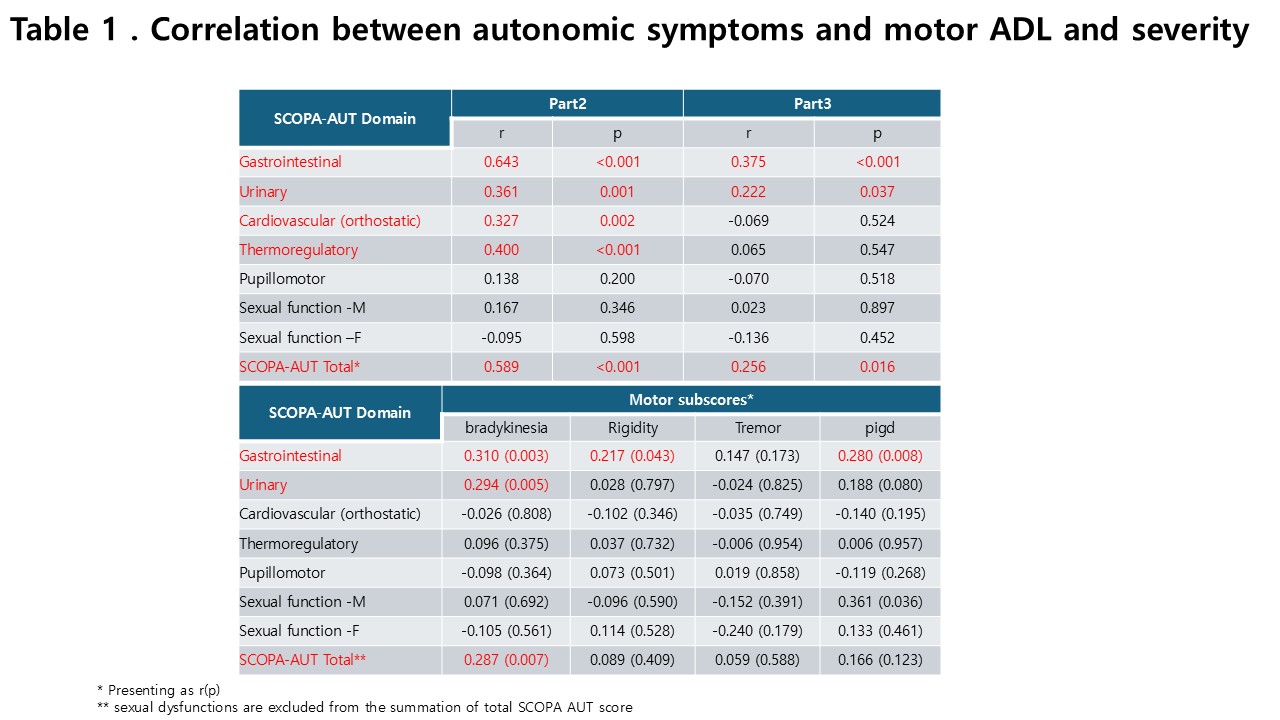
Table 1
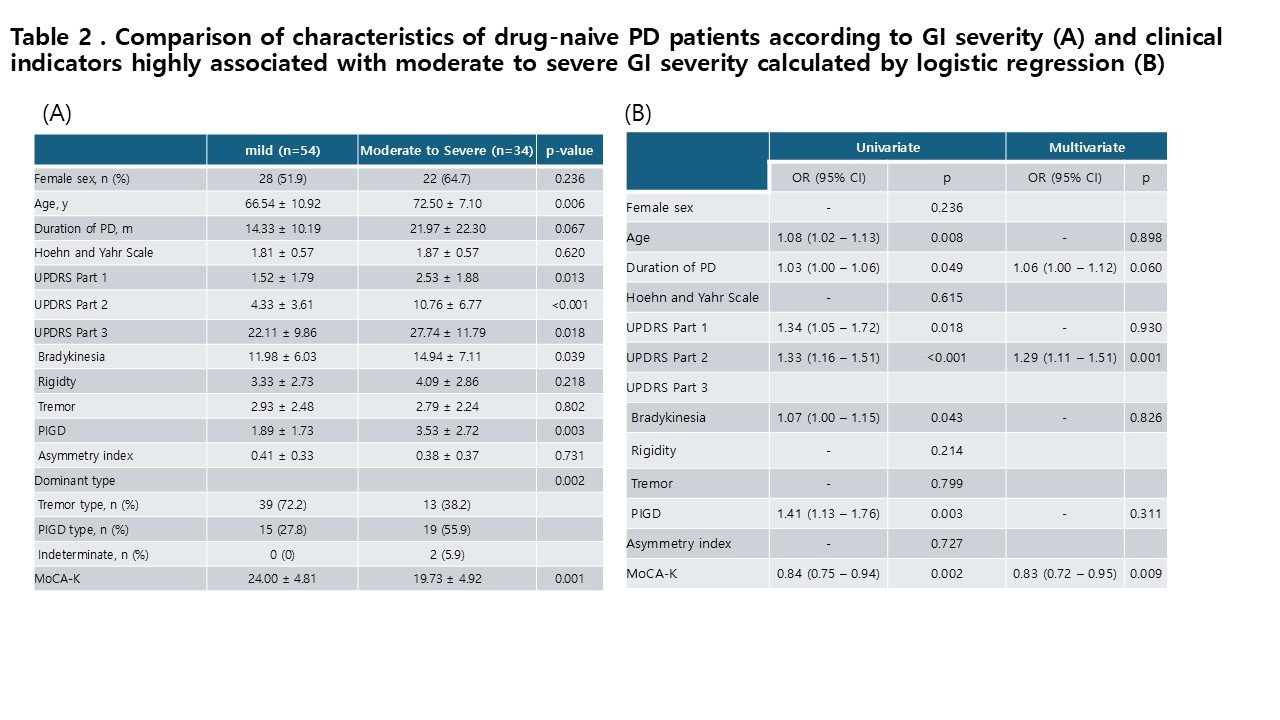
Table 2
To cite this abstract in AMA style:
YS. Hwang, J. Park, JM. Seok. The Nature of autonomic dysfunction and its relationship with motor symptoms in Drug-Naive Parkinson’s Disease Patients: Korean Cohort Data [abstract]. Mov Disord. 2026; 41 (suppl 1). https://www.mdsabstracts.org/abstract/the-nature-of-autonomic-dysfunction-and-its-relationship-with-motor-symptoms-in-drug-naive-parkinsons-disease-patients-korean-cohort-data/. Accessed October 1, 2026.« Back to 2026 International Congress
MDS Abstracts - https://www.mdsabstracts.org/abstract/the-nature-of-autonomic-dysfunction-and-its-relationship-with-motor-symptoms-in-drug-naive-parkinsons-disease-patients-korean-cohort-data/