
Category: Parkinson’s Disease: Clinical Trials
Objective: To examine whether the upregulation of the posterior parietal cortex (PPC) facilitates gait adaptation on the split-belt treadmill (SBT) and its transfer to overground walking in people with Parkinson’s disease (PwPD).
Background: The ability to adjust gait to environmental demands is often impaired in PwPD1,2. Although SBT training improves treadmill gait performance3,4, its effects do not consistently transfer to overground walking that requires advanced gait adaptation5, and it may depend on cognitive function6. Recent studies suggest that upregulating brain areas associated with cognitive-motor control may help alleviate motor impairment in PwPD9–11. The PPC is an area of interest because is activated during SBT7,8. Therefore, we investigated whether pairing SBT training with PPC upregulation enhances gait adaptation on SBT training and facilitates transfer of this adaptation to overground walking in PwPD.
Method: This randomized controlled crossover, single-blinded, and sham-controlled study included three visits: clinical screening on day 1 and two experimental sessions on day 2 and day 3. On each experimental day, participants completed pre-overground walking (straight walking, turning and steering) and pre-SBT adaptation tests (4 minutes of walking with belt-speed alternations every 30 seconds). Then, either real intermittent Theta Burst Stimulation (iTBS) or sham iTBS was applied at 80% of the first dorsal interosseus’ resting motor threshold, followed by SBT adaptation training (continuous changing belt ratios for 30 minutes with 1-minute breaks every 5 minutes). Finally, post-overground and post-SBT adaptation tests were performed. Gait parameters, including dual support, stride length, cadence, and symmetry ratios, were measured by APDM and Motive software.
Results: Preliminary results (n=5) showed a statistically significant decrease in dual support time (DS%) in a gait cycle pre- vs. post-overground (F(1, 25) = 4.70, p = .024) (Fig.1). However, there was no significant difference between iTBS vs sham.
Conclusion: These preliminary findings suggest that 30 minutes of SBT adaptation training could improve DS%, although this improvement did not seem to be influenced by the intervention type (iTBS vs. sham). This research would help us to provide new insights into integrating neuromodulation to physical training in PwPD.
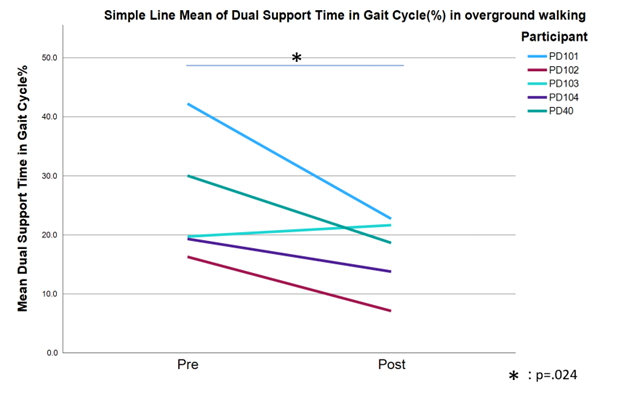
Figure.1
References: 1. Maidan I, Rosenberg-Katz K, Jacob Y, et al. Altered brain activation in complex walking conditions in patients with Parkinson’s disease. Parkinsonism Relat Disord. 2016;25:91-96. doi:10.1016/j.parkreldis.2016.01.025
2. Olson M, Lockhart TE, Lieberman A. Motor Learning Deficits in Parkinson’s Disease (PD) and Their Effect on Training Response in Gait and Balance: A Narrative Review. Front Neurol. 2019;10:62. doi:10.3389/fneur.2019.00062
3. Roemmich RT, Nocera JR, Stegemöller EL, Hassan A, Okun MS, Hass CJ. Locomotor adaptation and locomotor adaptive learning in Parkinson’s disease and normal aging. Clin Neurophysiol. 2014;125(2):313-319. doi:10.1016/j.clinph.2013.07.003
4. Seuthe J, D’Cruz N, Ginis P, et al. The Effect of One Session Split-Belt Treadmill Training on Gait Adaptation in People With Parkinson’s Disease and Freezing of Gait. Neurorehabil Neural Repair. 2020;34(10):954-963. doi:10.1177/1545968320953144
5. Hulzinga F, Seuthe J, D’Cruz N, Ginis P, Nieuwboer A, Schlenstedt C. Split-Belt Treadmill Training to Improve Gait Adaptation in Parkinson’s Disease. Mov Disord. 2023;38(1):92-103. doi:10.1002/mds.29238
6. Sasikumar S, Sorrento G, Lang AE, Strafella AP, Fasano A. Cognition affects gait adaptation after split-belt treadmill training in Parkinson’s disease. Neurobiol Dis. 2023;181:106109. doi:10.1016/j.nbd.2023.106109
7. Hinton DC, Thiel A, Soucy JP, Bouyer L, Paquette C. Adjusting gait step-by-step: Brain activation during split-belt treadmill walking. NeuroImage. 2019;202:116095. doi:10.1016/j.neuroimage.2019.116095
8. Jacobsen NA, Ferris DP. Electrocortical activity correlated with locomotor adaptation during split-belt treadmill walking. J Physiol. 2023;601(17):3921-3944. doi:10.1113/JP284505
9. Panda R, Deluisi JA, Lee TG, et al. Improving efficacy of repetitive transcranial magnetic stimulation for treatment of Parkinson disease gait disorders. Front Hum Neurosci. 2024;18. doi:10.3389/fnhum.2024.1445595
10. Potvin-Desrochers A, Paquette C. Potential Non-invasive Brain Stimulation Targets to Alleviate Freezing of Gait in Parkinson’s Disease. Neuroscience. 2021;468:366-376. doi:10.1016/j.neuroscience.2021.05.037
11. Potvin-Desrochers A, Martinez-Moreno A, Clouette J, Parent-L’Ecuyer F, Lajeunesse H, Paquette C. Upregulation of the parietal cortex improves freezing of gait in Parkinson’s disease. J Neurol Sci. 2023;452:120770. doi:10.1016/j.jns.2023.120770
To cite this abstract in AMA style:
T. Ogawa, C. Guedes, C. Mvomo, L. Hajjaji, J. Bedime, A. Potvin-Desrochers, C. Paquette. Can people with Parkinson’s disease improve gait adaptation skills via upregulation of the posterior parietal cortex? [abstract]. Mov Disord. 2026; 41 (suppl 1). https://www.mdsabstracts.org/abstract/can-people-with-parkinsons-disease-improve-gait-adaptation-skills-via-upregulation-of-the-posterior-parietal-cortex/. Accessed October 1, 2026.« Back to 2026 International Congress
MDS Abstracts - https://www.mdsabstracts.org/abstract/can-people-with-parkinsons-disease-improve-gait-adaptation-skills-via-upregulation-of-the-posterior-parietal-cortex/