
Objective: To examine if illness representations and cognitive-behavioural responses to symptoms explain additional variance in health-related quality of life (HRQoL) beyond demographic and established clinical factors in Parkinson’s disease (PD).
Background: Psychological factors, including how people perceive and respond to their illness and symptoms, may influence HRQoL in chronic conditions[1,2]. However, their role in PD remains unclear.
Method: This multi-centre, cross-sectional study recruited 58 people with idiopathic PD (median age 68 years; 55.2% male; 48.3% from minoritised ethnic backgrounds; Hoehn and Yahr stage 2-3). All underwent assessment of motor complications (Movement Disorder Society-Unified Parkinson’s Disease Rating Scale Part IV; MDS-UPDRS IV) and HRQoL (Parkinson’s Disease Questionnaire-39 Summary Index; PDQ-39 SI). Illness perceptions were measured with the Illness Perception Questionnaire-Revised (IPQ-R) Part 2, and cognitive-behavioural responses to symptoms with Cognitive and Behavioural Responses Questionnaire (CBRQ). Regression models were adjusted for age, sex, disease duration, motor severity (MDS-UPDRS Part III), levodopa equivalent daily dose (LEDD), anxiety (Hospital Anxiety and Depression Scale; HADS-Anxiety), depression (HADS-Depression), and cognitive function (Montreal Cognitive Assessment).
Results: Demographic and clinical covariates explained 77.3% of the variance in HRQoL (R²=.773). The addition of motor complication severity accounted for a significant incremental 3.7% of variance (ΔR²=.037, p=.004). Subsequent inclusion of illness consequences (IPQ-R) and catastrophising (CBRQ) explained a further 4.1% of variance (ΔR²=.041, p=.004), yielding a final adjusted R² of .815. In the fully adjusted model, catastrophising (B=.797, p=.027) and perceived consequences (B=.767, p=.013) remained independently associated with HRQoL. Age (p=.027), anxiety (p<.001), cognitive function (p=.007), and LEDD (p=.046) were also associated with HRQoL, while motor severity showed weaker association (p=.053).
Conclusion: HRQoL in PD appears to be influenced not only by the severity of motor symptoms but also by how patients interpret and respond to them (FIG 1). Clinicians should explore patients’ beliefs and responses to symptoms, to inform more holistic care and support adaptive coping strategies[3].
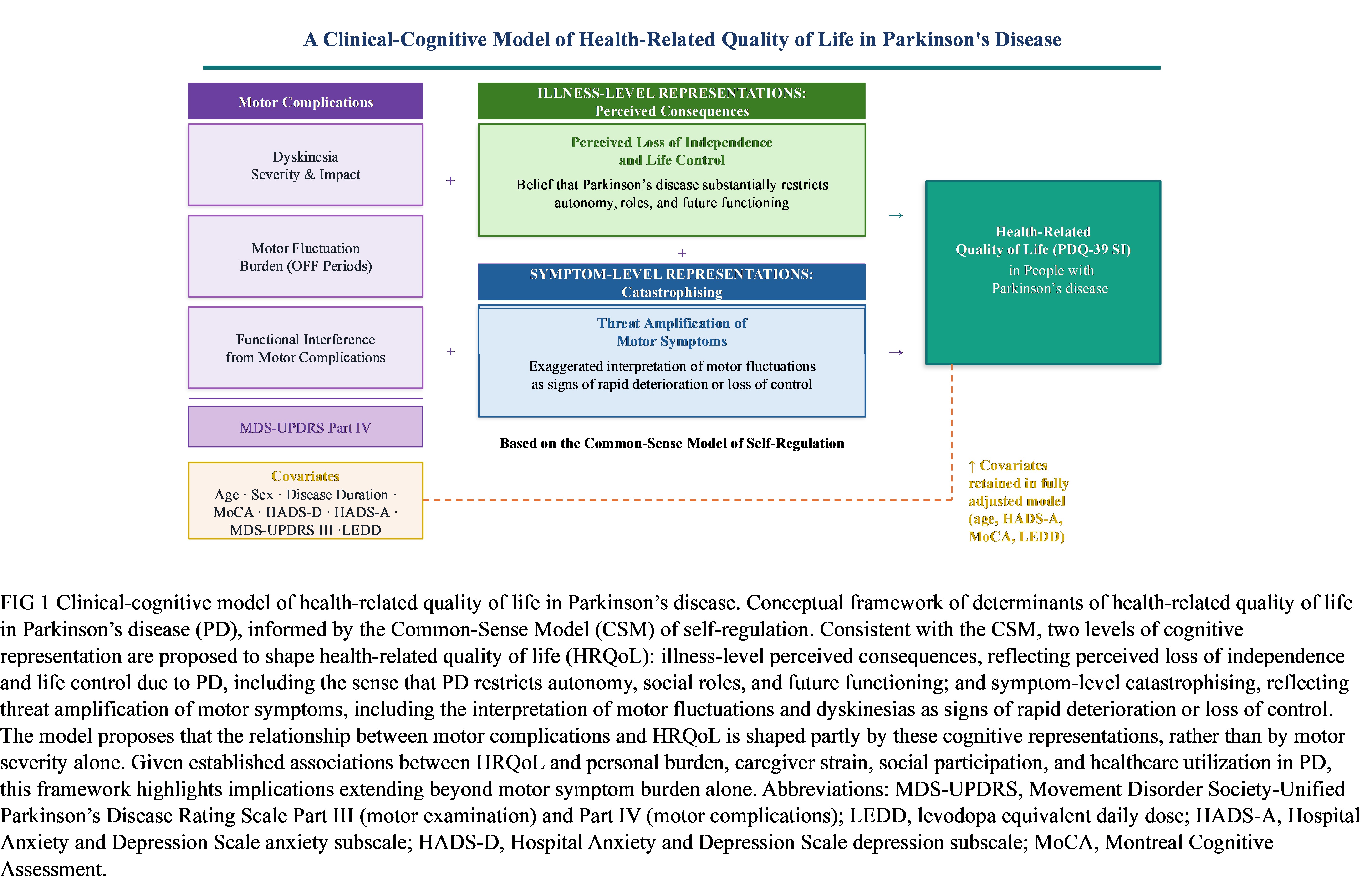
FIG
References: [1] Suzukamo Y, Ohbu S, Kondo T, Kohmoto J, Fukuhara S. Psychological adjustment has a greater effect on health-related quality of life than on severity of disease in Parkinson’s disease. Mov Disord. 2006 Jun;21(6):761-6. doi: 10.1002/mds.20817. PMID: 16511869.
[2] Evans D, Norman P. Illness representations, coping and psychological adjustment to Parkinson’s disease. Psychol Health. 2009 Dec;24(10):1181-96. doi: 10.1080/08870440802398188. PMID: 20204987.
[3] Hurt CS, Burn DJ, Hindle J, Samuel M, Wilson K, Brown RG. Thinking positively about chronic illness: An exploration of optimism, illness perceptions and well-being in patients with Parkinson’s disease. Br J Health Psychol. 2014 May;19(2):363-79. doi: 10.1111/bjhp.12043. Epub 2013 Mar 19. PMID: 23510498.
To cite this abstract in AMA style:
V. Azoidou, E. Bhadra, E. Camboe, K. Dey, A. Zirra, K. Rowsell, C. Quah, C. Budu, T. Boyle, D. Gallagher, J. Bestwick, L. Smith, A. Noyce, C. Simonet. Perceived Consequences and Catastrophising Help Explain Health-Related Quality of Life in Parkinson’s Disease [abstract]. Mov Disord. 2026; 41 (suppl 1). https://www.mdsabstracts.org/abstract/perceived-consequences-and-catastrophising-help-explain-health-related-quality-of-life-in-parkinsons-disease/. Accessed October 1, 2026.« Back to 2026 International Congress
MDS Abstracts - https://www.mdsabstracts.org/abstract/perceived-consequences-and-catastrophising-help-explain-health-related-quality-of-life-in-parkinsons-disease/