
Category: Parkinsonism (Other)
Objective: To determine whether mechanical ventilation modifies survival and disease trajectory in an expanded Japanese pedigree with DCTN1 p.G71A–related Perry disease.
Background: Perry disease is a rare autosomal dominant parkinsonian disorder caused by DCTN1 mutations and clinically characterized by early-onset parkinsonism, apathy, unexpected weight loss, and central hypoventilation leading to premature death. Historically described as rapidly fatal within 5 years, its natural history has been defined largely in the pre-ventilatory era. Whether structured respiratory management can alter long-term prognosis remains unknown.
Method: We retrospectively analyzed nine affected individuals from the original Japanese family (FUK-1) carrying the DCTN1 p.G71A mutation over more than two decades. Clinical features, ventilatory intervention, and survival were evaluated. Kaplan–Meier survival analysis compared patients with and without long-term mechanical ventilation.
Results: Median age at onset was 43 years. Median survival was 16.5 years in ventilated patients versus 5 years in non-ventilated patients (log-rank p = 0.005). Four patients initiated long-term mechanical ventilation at a median of 6 years from the onset. The longest surviving individual reached 22 years. Parkinsonism was initially levodopa responsive. Apathy predominated over major depressive episodes. Additional manifestations—including impulse control disorder, oculogyric crisis, tongue and foot dystonia, and vertical gaze palsy—were observed, indicating phenotypic expansion beyond the classic description.
Conclusion: Long-term mechanical ventilation was associated with marked prolongation of survival and apparent modification of the natural history of DCTN1-related Perry disease. These findings suggest that anticipatory respiratory management may transform a historically rapidly fatal hereditary parkinsonism into a chronic condition with extended survival. Although limited by small sample size and retrospective design, this 20-year longitudinal observation provides clinically actionable insight into prognosis and management of Perry disease.
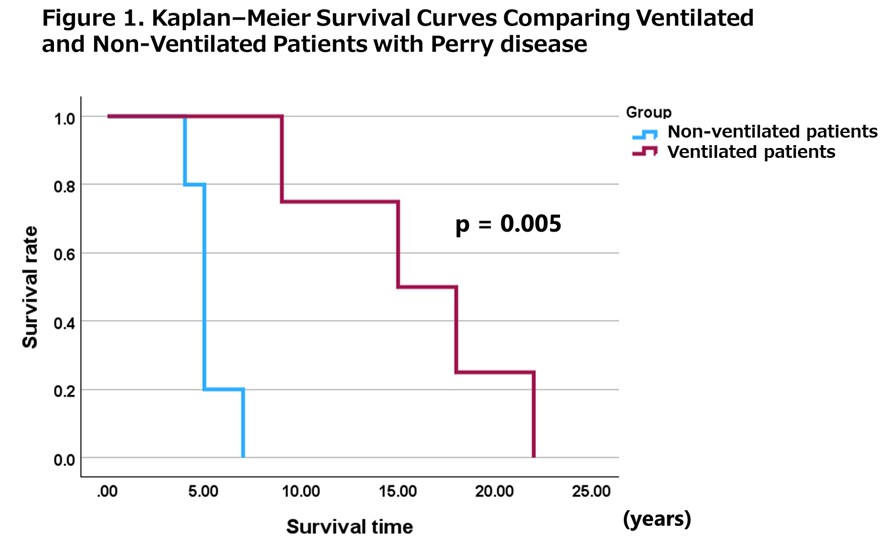
Figure 1.
To cite this abstract in AMA style:
Y. Tsuboi, T. Mishima, A. Kakimoto, J. Yuasa-Kawada, M. Kinoshita-Kawada, H. Shibayama, A. Nagatoshi, N. Sasagasako, N. Hattori. Mechanical Ventilation Modifies the Natural History of DCTN1 p.G71A Perry Disease: A 20-Year Longitudinal Study [abstract]. Mov Disord. 2026; 41 (suppl 1). https://www.mdsabstracts.org/abstract/mechanical-ventilation-modifies-the-natural-history-of-dctn1-p-g71a-perry-disease-a-20-year-longitudinal-study/. Accessed October 1, 2026.« Back to 2026 International Congress
MDS Abstracts - https://www.mdsabstracts.org/abstract/mechanical-ventilation-modifies-the-natural-history-of-dctn1-p-g71a-perry-disease-a-20-year-longitudinal-study/