
Objective: We investigated the prevalence and pathophysiology of exercise induced hypotension and exacerbation of orthostatic hypotension post-exercise in alpha-synucleinopathies.
Background: Low blood pressure during or following exercise can pose a significant challenge for people trying to maintain or improve mobility and can limit physiotherapists in their rehabilitation efforts.
Method: We performed a retrospective analysis of blood pressure (BP) and heart rate recorded with Dinamap during supine rest and supine graded cycling exercise (25W, 50W, 75W). Active standing tests were performed pre- and post-exercise from which we derived the orthostatic intolerance ratio (OIR). Additional data extracted from autonomic function testing included respiratory sinus arrythmia (RSA), head-up tilt, catecholamines, and isometric exercise. Participants (n=88) had a diagnosis of Parkinson’s disease/Lewy body dementia (PD/LBD, n=32), multiple system atrophy (MSA, n=15), or pure autonomic failure (PAF, n=41) and were split into two groups based on systolic BP (SBP) during exercise (risers and non-risers).
Results: SBP did not rise during exercise in 49 (59%) people of whom 45 had exercise induced hypotension. Different patterns were observed during post-exercise supine recovery [figure 1]. The standing SBP was lower post-exercise in both the non-risers and risers groups (p<0.001) [figure 2]. In the in non-risers group, there was a greater drop in BP during head-up tilt and lack of increase in BP during isometric exercise and worsen HR response to and Valsalva manoeuvre [table 1]. When comparing diagnoses post-exercise recovery of SBP and OIR worsening occurred only in MSA [table 2]. Heart rates increased during exercise and did not fully recover during 10 minutes of post-exercise supine rest in the risers and in both exercise groups (p<0.001)[figure 1].
Conclusion: Abnormal BP and HR responses to exercise are common in alpha-synucleinopathies and baroreflex impairment exacerbates orthostatic hypotension post-exercise. More severe autonomic failure, specifically slower vagal withdrawal and an inability to vasoconstrict could be important factors mediating the response. These factors should be considered when advising on physical activity and rehabilitation in clinic.
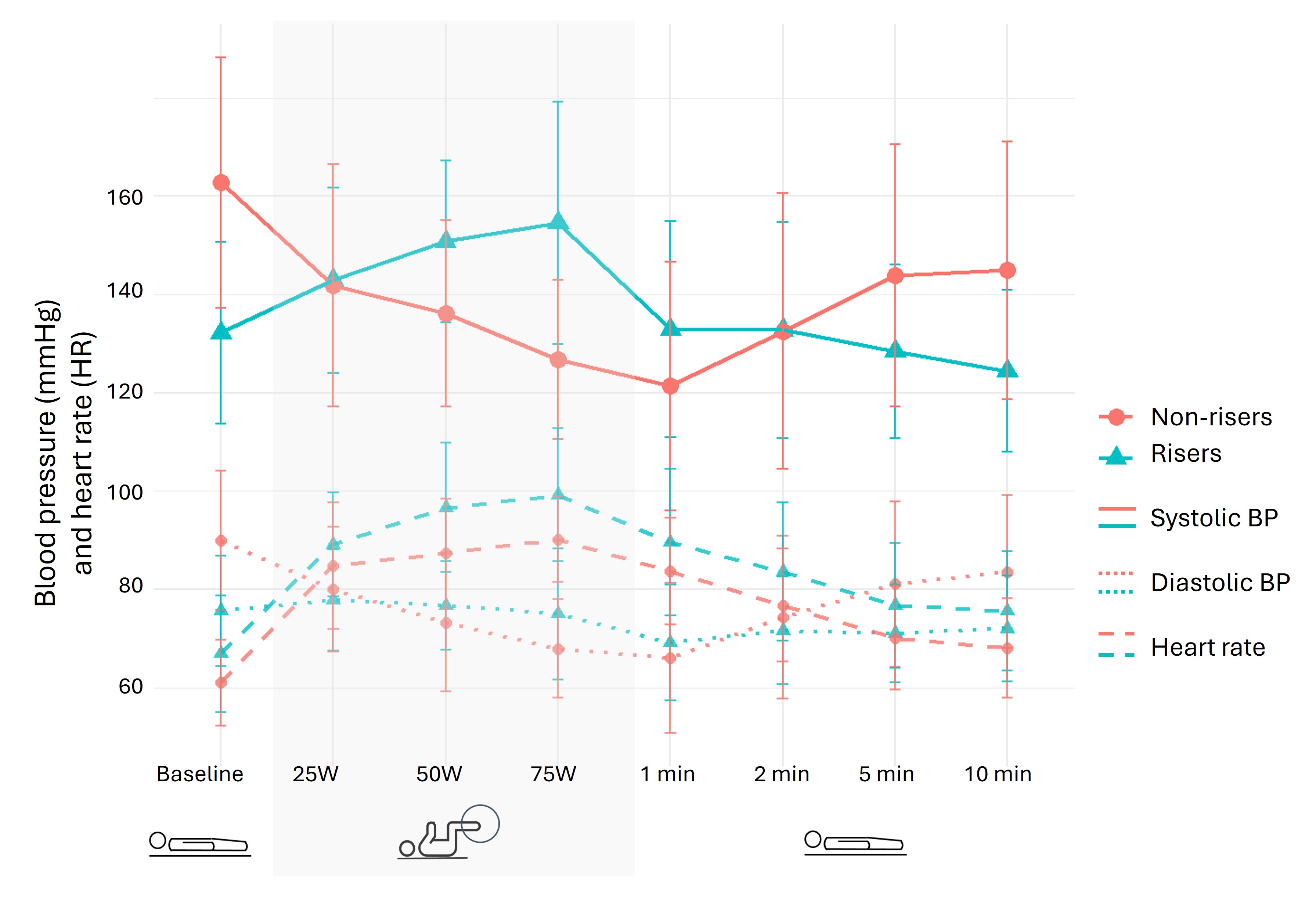
Haemodymanics of graded exercise and recovery
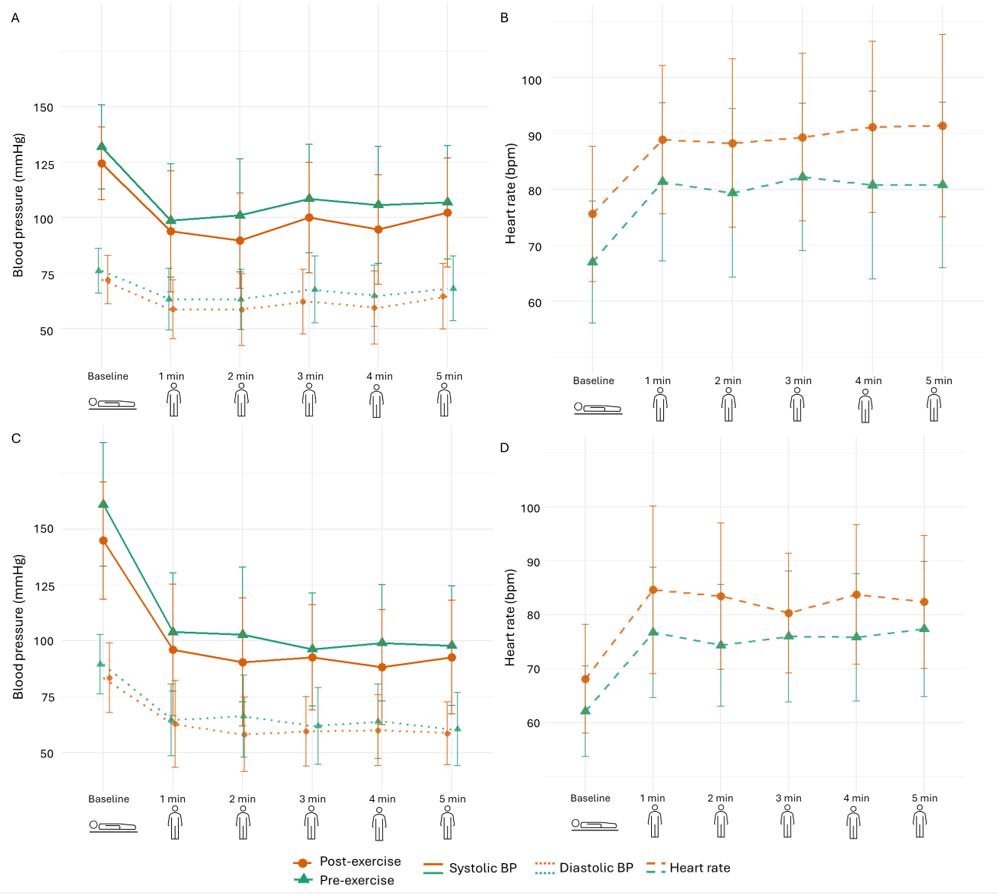
Active standing test: Heart rate & blood pressure
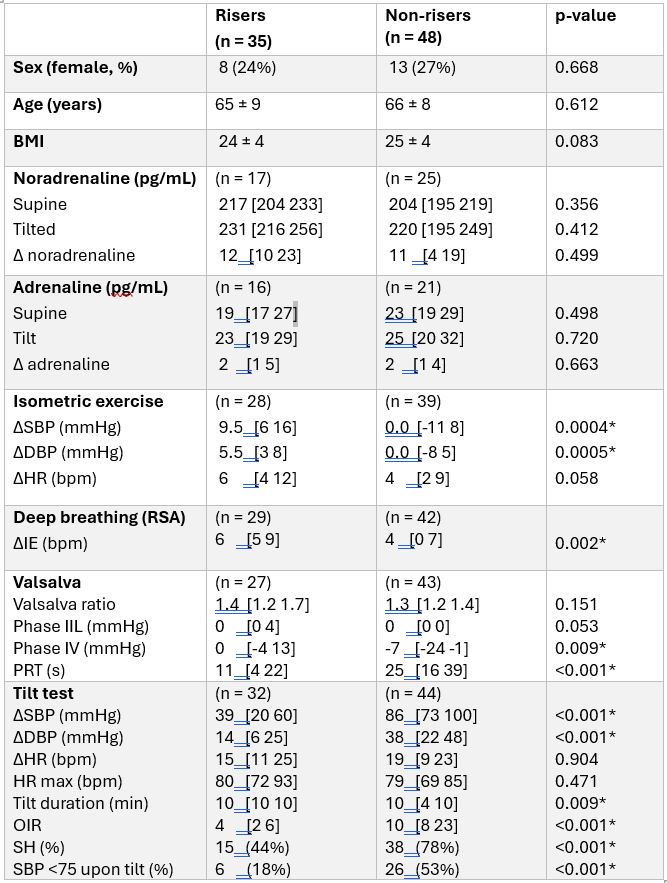
Demographic and autonomic outcome measures
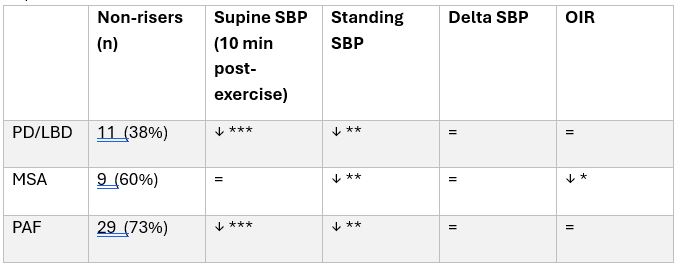
Exercise response incl. statistical significance
To cite this abstract in AMA style:
A. VAN.DER Stam, E. Barnes, Z. Jiang, G. Chiaro, V. Iodice. Supine Graded Exercise and Orthostatic Blood Pressure in Alpha-Synucleinopathies [abstract]. Mov Disord. 2026; 41 (suppl 1). https://www.mdsabstracts.org/abstract/supine-graded-exercise-and-orthostatic-blood-pressure-in-alpha-synucleinopathies/. Accessed October 1, 2026.« Back to 2026 International Congress
MDS Abstracts - https://www.mdsabstracts.org/abstract/supine-graded-exercise-and-orthostatic-blood-pressure-in-alpha-synucleinopathies/