
Category: Rare Neurometabolic Movement Disorders
Objective: To report a novel homozygous MYORG mutation causing primary brain calcification (PBC) with paroxysmal dyskinesia and evaluate its functional pathogenicity.
Background: PBC is a monogenic disorder marked by bilateral calcium deposits in the basal ganglia and other brain regions. To date, seven causative genes for PBC have been identified. Among them, MYORG encodes an endoplasmic reticulum (ER)-localized glycoside hydrolase primarily expressed in astrocytes and is involved in the regulation of brain phosphate homeostasis. However, the genetic and phenotypic spectrum of MYORG-associated PBC remains incompletely defined.
Method: We investigated a consanguineous Chinese family with two individuals presenting with intracranial calcifications. Clinical evaluation, biochemical testing, and brain CT were performed. Whole-genome sequencing (WGS) of the proband was followed by Sanger sequencing for segregation analysis. Structural prediction and cell-based functional assays were conducted to assess the impact of the identified variant.
Results: The proband, a 40-year-old man, presented with a 20-year history of episodic involuntary movements consistent with paroxysmal dyskinesia, accompanied by dysarthria, gait instability, and mild cognitive impairment (Fig. 1). Brain CT revealed extensive bilateral calcifications involving the basal ganglia, thalamus, cerebellum, and subcortical regions [total calcification score (TCS): 67]. His elder sister showed severe calcifications (TCS: 51) with mild cognitive decline. Biochemical parameters including serum calcium, phosphate, and parathyroid hormone were normal. Genetic analysis identified a novel homozygous frameshift variant in MYORG (c.348_352dup; p.G118Afs*76) in both affected siblings, while their mother and the proband’s daughter were heterozygous carriers. Structural modeling indicated that the frameshift truncates the protein and abolishes the catalytic GH31 domain. Functional studies demonstrated abnormal subcellular localization of the mutant protein, shifting from a typical ER pattern to partial ER retention with aberrant cytoplasmic and nuclear puncta.
Conclusion: This study broadens the genotypic and phenotypic landscape of MYORG-related PBC. Our findings link defective glycoside hydrolase function to cerebral calcification, and suggest that paroxysmal dyskinesia is not a rare secondary symptom resulting from MYORG mutation-driven calcification.
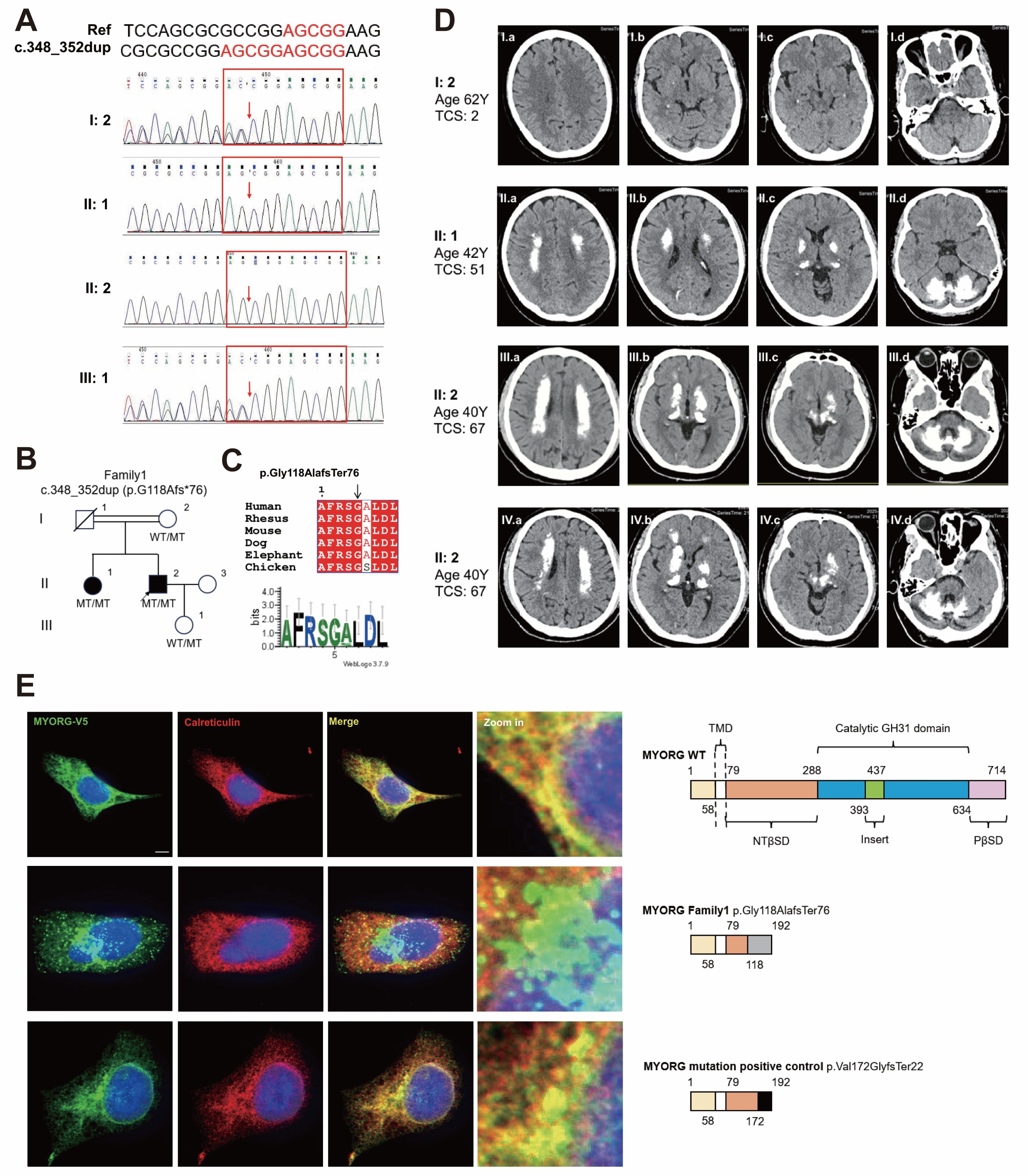
Figure 1. MYORG p.G118Afs*76 in PBC
To cite this abstract in AMA style:
Y. Guo, L. Wang, X. Wang, Z. Cen, W. Luo. A Novel Homozygous Variant in MYORG is Associated with Primary Brain Calcification and Paroxysmal Dyskinesia [abstract]. Mov Disord. 2026; 41 (suppl 1). https://www.mdsabstracts.org/abstract/a-novel-homozygous-variant-in-myorg-is-associated-with-primary-brain-calcification-and-paroxysmal-dyskinesia/. Accessed October 1, 2026.« Back to 2026 International Congress
MDS Abstracts - https://www.mdsabstracts.org/abstract/a-novel-homozygous-variant-in-myorg-is-associated-with-primary-brain-calcification-and-paroxysmal-dyskinesia/