
Objective: To evaluate whether the addition of PD symptom-specific odorants improves diagnostic accuracy in distinguishing patients with PD from healthy controls.
Background: Parkinson’s disease (PD) is the second most common neurodegenerative disorder. While olfactory dysfunction is a potential non-motor biomarker for PD diagnosis, it remains controversial whether symptom-specific odorants exist and if their inclusion enhances the diagnostic performance of abbreviated tests.
Method: We recruited 121 patients with PD for comprehensive evaluation (UPSIT, MDS-UPDRS, MMSE, MoCA, PDSS, BDI, BAI, QUIP-RS, NMSS, PDQ-39) and 89 healthy controls for UPSIT testing. Logistic regression determined correlations between each odorant and PD symptoms. Odorants linked to symptoms were defined as symptom-specific. Exp(B) values were calculated for each item to differentiate PD from controls, and brief UPSIT versions were constructed with or without symptom-specific odorants. ROC curve analysis evaluated the area under the curve (AUC), sensitivity, and specificity.
Results: The odorant “rubber tire” was significantly associated with total MDS-UPDRS scores (B = 0.979, p = 0.017), as well as Parts II, III (specifically the akinetic-rigid phenotype), and IV. Regarding non-motor symptoms, “rubber tire” correlated with cognitive performance (MMSE, MoCA), anxiety (BAI), miscellaneous symptoms (NMSS), and quality of life (PDQ-39). Despite these associations with motor and non-motor severity, adding this item to brief UPSIT subsets provided only marginal improvements in AUC and showed suboptimal overall performance compared to subsets selected based purely on discriminative power.
Conclusion: Although certain odorants like “rubber tire” demonstrate significant associations with PD motor and non-motor severity, their inclusion does not substantially enhance the diagnostic accuracy of abbreviated olfactory screening tools. Optimization of short-form tests should prioritize odorants with high overall discriminative performance rather than symptom-correlation alone.
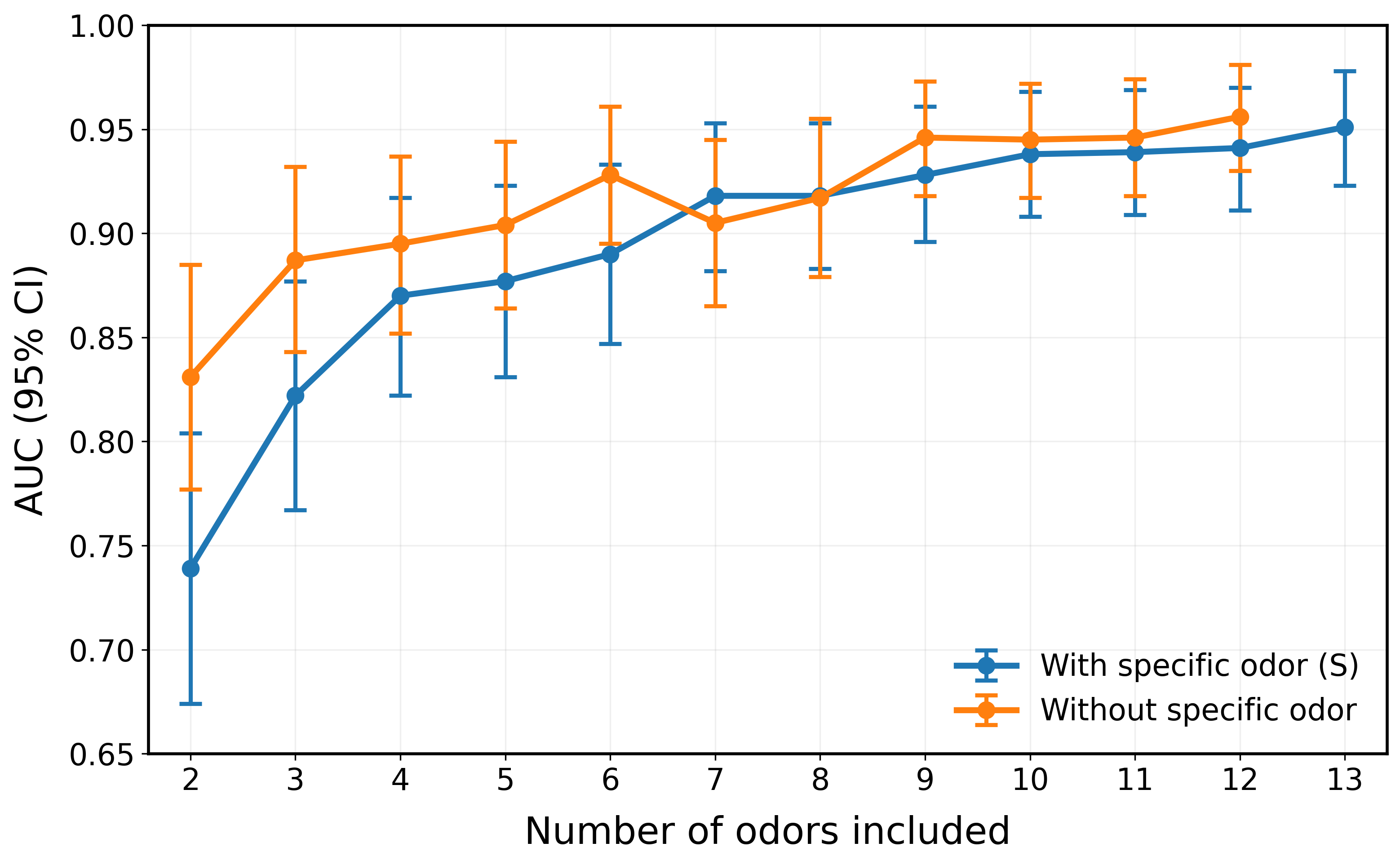
Effect of “Rubber Tire” on Short-Form UPSIT AUC
To cite this abstract in AMA style:
TC. Fang, YH. Lin, MH. Chang, YJ. Guo. Impact of Symptom-Specific Odorants on the Diagnostic Accuracy of Brief Olfactory Tests in Parkinson’s Disease [abstract]. Mov Disord. 2026; 41 (suppl 1). https://www.mdsabstracts.org/abstract/impact-of-symptom-specific-odorants-on-the-diagnostic-accuracy-of-brief-olfactory-tests-in-parkinsons-disease/. Accessed October 1, 2026.« Back to 2026 International Congress
MDS Abstracts - https://www.mdsabstracts.org/abstract/impact-of-symptom-specific-odorants-on-the-diagnostic-accuracy-of-brief-olfactory-tests-in-parkinsons-disease/