
Category: Parkinson's Disease (Other)
Objective: This study aims to develop algorithms that quantify gait parameters reflecting early clinical gait changes in PD.
Background: Parkinson’s disease (PD) is the fastest growing neurological disorder and places an increasing burden on healthcare systems worldwide. Clinical motor assessments are often time-consuming, subjective, and insufficiently sensitive to subtle early gait changes. Wearable sensors offer a promising approach for objective, streamlined motor assessment, but current algorithms may not adequately capture clinically meaningful gait features. To address this gap, we developed an algorithm that detects clinically relevant gait characteristics.
Method: We enrolled 29 people with PD (PwPD) (disease duration ≤4 years) and 36 age-matched healthy controls. PwPD were assessed in the OFF-medication condition after at least 12 hours of dopaminergic withdrawal. All participants underwent standardized MDS-UPDRS-III assessments, with simultaneous video and sensor recordings using the MVN Awinda motion capture system (Movella®). Sensor data were labeled with clinical features derived from the video recordings (Figure 1A). Custom MATLAB scripts were built to extract gait characteristics from sensors placed on the pelvis, and on both hands and hips. Arm swing amplitude was quantified in meters based on the hand movement trajectory.
Results: Wearable sensor measurements demonstrated that reduced arm swing is an early motor feature of PD. Figure 1B illustrates data from two representative individuals. The person exhibits markedly reduced right-arm swing compared with a healthy control. Population-level data (Figure 1C) showed that PwPD had significantly reduced arm swing relative to controls (unpaired t-test, ***P < 0.001). Notably, the magnitude of arm swing reduction exceeded the reductions observed in step length and stride length.
Conclusion: Wearable sensors can objectively quantify early motor features in PD with higher resolution than traditional clinical scales. By developing algorithms that align with clinically observed gait abnormalities, sensor-based assessments could enable more personalized, data-driven management of PD, including optimization of therapeutic dosing and treatment strategies.
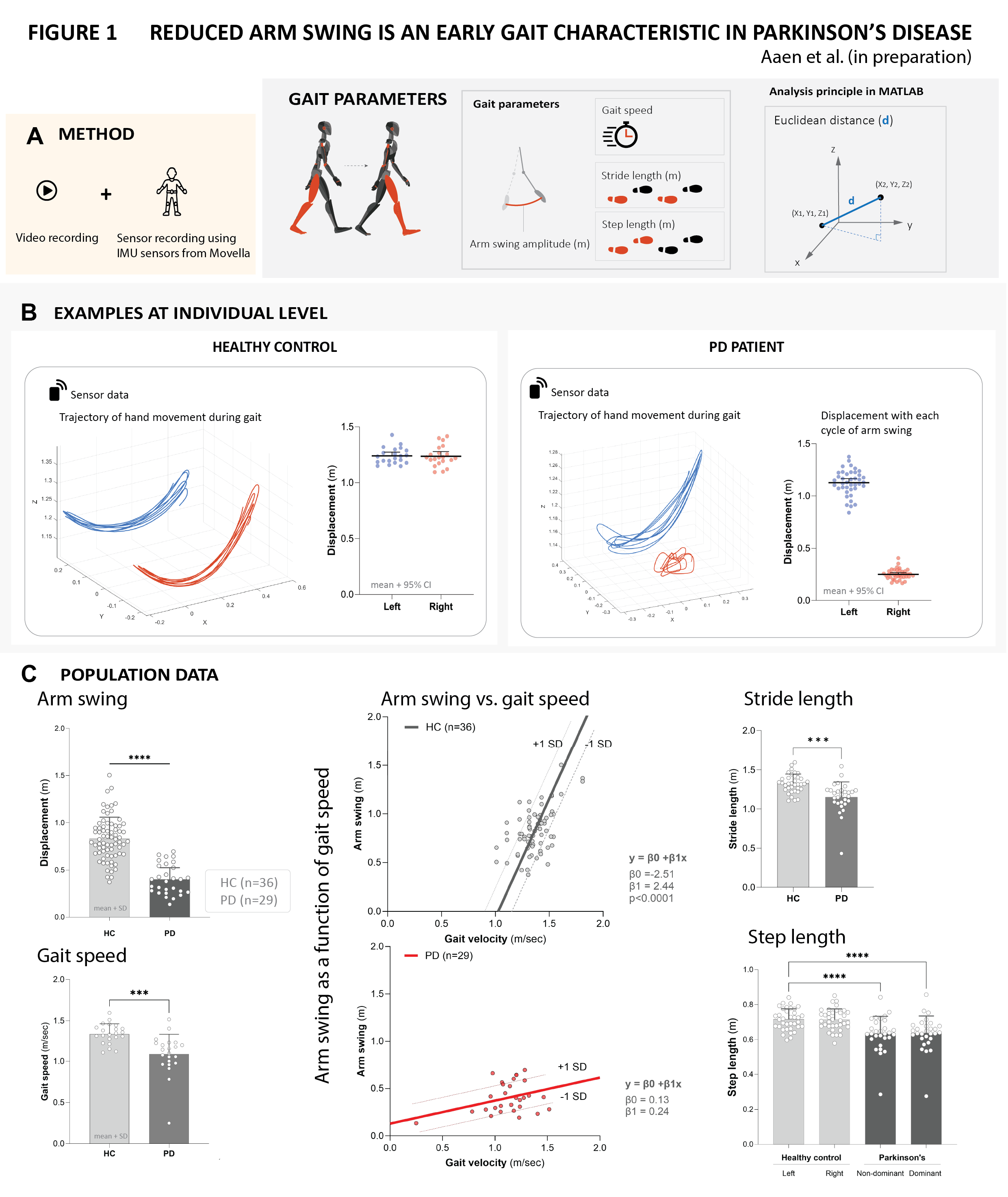
Figure 1
To cite this abstract in AMA style:
C. Aaen, M. Vendelhaven, A. Behrndtz, M. Stilund, A. Terkelsen, E. Danielsen, E. Johnsen, M. Møller, W. Sloth, J. Brincks, J. Phan. Arm Swing and Early Gait Characteristics in Parkinson’s Disease [abstract]. Mov Disord. 2026; 41 (suppl 1). https://www.mdsabstracts.org/abstract/arm-swing-and-early-gait-characteristics-in-parkinsons-disease/. Accessed October 1, 2026.« Back to 2026 International Congress
MDS Abstracts - https://www.mdsabstracts.org/abstract/arm-swing-and-early-gait-characteristics-in-parkinsons-disease/