
Objective: While sex differences in Parkinson’s disease (PD) are widely reported, data on how age influences these clinical variations are scarce. It is not fully understood whether geriatric onset alters the typical male-female phenotypic divide.
Background: We aimed to investigate whether sex differences in the motor and nonmotor profiles of de novo PD differ between geriatric (≥70 years) and nongeriatric (<70 years) patients.
Method: This cross-sectional analysis evaluated 179 consecutive patients presenting with parkinsonism. We excluded 66 individuals, primarily those already taking Parkinson medications (n=38), as well as those diagnosed with Parkinson-plus syndromes (n=9), normal pressure hydrocephalus (n=4), and vascular parkinsonism (n=4). The final cohort consisted of 113 patients with de novo PD. We divided them by age into a geriatric group (n=64) and a nongeriatric group (n=49). Motor severity was scored using the Unified Parkinson Disease Rating Scale Part III (UPDRS-III). Nonmotor features were captured via the Korean Montreal Cognitive Assessment (MoCA-K), Beck Depression/Anxiety Inventories (BDI/BAI), Parkinson’s Disease Fatigue Scale (PFS), and Scales for Outcomes in Parkinson’s Disease – Autonomic (SCOPA-AUT).
Results: The 113 enrolled patients had a mean (SD) age of 70.02 (8.95) years, comprising 59 women and 54 men. Across the total cohort, women experienced significantly higher anxiety (mean BAI, 6.90 vs 4.26; P = .02) and more severe fatigue (mean PFS, 43.05 vs 36.17; P = .03). They also presented with a lower body mass index (BMI) (P = .004) and less education (P = .04) compared to men. When analyzing the age subgroups, nongeriatric women (<70 years) continued to show distinctly higher anxiety than men (mean BAI, 7.76 vs 3.33; P = .02). In contrast, within the geriatric group (≥70 years), these sex differences in nonmotor symptoms vanished; BMI was the only metric that remained significantly different between older men and women (P < .001). Motor scores and cognitive performance did not differ significantly by sex in any group.
Conclusion: The distinct sex differences seen in the nonmotor symptoms of younger patients with de novo D appear to neutralize in older age. Advancing age might mask typical male-female variations in anxiety and fatigue, indicating that clinical management for early PD should be customized based on an interaction of both sex and patient age.
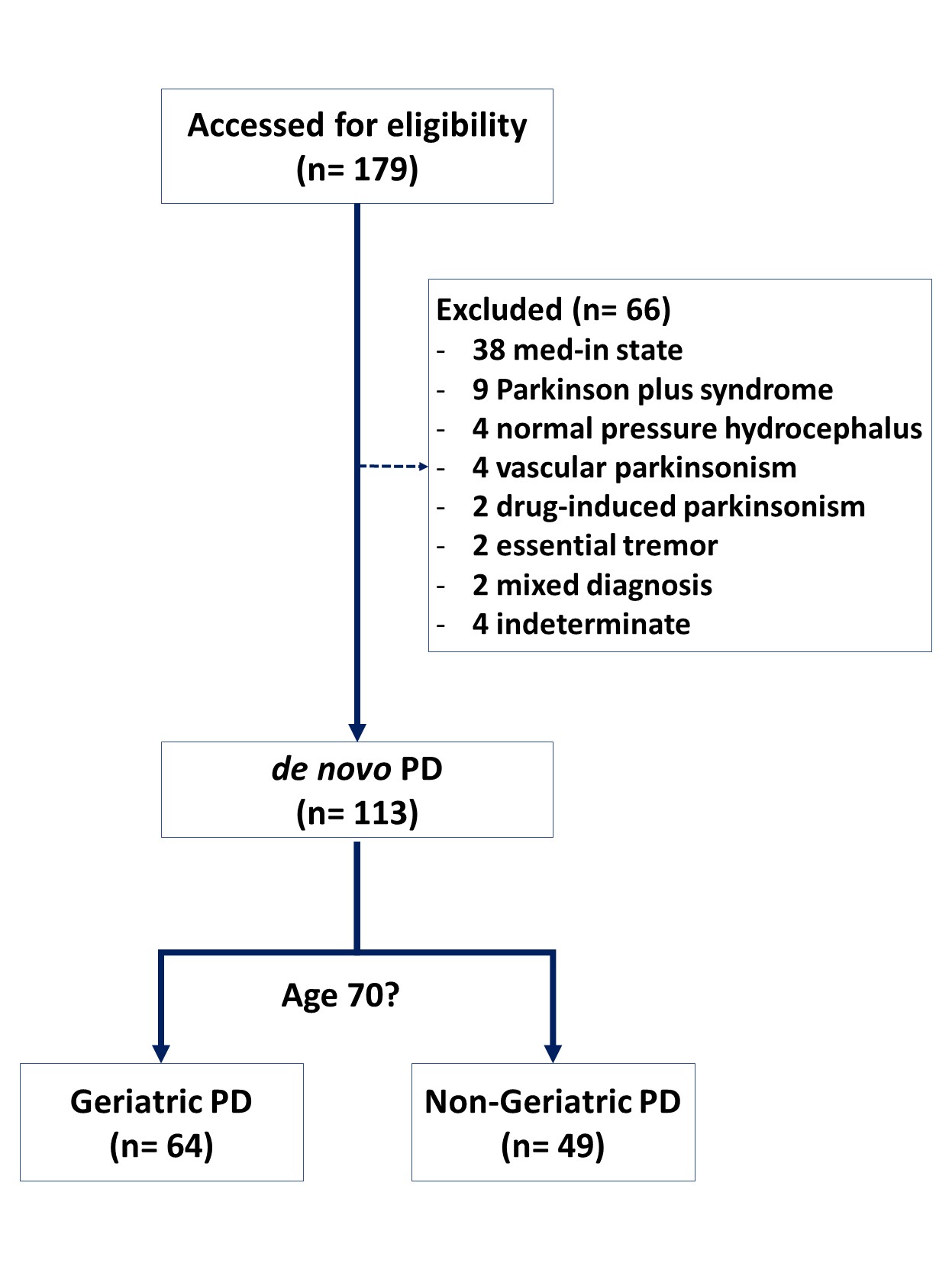
Figure 1
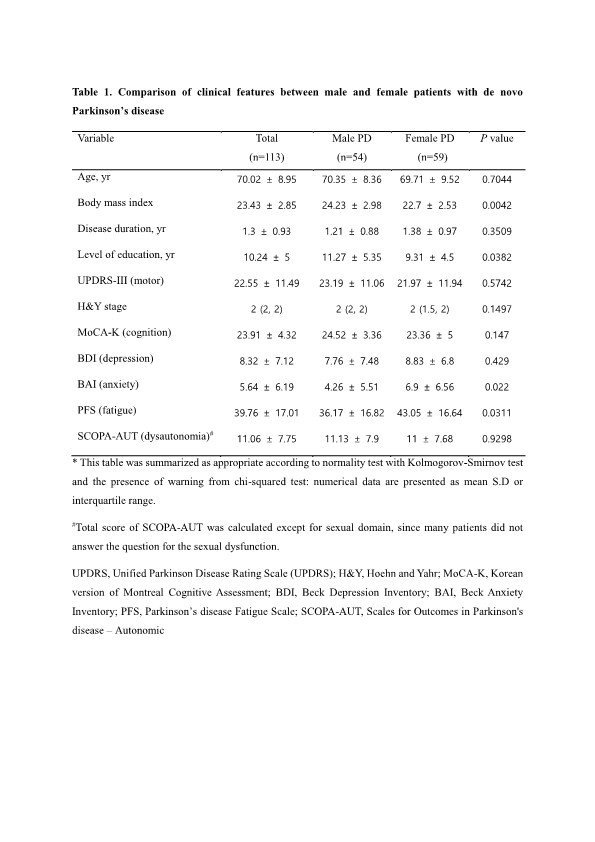
Table 1
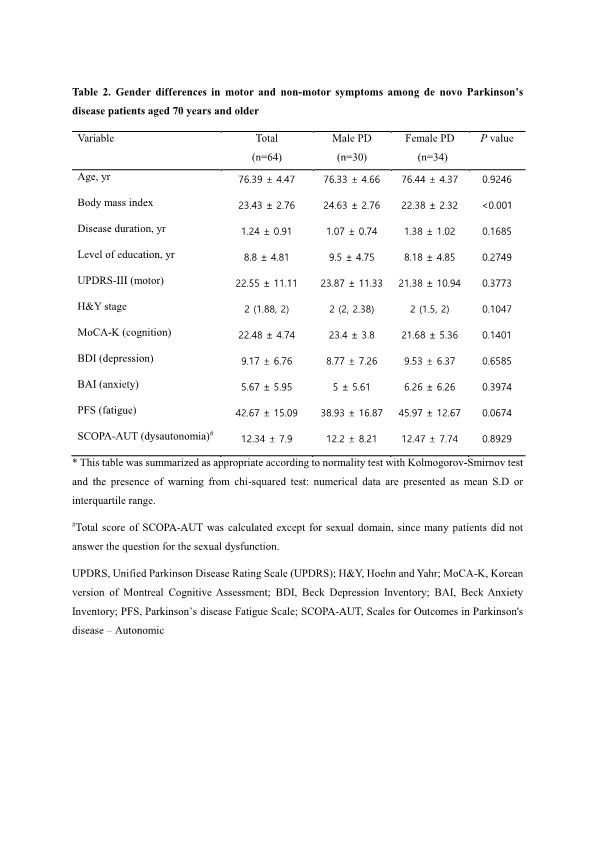
Table 2
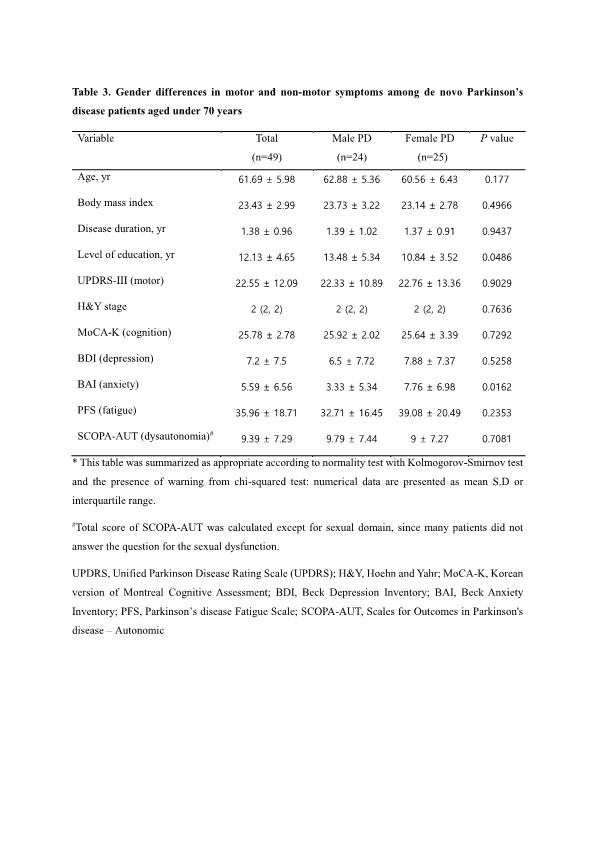
Table 3
To cite this abstract in AMA style:
KY. Kwon, H. Lee, J. Yoon, G. Gye, G. Oh, J. You. Sex Differences in Motor and Nonmotor Symptoms of De Novo Parkinson Disease by Age Group [abstract]. Mov Disord. 2026; 41 (suppl 1). https://www.mdsabstracts.org/abstract/sex-differences-in-motor-and-nonmotor-symptoms-of-de-novo-parkinson-disease-by-age-group/. Accessed October 1, 2026.« Back to 2026 International Congress
MDS Abstracts - https://www.mdsabstracts.org/abstract/sex-differences-in-motor-and-nonmotor-symptoms-of-de-novo-parkinson-disease-by-age-group/