
Category: Parkinson's Disease: Surgical Therapy
Objective: These case series illustrate practical programming strategies and clinical decision-making in real-world DBS practice using the concept of stimulating the dorsal STN or ZI to reduce dyskinesia.
Background: Dyskinesia is a common complication in PD patients treated with STN-DBS. Stimulation of dorsal contacts located near the zona incerta (ZI), which contains pallidofugal fibre tracts connecting the globus pallidus internus to the thalamus, may exert an anti-dyskinetic effect while maintaining motor benefit.
Method: Three patients with PD who had undergone bilateral STN-DBS later presented with dyskinesia. DBS settings were adjusted to stimulate the dorsal STN contacts. Dyskinesia severity was assessed using the Abnormal Involuntary Movement Scale (AIMS) based on video recordings.
Results: The first case was a 73-year-old woman with bilateral STN-DBS (model 3389, Activa RC, Medtronic) who presented with left-sided dyskinesia, while medication reduction worsened Parkinsonism. Interleaving stimulation was introduced by activating a more dorsal contact (contact no. 11) in the right STN at a lower amplitude while maintaining the original contact. This adjustment reduced dyskinesia while preserving motor control, without requiring further medication changes.
The second case was a 71-year-old patient with bilateral STN-DBS (model 3389, Kinetra (First IPG) and Percept PC (current IPG), Medtronic) and severe right-sided dyskinesia. Reducing stimulation or levodopa worsened Parkinsonian symptoms. Interleaving stimulation was therefore applied by activating a more dorsal contact (contact no. 3) in the left STN at a lower amplitude while maintaining the original contact. Dyskinesia improved, with motor control preserved, without medication changes.
The third case was a 48-year-old patient with bilateral STN-DBS (model DB-2202-45, Vercise Genus R16, Boston Scientific) who presented with severe right-sided dyskinesia. Image-guided programming was used to visualize the volume of tissue activated and steer stimulation vertically (toward contact L4), which is close to the ZI. This configuration provided therapeutic benefit while reducing dyskinesia.
Conclusion: These three cases illustrate that dyskinesia after STN-DBS remains a significant clinical challenge. Targeting the dorsal STN or ZI may provide an alternative strategy for reducing dyskinesia while maintaining motor benefit.
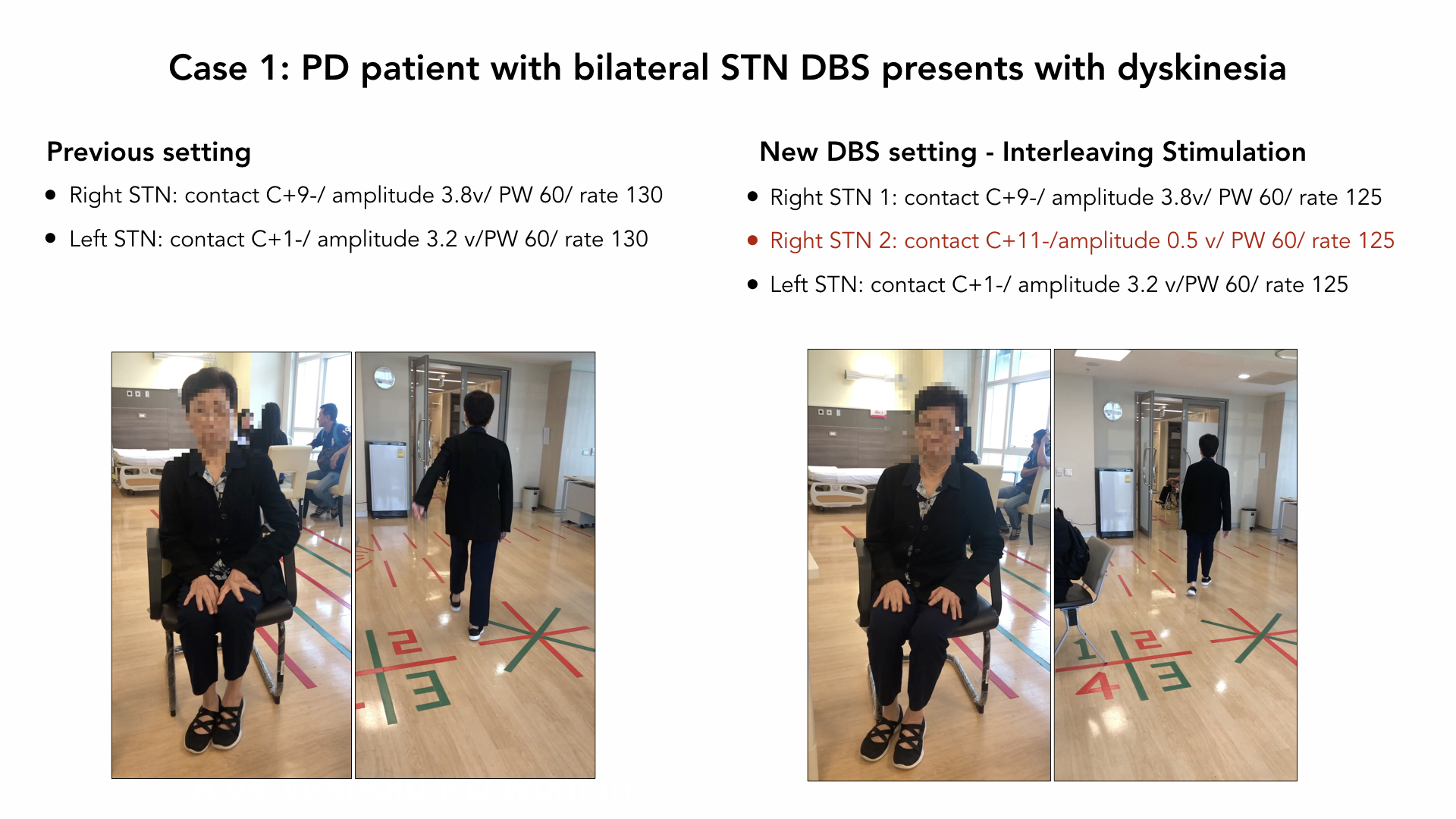
Case 1
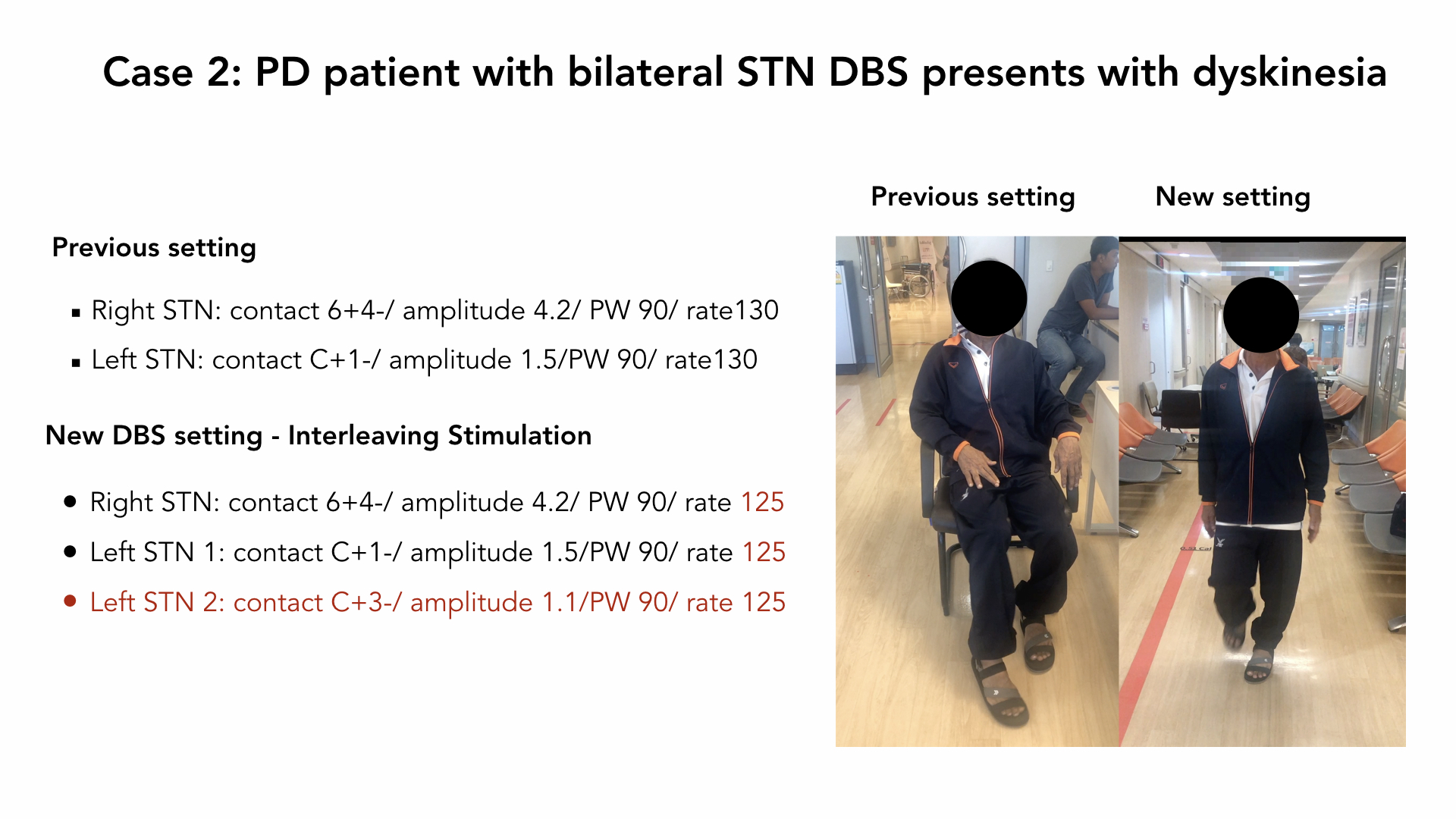
Case 2
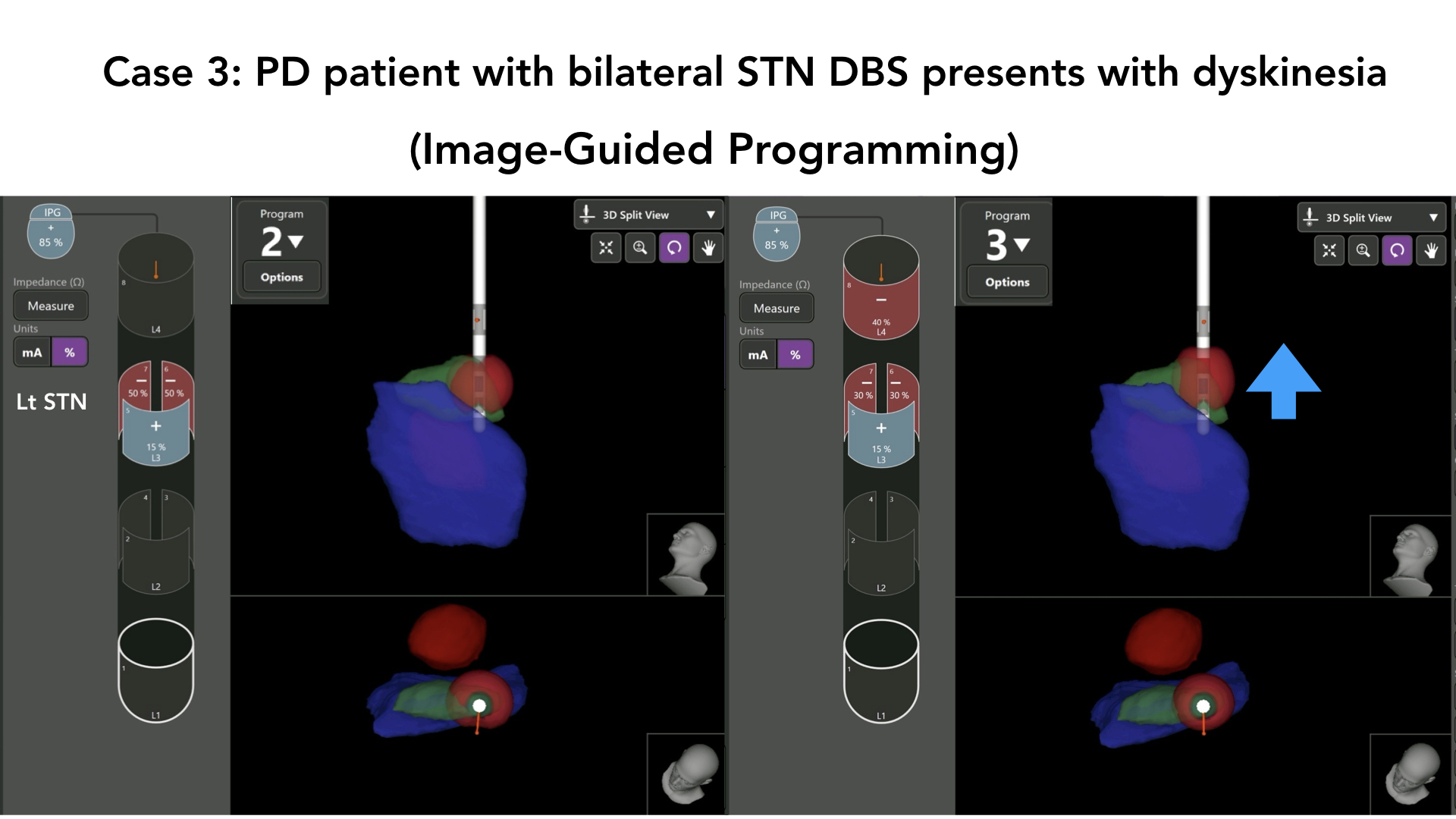
Case 3
References: Reference
1. Herzog J, et al. Stimulation of subthalamic fibre tracts reduces dyskinesias in STN-DBS. Mov Disord 2007;15:22(5):679-84.
2. Hirt L, et al. Case series investigating the differences between stimulation of rostral zona incerta region in isolation or in conjunction with the subthalamic nucleus on acute clinical effects for Parkinson’s disease. Interdisciplinary Neurosurgery 2022;29:101553.
3. Ossowska K, et al. Zona incerta as a therapeutic target in Parkinson’s disease. Journal of Neurology 2020;267:591-606.
To cite this abstract in AMA style:
O. Phokaewvarangkul, K. Katawatee, R. Seeluangsawat, K. Sanyawat, N. Rattanapitak, R. Bhidayasiri. Dorsal STN and Zona Incerta Stimulation as a Strategy to Reduce Dyskinesia after STN-DBS: A Case Series with Literature Reviews [abstract]. Mov Disord. 2026; 41 (suppl 1). https://www.mdsabstracts.org/abstract/dorsal-stn-and-zona-incerta-stimulation-as-a-strategy-to-reduce-dyskinesia-after-stn-dbs-a-case-series-with-literature-reviews/. Accessed October 1, 2026.« Back to 2026 International Congress
MDS Abstracts - https://www.mdsabstracts.org/abstract/dorsal-stn-and-zona-incerta-stimulation-as-a-strategy-to-reduce-dyskinesia-after-stn-dbs-a-case-series-with-literature-reviews/