
Objective: To investigate the safety and efficacy of continuous circadian and personalized intracerebroventricular (i.c.v.) administration of anaerobic dopamine (A-dopamine) in Parkinson’s disease patients refractory to L-dopa-based therapies. To assess whether A-dopamine alone can control the symptoms of Parkinson’s disease without inducing the complications of L-dopa.
Background: A phase 1/2 study showed that A-dopamine as add-on therapy increased the duration of perfect control (i.e., no “off” or episodes or dyskinesia, even mild ones) by 4.4 hours and the duration of good autonomy by 6.2 hours (i.e., including mild off or mild dyskinesia) on the home diary, compared to the best oral treatment with a 60% reduction in oral L-dopa (Moreau et al., Nat Med 2025). The blinded assessment of percentage over target (i.e., off and dyskinesia), recorded by actimetry at home using a wristwatch, was also significantly improved.
Method: One of these 12 patients, a 65-year-old woman, benefited from long-term administration of A-dopamine as monotherapy, using a telemetry-controlled subcutaneous abdominal pump connected to a catheter implanted in the ventricle near the striatum. Outcomes included the two-week home diaries, dyskinesia and MDS-UPDRS scales, safety and behavior using neuropsychological and psychiatric examinations.
Results: A reduction in dyskinesias was observed with 50 mg of A-dopamine without reducing oral L-dopa. Complete disappearance of all complications (dyskinesia, off, dystonia) was observed with 150 mg of A-dopamine during the day and 30 mg at night, with a concomitant reduction of 63.3% in oral L-dopa equivalent daily dose (from 1,500 mg to 550 mg). A dose of 240 mg during the day and 40 mg at night allowed complete control of motor symptoms for 19 months without any oral treatment and without mental excitement or addiction.
Conclusion: A-dopamine monotherapy produced greater benefits than add-on therapy on top of an optimized oral treatment and had a fully differentiated clinical effect from that of L-dopa.
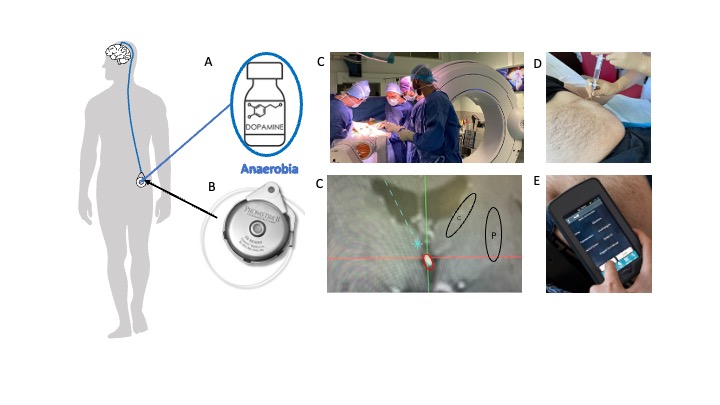
New therapeutic concept (c caudate p putamen)
References: – Laloux C, Gouel F, Lachaud C, et al. Continuous cerebroventricular administration of dopamine: A new treatment for severe dyskinesia in Parkinson’s disease? Neurobiol Dis 2017;103:24‒31.
– Moreau C, Rolland AS, Pioli E, et al. Intraventricular dopamine infusion alleviates motor symptoms in a primate model of Parkinson’s disease. Neurobiol Dis. 2020;139:104846.
– Moreau C, Odou P, Labreuche J, Demailly A, Touzet G, Reyns N, Gouges B, Duhamel A, Barthelemy C, Lannoy D, Carta N, Palas B, Vasseur M, Marchand F, Ollivier T, Leclercq C, Potey C, Ouk T, Baigne S, Dujardin K, Carton L, Rolland AS, Devedjian JC, Foutel V, Deplanque D, Fisichella M, Devos D. Intracerebroventricular anaerobic dopamine in Parkinson’s disease with L-dopa-related complications: a phase 1/2 randomized-controlled trial. Nat Med. 2025;31:819-828.
To cite this abstract in AMA style:
C. Moreau, F. Marchand, J. Bene, C. Leclercq, V. Foutel, M. Fisichella, D. Devos. A case of monotherapy with intracerebroventricular anaerobic dopamine allows complete control of Parkinson’s disease symptoms [abstract]. Mov Disord. 2026; 41 (suppl 1). https://www.mdsabstracts.org/abstract/a-case-of-monotherapy-with-intracerebroventricular-anaerobic-dopamine-allows-complete-control-of-parkinsons-disease-symptoms/. Accessed October 1, 2026.« Back to 2026 International Congress
MDS Abstracts - https://www.mdsabstracts.org/abstract/a-case-of-monotherapy-with-intracerebroventricular-anaerobic-dopamine-allows-complete-control-of-parkinsons-disease-symptoms/