
Category: Parkinson’s Disease: Clinical Trials
Objective: To evaluate the effect of tavapadon vs monoamine oxidase B inhibitors (MAO-BIs) on motor function in people with early Parkinson’s disease (PD).
Background: In phase 3 trials, tavapadon, an oral, once-daily, selective D1/D5 agonist, provided significant improvements vs placebo in PD motor symptoms for participants with early PD (TEMPO-1 [NCT04201093] and TEMPO-2 [NCT04223193]). Eligibility criteria for TEMPO-1 and TEMPO-2 permitted prior and concomitant use of MAO-BIs if use was initiated >90 days before the baseline visit. The comparative effect of tavapadon vs MAO-BIs on motor function has not been assessed.
Method: People with early PD (<3 years’ duration) received fixed-dose tavapadon (5 or 15 mg; TEMPO-1), flexible-dose tavapadon (5-15 mg; TEMPO-2), or placebo once daily for 27 weeks. Motor function was assessed from baseline to week 26 using MDS-UPDRS Parts II and III scores (lower scores = improvement). This post hoc analysis assessed improvements in motor function with tavapadon vs MAO-BIs using a mixed-effects model for repeated measures. Reported P values are nominal; no correction for multiplicity was applied.
Results: In TEMPO-1, participants treated with tavapadon (no MAO-BI, n=252) experienced a greater reduction in MDS-UPDRS Parts II/III combined score vs placebo + MAO-BI (n=42; least squares mean [LSM] difference, −12.0 [95% CI, −15.3, −8.6]; P<0.0001) [table]. Similarly, in TEMPO-2, tavapadon-treated participants (no MAO-BI, n=104) reported a greater reduction in MDS-UPDRS Parts II/III combined score vs placebo + MAO-BI (n=45; LSM difference, −7.5 [95% CI, −11.5, −3.5]; P=0.0003). Tavapadon also led to reductions in separate MDS-UPDRS Parts II and III total scores vs placebo + MAO-BI in both trials. There was no significant difference in MDS-UPDRS Parts II/III combined score with placebo + MAO-BI (n=42) vs placebo alone (n=132) in TEMPO-1 (LSM difference, 0.4 [95% CI, −3.2, 4.0]; P=0.8270) or TEMPO-2 (n=45 vs n= 106, respectively; LSM difference, −1.4 [95% CI, −5.0, 2.3]; P=0.4608).
Conclusion: This post hoc analysis suggests that tavapadon may provide greater improvements in motor function than MAO-BIs in people with early PD. Because these 2 trials were not designed to derive a true pretreatment baseline for participants taking MAO-BIs, further studies are needed to confirm these findings.
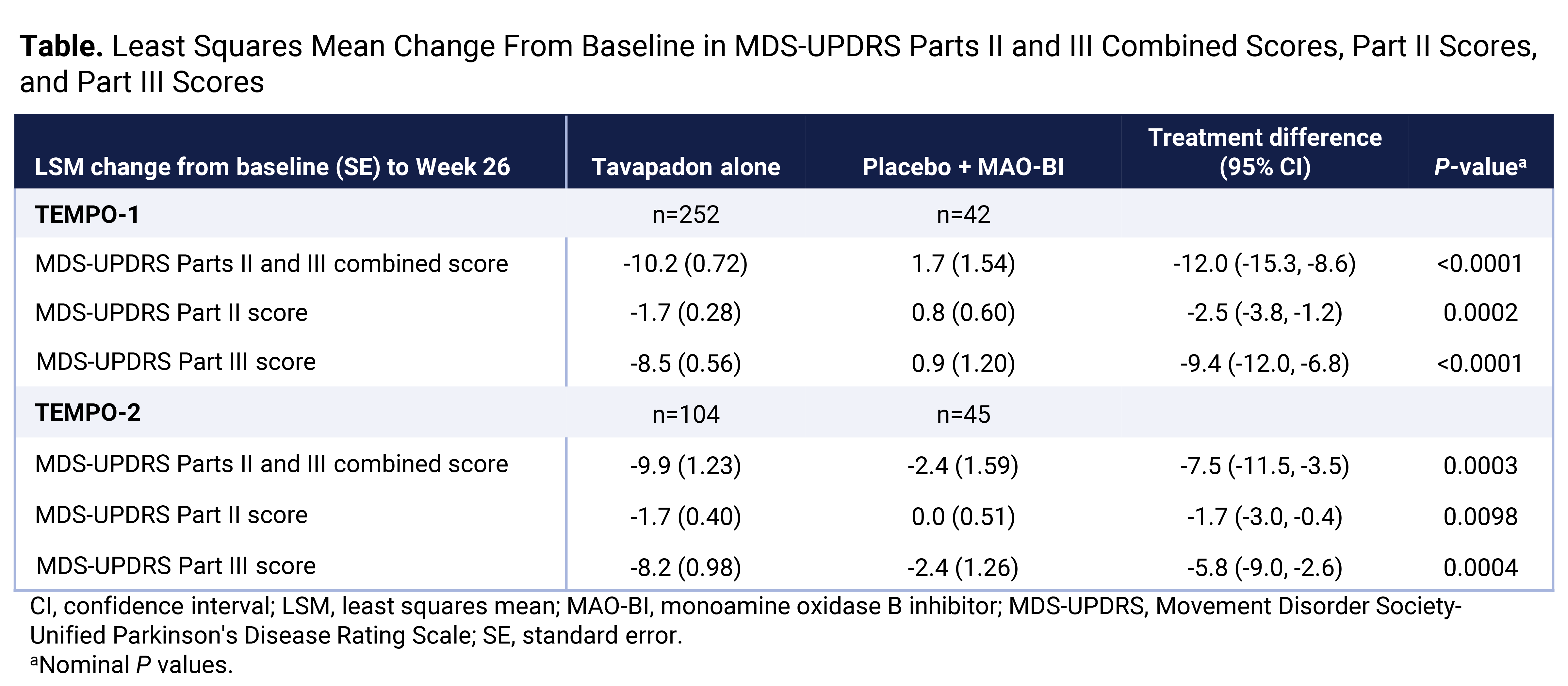
Table 1
To cite this abstract in AMA style:
E. Freire Alvarez, K. Chan, J. Eubanks, J. Ma, E. Peckham. Exploratory Efficacy Analysis of Tavapadon Versus MAO-B Inhibitors in People With Early Parkinson’s Disease [abstract]. Mov Disord. 2026; 41 (suppl 1). https://www.mdsabstracts.org/abstract/exploratory-efficacy-analysis-of-tavapadon-versus-mao-b-inhibitors-in-people-with-early-parkinsons-disease/. Accessed October 1, 2026.« Back to 2026 International Congress
MDS Abstracts - https://www.mdsabstracts.org/abstract/exploratory-efficacy-analysis-of-tavapadon-versus-mao-b-inhibitors-in-people-with-early-parkinsons-disease/