
Category: Parkinson’s Disease: Clinical Trials
Objective: To compare clinical-trial tavapadon with real-world oral standard of care (SoC) in patients with Parkinson’s disease (PD) experiencing motor fluctuations.
Background: In the phase 3 TEMPO-3 trial (NCT04542499), adjunctive tavapadon, an oral, once-daily, selective D1/D5 agonist, significantly improved motor outcomes versus placebo in levodopa-treated patients with PD. The comparative effectiveness of tavapadon versus oral SoC is unknown.
Method: Tavapadon-treated patients in TEMPO-3 were indirectly matched to an external control cohort from PROSPECT, a real-world observational study [EUPAS36303] of patients with PD receiving SoC treatments and inadequately controlled motor fluctuations (≥2.5 OFF hours/day). The analytic cohort included participants aged 40-80 years, had modified Hoehn and Yahr score 2-3 in the ON state, had Montreal Cognitive Assessment score >26/Mini-Mental State Examination score >29, were receiving only oral PD treatments, and had complete data at baseline and week 26. Change from baseline to week 26 outcomes between groups were evaluated using inverse probability weighting and a covariate-adjusted generalized linear model. Motor function was assessed from baseline to week 26 using the PD Hauser Diary and MDS-UPDRS Part II. Quality of life (QoL) was assessed using the PDQ-39, EQ-5D-5L and EQ-VAS.
Results: The analytic cohort included 157 tavapadon-treated patients from TEMPO-3 and 76 SoC-treated patients from PROSPECT (mean age, 65-66 years; mean PD duration, 6-10 years; mean baseline OFF time, 5 hours/day) [table 1]. Tavapadon demonstrated statistically significant improvements in daily OFF time (−1.9 vs −0.7 h; P=0.001), Good ON time (ON time without troublesome dyskinesia; 1.9 vs 0.6 h; P=0.005), and Best ON time (ON time without dyskinesia; 1.6 vs 0.2 h; P=0.031) versus SoC [table 2]. Tavapadon also showed statistically significantly greater improvements than SoC in MDS-UPDRS Part II (−1.8 vs 0.5; P=0.046) and EQ-VAS scores (2.0 vs −4.0; P<0.001).
Conclusion: Findings suggest clinical-trial tavapadon was associated with greater improvements in motor function and QoL outcomes than real-world oral SoC treatments in patients with PD who experience motor fluctuations.
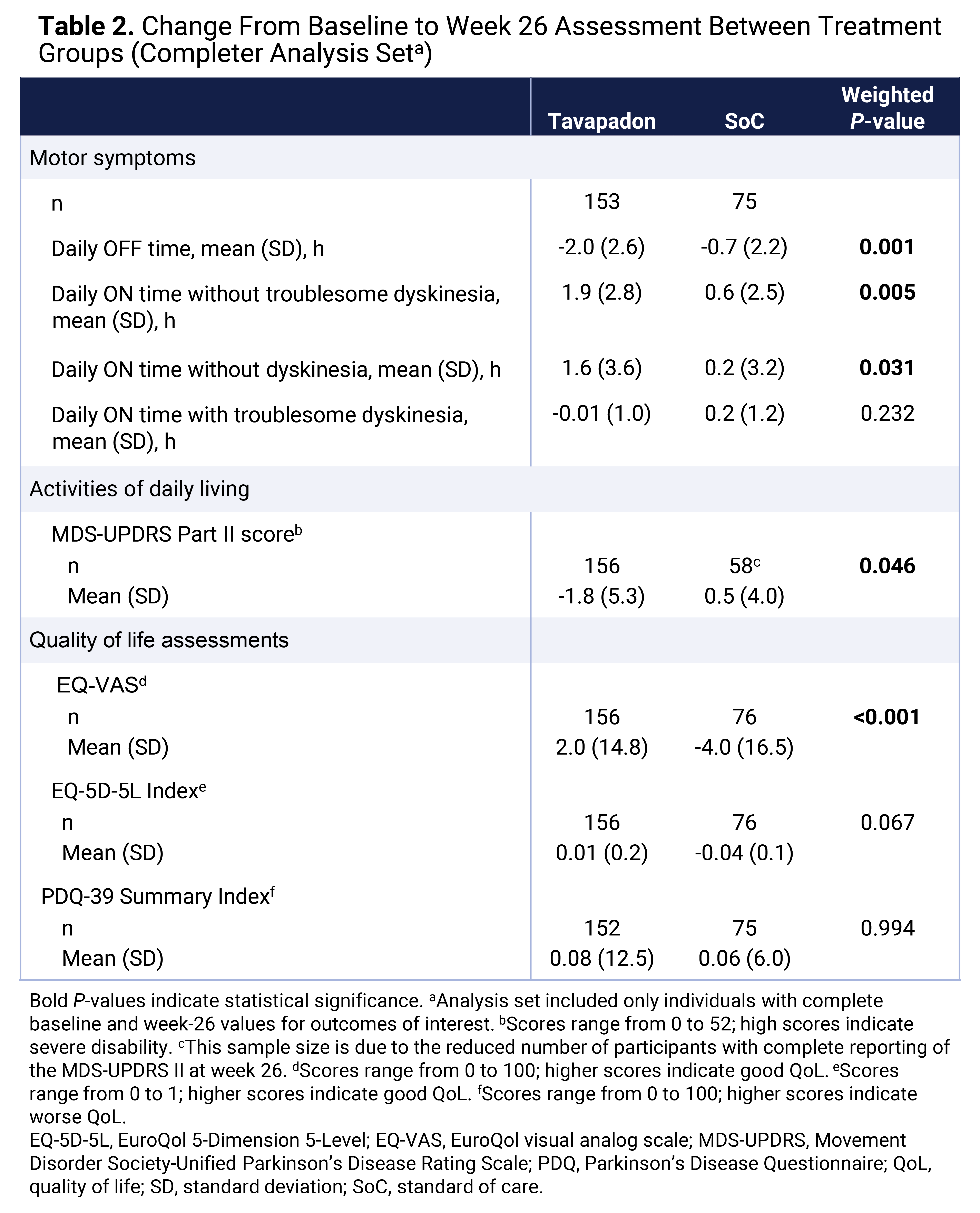
Table 2
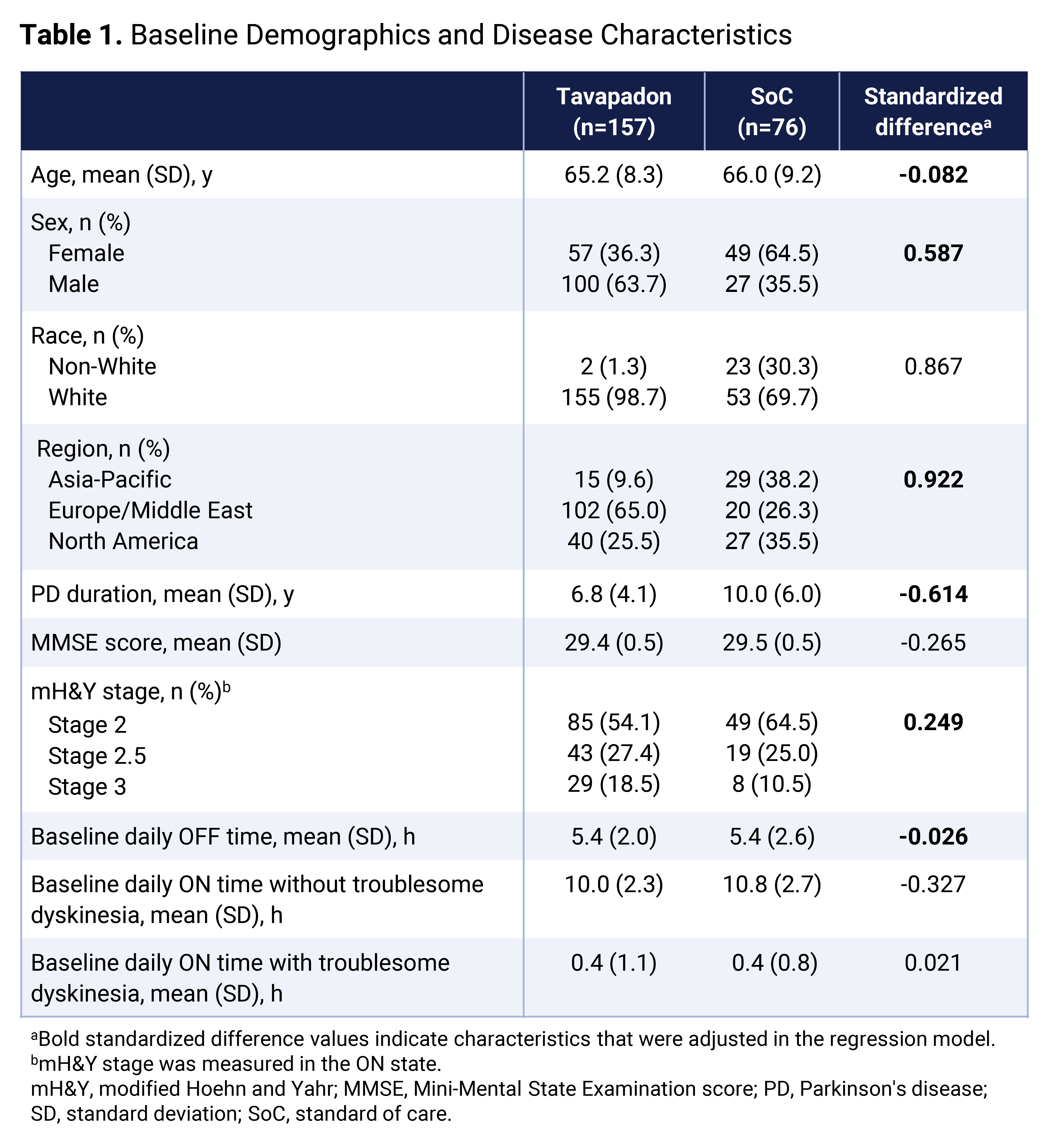
Table 1
To cite this abstract in AMA style:
P. Agarwal, R. Pahwa, A. Fasano, H. Deng, C. Yan, L. Harmer, S. Huang, K. Onuk, A. Espay. Comparative Effectiveness of Tavapadon Versus Real-world Oral Standard of Care Treatments in Parkinson’s Disease With Motor Fluctuations: an Indirect Comparison Analysis [abstract]. Mov Disord. 2026; 41 (suppl 1). https://www.mdsabstracts.org/abstract/comparative-effectiveness-of-tavapadon-versus-real-world-oral-standard-of-care-treatments-in-parkinsons-disease-with-motor-fluctuations-an-indirect-comparison-analysis/. Accessed October 1, 2026.« Back to 2026 International Congress
MDS Abstracts - https://www.mdsabstracts.org/abstract/comparative-effectiveness-of-tavapadon-versus-real-world-oral-standard-of-care-treatments-in-parkinsons-disease-with-motor-fluctuations-an-indirect-comparison-analysis/