
Category: Drug-Induced Movement Disorders
Objective: To compare motor severity between individuals with drug-induced Parkinsonism (DIP) and idiopathic Parkinson’s disease (iPD)
Background: DIP and iPD may present with similar motor impairments, including bradykinesia, tremor, rigidity, and postural instability. However, a key differentiating factor between the two conditions is presynaptic dopaminergic integrity. In DIP, nigrostriatal neurons remain preserved, whereas in iPD, they undergo progressive degeneration. These pathophysiological differences may lead to differences in motor severity between the conditions
Method: A systematic review was conducted using EMBASE, PEDro, PsycINFO, PubMed, Scopus, and Web of Science. The study followed the PRISMA guidelines. We included studies comparing participants diagnosed with DIP and iPD. Studies were excluded when analyses combined DIP or iPD with other neurological or psychiatric conditions. Motor severity was compared between groups using baseline UPDRS Part III scores, with participants matched according to Hoehn & Yahr stage. A random-effects meta-analysis was performed using the restricted maximum likelihood (REML) estimator. Mean differences (MD) with 95% confidence intervals were calculated to assess differences in UPDRS Part III scores between groups. Between-study heterogeneity was evaluated using the I² statistic and τ²
Results: A total of 30,584 records were retrieved from the databases. Two independent reviewers determined that 23 studies met the inclusion criteria, comprising 2,629 participants. The document screening process is shown in Figure 1, and the global distribution of included studies is illustrated in Figure 2. Of these, 11 studies were included in the meta-analysis, totaling 816 participants: 297 in the DIP group and 519 in the iPD group. The meta-analysis showed no difference in motor severity between the groups (MD = −0.85 points; 95% CI −4.89 to 3.18). High heterogeneity was observed among studies (I² = 84.2%; τ² = 29.86), indicating substantial variability across the included samples (Figure 3)
Conclusion: No consistent differences in motor severity were observed between DIP and iPD. However, the high heterogeneity and the influence of individual studies indicate that potential clinical differences may depend on population characteristics, such as symptom severity, diagnostic criteria, and the offending drug
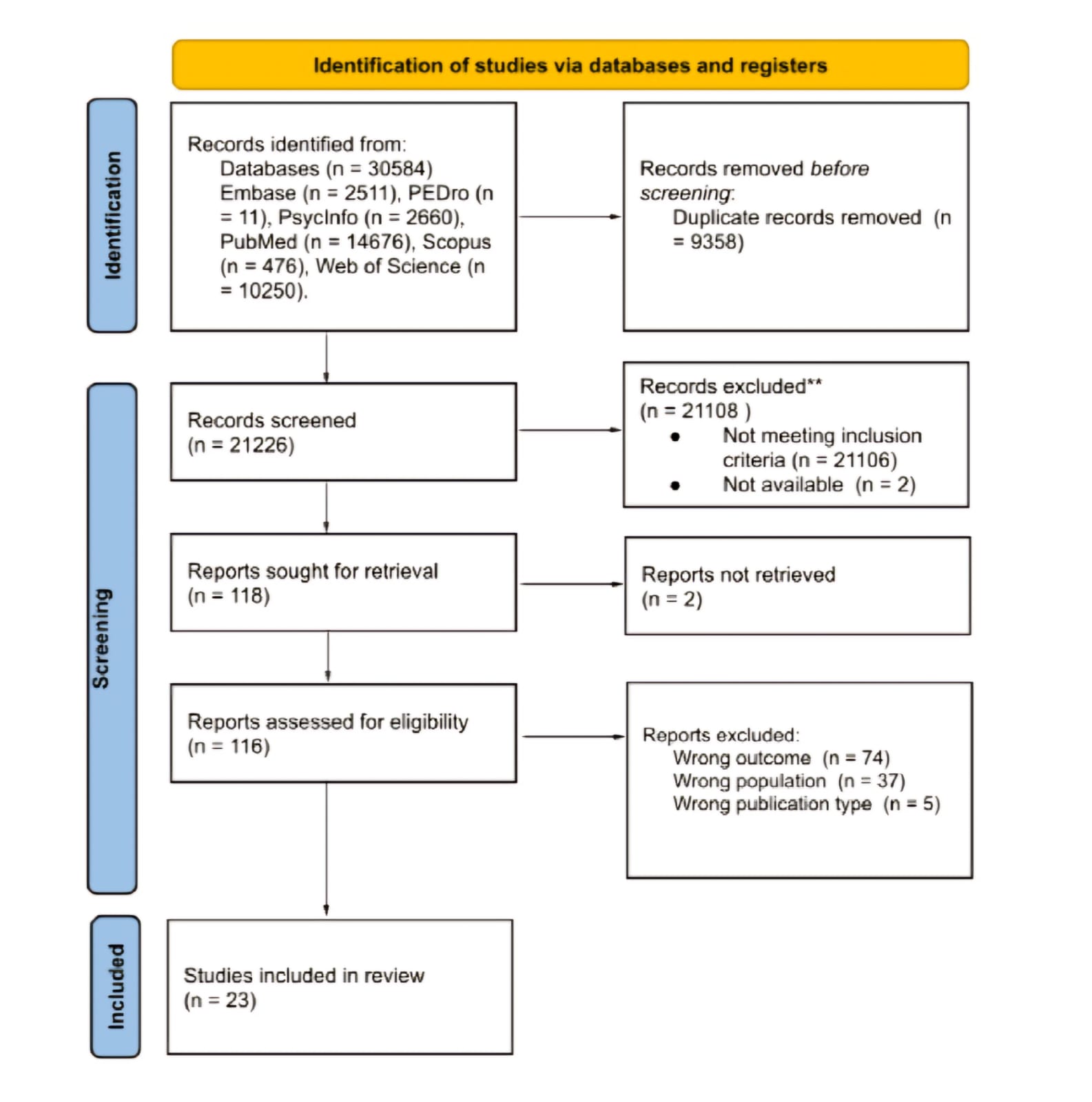
Flowchart of the study selection procedure
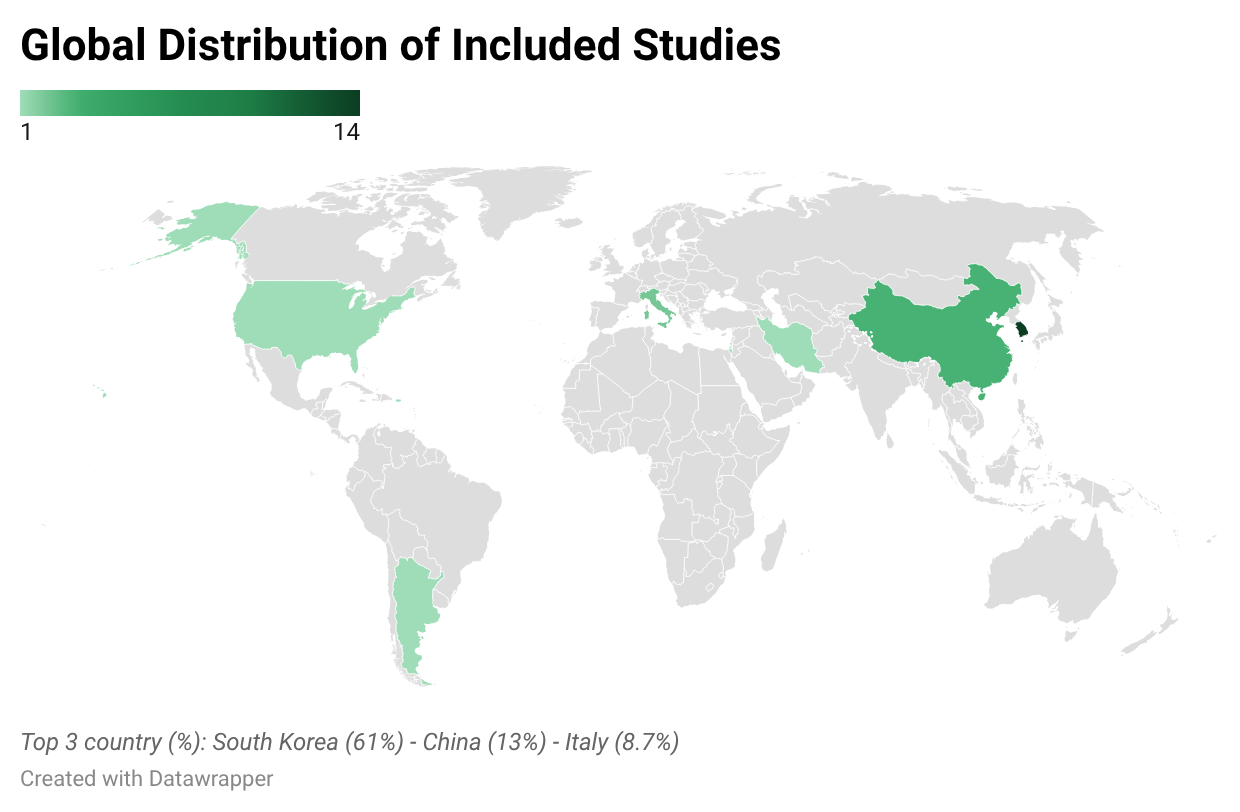
The global distribution of included studies.
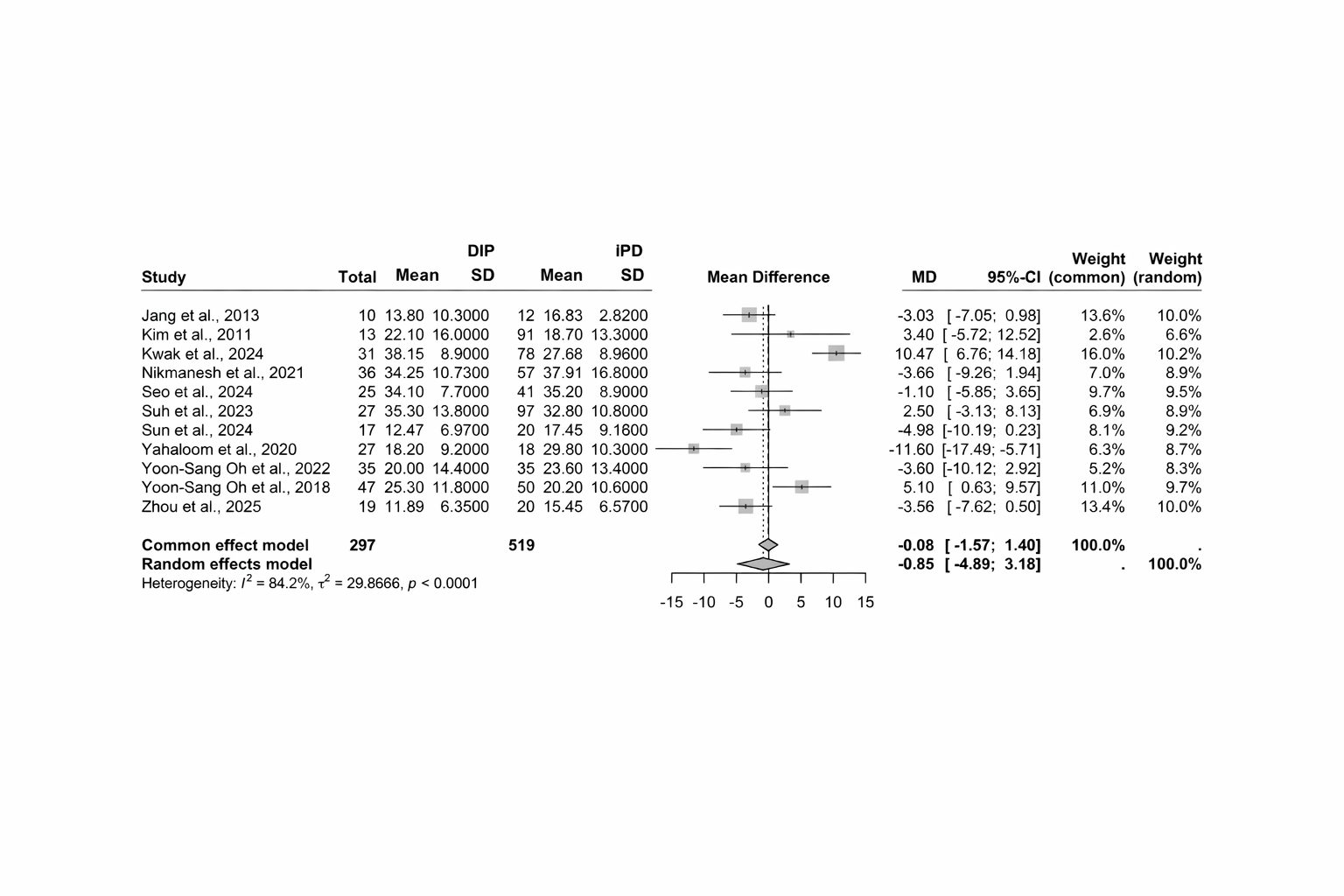
Forest plot comparing motor severity in DIP vs iPD
References: [1] Bovi T, Antonini A, Ottaviani S, Antonioli A, Cecchini MP, Di Francesco V, et al. The status of olfactory function and the striatal dopaminergic system in drug-induced parkinsonism. J Neurol. 2010;257(11):1882-1889. doi:10.1007/s00415-010-5631-3.
[2] Jang W, Han J, Park J, Kim JS, Cho JW, Koh SB, et al. Waveform analysis of tremor may help to differentiate Parkinson’s disease from drug-induced parkinsonism. Physiol Meas. 2013;34(3):N15-N24. doi:10.1088/0967-3334/34/3/N15.
[3] Kim JS, Youn J, Shin H, Cho JW. Nonmotor symptoms in drug-induced parkinsonism and drug-naïve Parkinson disease. Can J Neurol Sci. 2013;40(1):36-41. doi:10.1017/s0317167100012920.
[4] Kim JS, Ryu DW, Oh JH, Lee YH, Park SJ, Jeon K, et al. Cardiovascular autonomic dysfunction in patients with drug-induced parkinsonism. J Clin Neurol. 2017;13(1):15-20. doi:10.3988/jcn.2017.13.1.15.
[5] Kim YD, Kim JS, Chung SW, Song IU, Yang DW, Hong YJ, et al. Cognitive dysfunction in drug induced parkinsonism (DIP). Arch Gerontol Geriatr. 2011;53(2):e222-e226. doi:10.1016/j.archger.2010.11.025.
[6] Kwak IH, Kim YE, Kang SY, Lee JS, Lee J, Kim MS, et al. Comparative olfactory profiles in Parkinson’s disease and drug-induced parkinsonism. J Mov Disord. 2024;17(1):64-70. doi:10.14802/jmd.23105.
[7] Lee JJ, Shin NY, Lee Y, Lee SK, Sohn YH, Lee PH. Optic nerve integrity as a visuospatial cognitive predictor in Parkinson’s disease. Parkinsonism Relat Disord. 2016;31:41-45. doi:10.1016/j.parkreldis.2016.06.020.
[8] Lee Y, Ho Choi Y, Lee JJ, Lee HS, Sohn YH, Lee JM, et al. Microstructural white matter alterations in patients with drug induced parkinsonism. Hum Brain Mapp. 2017;38(12):6043-6052. doi:10.1002/hbm.23809.
[9] Leiguarda RC, Pramstaller PP, Merello M, Starkstein S, Lees AJ, Marsden CD. Apraxia in Parkinson’s disease, progressive supranuclear palsy, multiple system atrophy and neuroleptic-induced parkinsonism. Brain. 1997;120(Pt 1):75-90. doi:10.1093/brain/120.1.75.
[10] Morley JF, Pawlowski SM, Kesari A, Maina I, Pantelyat A, Duda JE. Motor and non-motor features of Parkinson’s disease that predict persistent drug-induced Parkinsonism. Parkinsonism Relat Disord. 2014;20(7):738-742. doi:10.1016/j.parkreldis.2014.03.024.
[11] Nikmanesh N, Sarani EM, Khazraei S, Petramfar P, Ostovan VR. Diagnostic accuracy of brain stem auditory evoked response in distinguishing drug-induced parkinsonism from Parkinson’s disease. Neurophysiol Clin. 2021;51(6):524-532. doi:10.1016/j.neucli.2021.10.001.
[12] Nisticò R, Fratto A, Vescio B, Arabia G, Sciacca G, Morelli M, et al. Tremor pattern differentiates drug-induced resting tremor from Parkinson disease. Parkinsonism Relat Disord. 2016;25:100-103. doi:10.1016/j.parkreldis.2016.02.002.
[13] Oh SW, Shin NY, Yoon U, Sin I, Lee SK. Shared functional neural substrates in Parkinson’s disease and drug-induced parkinsonism: Association with dopaminergic depletion. Sci Rep. 2020;10:11617. doi:10.1038/s41598-020-68514-0.
[14] Oh YS, Kwon DY, Kim JS, Park MH, Berg D. Transcranial sonographic findings may predict prognosis of gastroprokinetic drug-induced parkinsonism. Parkinsonism Relat Disord. 2018;46:36-40. doi:10.1016/j.parkreldis.2017.10.011.
[15] Oh YS, Yoo SW, Lyoo CH, et al. Decreased thalamic monoamine availability in drug-induced parkinsonism. Sci Rep. 2022;12:3749. doi:10.1038/s41598-022-07773-5.
[16] Seo S, Kim S, Kim SP, Kim J, Kang SY, Chung D. Low-frequency EEG power and coherence differ between drug-induced parkinsonism and Parkinson’s disease. Clin Neurophysiol. 2024;168:131-138. doi:10.1016/j.clinph.2024.10.013.
[17] Suh W, Baek SU, Oh JS, Seo SY, Kim JS, Han YM, et al. Retinal thickness and its interocular asymmetry between Parkinson’s disease and drug-induced parkinsonism. J Korean Med Sci. 2023;38(11):e86. doi:10.3346/jkms.2023.38.e86.
[18] Sun L, He S, Cheng B, Shen Y, Zhao W, Tu R, et al. White matter microstructure alteration in patients with drug-induced parkinsonism: A diffusion tensor imaging study with tract-based spatial statistics. J Integr Neurosci. 2024;23(11):202. doi:10.31083/j.jin2311202.
[19] Sun Y, Na HK, Jeon S, Ye BS, Lee PH, Yoo HS, Lyoo CH. Cerebral perfusion and motor deficits in drug-induced parkinsonism: A dual-phase 18F-FP-CIT PET study. Neurology. 2026;106(3):e214573. doi:10.1212/WNL.0000000000214573.
[20] Sung YH, Noh Y, Lee J, Kim EY. Drug-induced Parkinsonism versus idiopathic Parkinson disease: Utility of Nigrosome 1 with 3-T imaging. Radiology. 2016;279(3):849-858. doi:10.1148/radiol.2015151466.
[21] Yahalom H, Israeli-Korn S, Linder M, Yekutieli Z, Karlinsky KT, Rubel Y, et al. Psychiatric patients on neuroleptics: Evaluation of parkinsonism and quantified assessment of gait. Clin Neuropharmacol. 2020;43(1):1-6. doi:10.1097/WNF.0000000000000371.
[22] Zhou W, Tang M, Sun L, Lin H, Tan Y, Fan Y, et al. Subcortical structure alteration in patients with drug-induced parkinsonism: Evidence from neuroimaging. IBRO Neurosci Rep. 2024;16:436-442. doi:10.1016/j.ibneur.2024.03.001.
[23] Zhou W, Tang M, Cheng B, Sun L, Lin H, Fan Y, et al. Exploring cognitive and emotional symptoms associated with hippocampal subfield atrophy in drug-induced Parkinsonism. Front Aging Neurosci. 2025;17:1566785. doi:10.3389/fnagi.2025.1566785.
To cite this abstract in AMA style:
E. Maciel, T. da Rosa, F. Pereira, P. Nepomuceno, A. Pagnussat. Comparison of Motor Severity in Individuals with Drug-Induced Parkinsonism and Idiopathic Parkinson’s Disease A Systematic Review and Meta-Analysis [abstract]. Mov Disord. 2026; 41 (suppl 1). https://www.mdsabstracts.org/abstract/comparison-of-motor-severity-in-individuals-with-drug-induced-parkinsonism-and-idiopathic-parkinsons-disease-a-systematic-review-and-meta-analysis/. Accessed October 1, 2026.« Back to 2026 International Congress
MDS Abstracts - https://www.mdsabstracts.org/abstract/comparison-of-motor-severity-in-individuals-with-drug-induced-parkinsonism-and-idiopathic-parkinsons-disease-a-systematic-review-and-meta-analysis/